Danish design in Copenhagen: where to see it, what it costs
Copenhagen Card: Access 80+ Attractions and Transportation
Where is the best place to see Danish design in Copenhagen?
Designmuseum Danmark (Bredgade 68) is the most comprehensive starting point — a serious collection of 20th-century Scandinavian design with significant Arne Jacobsen holdings. Entry 155 DKK (adults). For living design, Illums Bolighus on Amagertorv and the Hay House on Pilestræde cover two very different ends of the contemporary market.
Danish design has been internationally fashionable in waves since the 1950s. The current wave is sustained rather than cyclical — Danish furniture, ceramics and product design have maintained a persistent global market for 70 years, and the industry is large enough to support a serious museum, multiple internationally recognised brands and a design export economy that punches substantially above Denmark’s population size.
Understanding what makes Danish design distinct, and where to see it honestly rather than in a marketing context, is worth some preparation.
| Where | Indre By (Bredgade, Pilestræde, Amagertorv/Strøget) |
| Cost | Designmuseum 155 DKK; shops free to browse |
| Time needed | Half a day for museum + shops |
| Best for | Furniture, ceramics, silver, architecture |
| Free options | National Museum, City Hall, exterior landmarks |
What Danish design actually is
The term covers several related but distinct traditions.
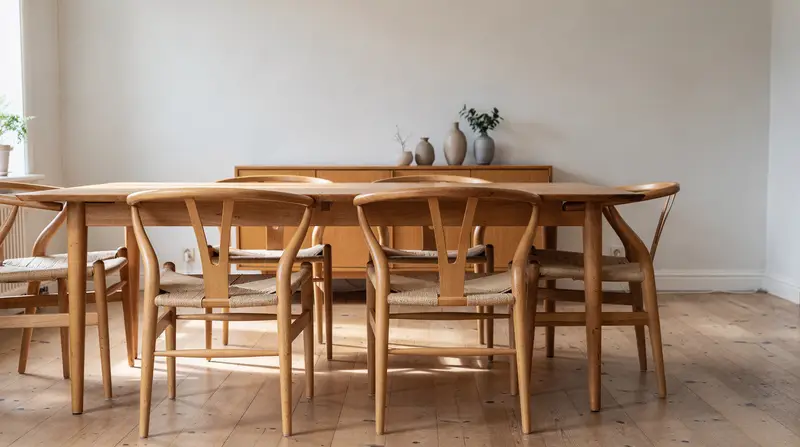
Furniture design is the best-known internationally: the mid-20th-century Danish modern movement that produced Arne Jacobsen’s chairs, Hans J. Wegner’s shell chair and wishbone chair, Finn Juhl’s organic forms and Kaare Klint’s rationalist approach to furniture dimensions. These pieces are still in production (Fritz Hansen, Carl Hansen, PP Møbler) and still widely considered among the best-designed chairs and tables ever made.
Ceramics and craft is a parallel tradition running from the Royal Copenhagen porcelain factory (founded 1775, still operating) through the 20th-century craft revival. The distinctive Royal Copenhagen Blue Fluted pattern has been produced continuously since 1775; the more recent Noma-influenced craft ceramics movement has produced a generation of small-batch producers.
Product and industrial design includes the Bang & Olufsen audio tradition (the Beolit radio, the Beogram turntable) and a broad range of Danish-designed everyday objects — from the Egmont H. Petersen cutlery to more recent designs by HAY, Normann Copenhagen and other contemporary brands.
Textile and graphic design is less internationally recognised but significant domestically — Marimekko is Finnish, but Danish textile design has its own tradition through companies like Kvadrat (upholstery fabric used in most Danish-designed furniture) and Scion.
Designmuseum Danmark
Bredgade 68, Copenhagen Entry: 155 DKK (adults), 130 DKK (students/seniors), free for under-18s Open: Tuesday–Sunday 10:00–18:00; Tuesday until 21:00 (free from 17:00) Metro: Kongens Nytorv (M1/M2), 12 minutes’ walk
The museum occupies the former Frederiks Hospital, an 18th-century rococo building of considerable beauty. The architecture alone justifies the entry fee in the context of what the city charges for comparable cultural experiences.
The permanent collection is serious — not a lifestyle showroom but a design history collection with scholarly depth. The 20th-century Danish design rooms are the centrepiece: Kaare Klint’s furniture alongside the rationalist principles he developed at the furniture school he founded in 1924; a substantial Arne Jacobsen room with original Egg, Swan and Ant chairs in context; Finnish and Swedish design alongside the Danish pieces (the museum covers Scandinavian design broadly, not Denmark exclusively).
The decorative arts collections — ceramics, glass, textiles — run from the 18th century to the present and include significant Royal Copenhagen holdings. The fashion collection is less essential unless the subject interests you specifically.
What to prioritise: the 20th-century design floor; the ceramics gallery; the building’s central courtyard (particularly in summer). Temporary exhibitions vary in quality — check before visiting.
Practical: the museum café is acceptable (coffee 45 DKK, lunch dishes 115–165 DKK) and the courtyard seating is pleasant in summer. The museum shop has good reproduction prints and some design objects that are cheaper here than in retail.
The Copenhagen Card includes entry to Designmuseum Danmark along with 80+ other attractions and unlimited public transport. If you are visiting several museums plus using the metro extensively, the card may represent value — see the Copenhagen Card guide for the calculation.
Illums Bolighus
Amagertorv 10, Copenhagen Open: Monday–Friday 10:00–19:00, Saturday 10:00–18:00, Sunday 11:00–17:00
The shop that defines Copenhagen’s aspirational design retail. Illums Bolighus opened in 1925 and has occupied its current premises — a large multi-floor space on the pedestrian axis of Strøget — for most of that period. It functions simultaneously as a serious homeware retailer and as a showroom for Danish design at its most commercially refined.
The ground floor is fragrance, jewellery and a Royal Copenhagen counter. Move upstairs through furniture (Fritz Hansen chairs, HAY sofas, Fredericia pieces), lighting (Le Klint’s handmade pleated shades, Poul Henningsen’s PH lamp reproductions), textiles and ceramics. The selection is curated Danish and Nordic, with some international additions (Iittala, Alessi).
What to look for: the Georg Jensen silver on the ground level (the Henning Koppel fish dish from 1954 is still in production and still extraordinary); the Le Klint lighting department upstairs; the Royal Copenhagen Blue Fluted Mega collection (a post-modern reinterpretation of the 1775 pattern by Karen Kjeldgaard-Larsen, introduced 1993, now a collector piece).
Price context: Illums Bolighus is full retail. A Royal Copenhagen Blue Fluted dinner plate costs around 600–800 DKK. A PH 5 lamp (the most recognisable Poul Henningsen design, developed 1958 and still in production by Louis Poulsen) starts at around 8,000 DKK. Smaller items — a ceramic mug from HAY (80–120 DKK), a Le Klint table lamp (from 1,200 DKK) — are more accessible.
Hay House
Pilestræde 29–31, Copenhagen Open: Monday–Friday 10:00–18:00, Saturday 10:00–17:00, Sunday 12:00–16:00
The flagship store for HAY, the Danish brand founded in 2002 by Mette and Rolf Hay, occupies two interconnected buildings in Pilestræde near Strøget. The retail environment is exceptional — high ceilings, a curated installation approach rather than a conventional shop floor, and the full range of HAY’s design output in one space.
HAY’s positioning is democratically-priced Danish design: the brand makes no claims to artisanal hand-finishing (unlike some Danish furniture producers) and focuses on colour, material quality and a commitment to mid-century-influenced forms at prices that non-millionaires can occasionally afford. A HAY cushion cover runs 200–350 DKK; a ceramic coffee mug 85–120 DKK; a Palissade outdoor chair (powder-coated steel, designed with Ronan and Erwan Bouroullec) from 2,200 DKK.
The store also stocks a curated selection of objects from other brands — books, small accessories, some vintage pieces. Worth an hour even if you are not buying.
Nearby: the Frama studio-store at Pilestræde 10 (open Tuesday–Friday 10:00–17:30, Saturday 11:00–16:00) is a quieter space with a more architectural, minimal aesthetic and some genuinely original design. Frama makes fragrances, furniture and objects with a coherent material language (raw concrete, unlacquered wood, pharmaceutical glass). Prices are high but the design is serious.
Georg Jensen
Amagertorv 4 and Strøget 40, Copenhagen
The Georg Jensen silversmithing house, founded in Copenhagen in 1904, remains the most internationally recognised Danish luxury design brand. The contemporary range is broad and uneven — some pieces are direct reproductions of Henning Koppel, Vivianna Torun Bülow-Hübe or Georg Jensen’s original designs; others are more generic contemporary jewellery.
The original Jensen designs are worth seeking out. The Acorn cutlery (designed by Johan Rohde in 1915, still in production) is one of the most influential cutlery designs of the 20th century. The Cosmos necklace by Vivianna Torun Bülow-Hübe (1960s) is a paradigmatic example of Scandinavian modern jewellery.
The flagship on Amagertorv has the widest selection. Budget: small silver jewellery from 1,500 DKK; full cutlery sets from 15,000 DKK upwards.
Where else to see Danish design in the city
The National Museum (Ny Vestergade 10): free entry, includes excellent decorative arts sections covering Danish domestic interiors from the 17th century to the 20th. The 20th-century interiors are undervisited relative to the prehistoric and Viking sections.
Rosenborg Castle: primarily a royal history museum, but the interiors give context for the scale and quality of Danish craft production in silver, glass and textiles over four centuries.
The SAS Royal Hotel (now Radisson Blu Royal, Hammerichsgade 1): Arne Jacobsen designed the building (1960) and every detail within it — furniture, cutlery, light fixtures, door handles. The hotel is still operating; Room 606 is preserved in its original 1960 condition and is bookable (around 4,000–5,000 DKK per night, but you can visit the hotel public areas for free). The lobby bar has reproduced the Jacobsen chair designs in their original context.
Den Permanente: a historic design collective that operated from 1931 to 1981, Den Permanente no longer exists but shaped Danish design’s international profile. Its legacy is visible in the Designmuseum collection.
Design in Copenhagen’s public spaces
Much of the most interesting Danish design in Copenhagen is simply built into the city and visible for free.
The Poul Henningsen street lamps lining the Lakes (Søerne) and several central streets were designed by Henningsen and deployed from the 1920s. The PH lamp principle — diffusing light to eliminate glare through a layered shade system — is still considered an engineering solution to a genuine problem.
The Metro stations were designed by the architectural firm Arup with a consistent aesthetic: steel and concrete, legible geometry, efficient but not hostile. Station design in Denmark is taken seriously; the new Cityringen line stations (opened 2019) extend this tradition.
Bicycle infrastructure as design: the city’s 390km of dedicated cycle lanes are a designed system, not an accident. The cycling infrastructure, including the signal systems, lane markings and bike bridges (the Cykelslangen bridge at Fisketorvet, designed by Dissing+Weitling, 2014), is worth looking at as an example of large-scale public design. The best bike tours in Copenhagen cover several of these routes with a design-literate guide, which is a good way to see the infrastructure as intended rather than just crossing it to get somewhere else.
Vintage Danish design: where locals actually buy
Retail prices at Illums Bolighus or the brand flagships are full price. A different, often better-value route into Danish design is the second-hand and vintage market, which is genuinely strong in Copenhagen because so much mid-century furniture is still in circulation from Danish households.
Ravnsborggade in Nørrebro is the closest thing to an antiques street in Copenhagen — a run of small dealers specialising in 1950s–1970s Danish furniture, several of them serious about provenance and condition rather than simply importing generic “Scandi” pieces. Expect a genuine Wegner or Børge Mogensen chair here for a fraction of a new reproduction, though good pieces move fast and prices for recognised names have risen since 2015.
Jægersborggade, also in Nørrebro, leans toward independent ceramics studios rather than furniture — several working potters sell directly from small storefronts, which is a more honest way to buy contemporary Danish craft than a department-store shelf.
Auction houses (Bruun Rasmussen is the largest, with a design-specific department and regular sales) are worth a look even if you are not bidding — the preview days are free to browse and are effectively a rotating, unlabelled design museum.
A half-day design walking route
If you want to see the best of Copenhagen design without a car or extensive planning, a workable half-day route runs: start at Designmuseum Danmark on Bredgade (allow 1.5–2 hours), walk 15 minutes south-west into Indre By toward Hay House and the Frama studio-store on Pilestræde, continue to Illums Bolighus and the Georg Jensen flagship on Amagertorv, then finish with coffee at Torvehallerne.
This roughly retraces part of the one-day Copenhagen itinerary but slows down for design specifically rather than treating it as a stop on a longer sightseeing day. Budget 4–5 hours including the museum, and expect to spend more time than planned in Hay House regardless of intentions.
Frequently asked questions about Copenhagen design
Is Designmuseum Danmark worth visiting?
Yes, if design history interests you — particularly the 20th-century Scandinavian canon. The permanent collection covers Kaare Klint, Arne Jacobsen, Finn Juhl and the Danish craft traditions in ceramics, glass and textiles with serious curatorial depth. Entry 155 DKK (adults), free for under-18s. Free on Tuesdays between 17:00 and 21:00. Allow 2 hours minimum.
What is the difference between Hay and Normann Copenhagen?
Hay (founded 2002) positions itself in accessible mid-century-influenced design — colourful, playful, quality-conscious. Normann Copenhagen (founded 1999) is more architecturally oriented and generally more expensive. Both have flagship stores in Copenhagen; Hay House on Pilestræde is the more interesting retail environment.
Can you see Danish design without spending money?
Yes. The National Museum has free entry and includes Danish decorative arts. The City Hall interior is open to visitors for free. The Black Diamond and BIG-designed buildings are exterior landmarks requiring no entry. The SMK is free on Tuesdays.
What is Illums Bolighus?
Illums Bolighus (Amagertorv 10) is the landmark Copenhagen homeware department store — in operation since 1925. It stocks Danish and Scandinavian design at full retail, including Royal Copenhagen, Georg Jensen, Lyngby Porcelæn and Le Klint. A reliable place to buy gifts; also a good overview of what Danish design currently looks like.
Who is Arne Jacobsen?
Arne Jacobsen (1902–1971) is the internationally best-known Danish designer — responsible for the Egg Chair (1958), Swan Chair (1958), Ant Chair (1952) and Series 7 chair (1955), which is still the best-selling chair in Scandinavian design history. He was also an architect (SAS Royal Hotel) and worked comprehensively across product design, textiles and architecture.
What is the design district in Copenhagen?
There is no single design district. The highest concentration of design shops is in Indre By — particularly around Pilestræde (Hay House, Frama), Bredgade (Designmuseum, antique dealers) and Amagertorv/Strøget (Illums Bolighus, Georg Jensen).
Is Copenhagen design expensive to buy?
Danish design at proper retail is not cheap anywhere in the world. A Series 7 chair (Fritz Hansen) costs from 4,500 DKK; an Egg Chair from 35,000 DKK. Hay is more accessible — cushion covers from 200 DKK, ceramics from 100 DKK. Vintage Danish design from Copenhagen dealers is sometimes better value than buying new reproductions.