Scandinavian architecture in Copenhagen: the buildings worth knowing
Copenhagen: Canal Cruise with Guide
Duration: 1 hour
What is the most interesting architecture to see in Copenhagen?
The Black Diamond (Royal Library extension, 1999, Schmidt Hammer Lassen) and the Copenhagen Opera House (2005, Henning Larsen) are best seen together on a harbour walk. For contemporary, CopenHill (2019, BIG) and 8 House (2010, BIG) require a trip to Amager/Ørestad. Grundtvig's Church (1940, Peder Vilhelm Jensen-Klint) in Bispebjerg is the most unusual historical building and genuinely worth the detour.
Copenhagen is an unusually good city for architecture tourism — not in the sense of having many landmarks, but in the sense of having a consistently high standard of building across different periods, in a compact city where everything is reachable on foot or by metro. The current wave of contemporary Danish architecture, led internationally by BIG (Bjarke Ingels Group), built on a tradition running through Jørn Utzon (Sydney Opera House, Bagsværd Church), Henning Larsen, Arne Jacobsen and further back to the 18th-century urban planning of Frederick V’s Frederiksstaden.
What follows covers the most architecturally significant buildings in and around Copenhagen, with practical information on how to see them.
| Where | Harbour front, Ørestad, Bispebjerg and Frederiksstaden |
| Cost | Mostly free exteriors; interiors from ~85–100 DKK |
| Time needed | Half-day for the harbour route; separate half-day for Ørestad |
| Getting there | Walking/metro for the centre; metro M1 for Ørestad |
| Best time | Any season; low winter light suits the Black Diamond and Marble Church |
The contemporary architecture map
CopenHill (Amager Bakke / Amager Resource Center)
Vindmøllevej 6, Amager Designed by Bjarke Ingels Group (BIG), opened 2019 Open daily; slope access from 85 DKK
CopenHill is what happens when a city decides to build a waste-to-energy plant and asks an architect with a track record of literal concept architecture to design it. The building is a working industrial facility — it processes 400,000 tonnes of waste annually and supplies heat and electricity to around 150,000 Copenhagen households — with a publicly accessible ski slope running across its roof.
The slope is 450 metres long with a vertical drop of around 85 metres. In winter there is machine-made snow; in summer it operates as a grass hiking track. The building also has an 85-metre climbing wall on the southern facade — the tallest artificial climbing wall in the world — and a rooftop bar.
BIG’s concept was explicit: if the city is going to build a waste facility in the middle of a residential area, it should also give something back. The building has won numerous international awards; it has also been criticised for being an expensive conceptual gesture when the money could have gone elsewhere. Both things can be true.
Getting there: Metro M2 to Christianshavn, then bus 2A to Vindmøllevej. Or cycling along the harbour from the centre — approximately 3km from Nyhavn, flat, on good cycle paths.
8 House (8-Tallet)
Richard Mortensens Vej 61, Ørestad Designed by BIG, completed 2010 Free to visit the exterior walkway
The figure-eight residential complex in Ørestad won the World Architecture Festival’s Building of the Year award in 2011. It houses approximately 476 apartments across 61,000 square metres, with a continuous sloping walkway that runs from ground level up to the 10th floor on the outside of the figure-eight perimeter.
The building addresses a real urban design problem — Ørestad (Copenhagen’s new business district, built from the 1990s around the metro extension to the airport) is a planning exercise that has produced competent buildings but limited urban vitality. BIG’s approach with 8 House was to create a mixed-use building (apartments above, commercial and retail at street level) organised around communal space.
The exterior walkway is publicly accessible. You can walk from street level up the slope to the roof terrace, which has views over the flat Amager landscape toward the city and the wind turbines offshore. The metro to Ørestad runs directly: M1/M2 from Central Station (Vesterport) to Ørestad station, then 8 minutes’ walk.
VM Houses
Victor Albecks Vej 1–11, Ørestad Designed by BIG and JDS Architects, completed 2005 Free to view exterior
Two residential blocks immediately north of 8 House, also in Ørestad. VM Houses were BIG’s first major completed building — two triangular blocks with dramatically protruding balconies designed to give every apartment both south-facing light and cross-ventilation. They are visually aggressive in a way CopenHill and 8 House are not, and are worth seeing as a record of the firm’s early register.
The Mountain (Bjerget)
Ørestads Boulevard 55, Ørestad Designed by BIG and JDS Architects, completed 2008 Free to view exterior
Another Ørestad complex, immediately south of the VM Houses. A pyramid-form housing block with terraced gardens stepping up from a rooftop parking structure at the base. 80 apartments with south-facing terraces; the base contains a multi-storey car park for 480 vehicles that is concealed within the mountain form. One of the more successfully resolved BIG concepts — the car parking problem (Ørestad was built around car ownership) is solved without producing a conventional multi-storey car park.
The harbour buildings
The Black Diamond (Det Sorte Diamant)
Søren Kierkegaards Plads 1, Slotsholmen Designed by Schmidt Hammer Lassen, opened 1999 Open Monday–Friday 8:00–22:00, Saturday 10:00–18:00; free entry to public areas
The extension to the Royal Library on the waterfront is one of the most successful harbour buildings in northern Europe. The polished black granite facade tilts outward over the water, angling to reflect the sky and the harbour surface. On a day with dramatic clouds or low winter light, the effect is extraordinary.
The interior is publicly accessible — the central atrium has a café (coffee 45 DKK, lunch 120–175 DKK), a bookshop with a good architecture and design section, and a programme of temporary exhibitions. The reading rooms and library collections require a library card; the public spaces do not.
Context: the original Royal Library building (the red-brick building adjacent, opened 1906) is also worth seeing — the combination of the historicist 1906 building and the 1999 extension demonstrates Danish architecture’s ability to make the contrast between old and new productive rather than jarring.
A canal cruise from Gammel Strand passes directly in front of the Black Diamond and the Opera House — the best way to see both buildings from the water, which is where their harbour orientation is designed to be appreciated.
Copenhagen Opera House (Operaen)
Ekvipagemestervej 10, Holmen Designed by Henning Larsen Architects, opened 2005 Free to visit public lobby; guided tours ~100 DKK
The Opera House sits on the Holmen naval island, directly across the harbour from Amalienborg Palace, on an axis that was apparently not agreed with the palace administration before construction — a source of some controversy at the time.
The building is funded by the Mærsk shipping company to the tune of approximately 2.5 billion DKK (around 330 million euros), making it one of the most expensive opera houses built anywhere in recent decades. The main auditorium seats 1,500.
From the harbour the building reads as a massive horizontal volume — a wide, low form with a projecting canopy over the main entrance. Henning Larsen Architects (the firm Larsen founded in 1959 and which has since become Henning Larsen) won the commission in a competition process that was complicated by the scale of the Mærsk donation and the resulting patron influence on design decisions.
Guided tours cover the backstage areas, the main auditorium and the technical facilities. The schedule is posted on the Royal Danish Theatre website; booking in advance is recommended as places are limited.
Playhouse (Skuespilhuset)
Sankt Annæ Plads 36 Designed by Lundgaard and Tranberg, opened 2008
The Royal Danish Theatre’s drama house, built on a reclaimed industrial site north of Nyhavn. A lower-profile building than the Opera House but in some respects more successful as urban architecture — it creates a useful public harbourfront promenade between the building and the water, and the brick exterior relates more comfortably to the surrounding buildings than the Opera House does.
The lobby is open to visitors; performances in Danish.
Historical architecture
Grundtvig’s Church (Grundtvigs Kirke)
På Bjerget 14B, Bispebjerg Designed by Peder Vilhelm Jensen-Klint (exterior) and Kaare Klint (interior), 1913–1940 Open daily 9:00–16:00 (hours may vary); free entry
If you visit one building outside the tourist centre, this is the one. Grundtvig’s Church is unlike any church in Scandinavia — a massive Gothic expressionist structure in yellow brick (built from 6 million handmade bricks) that rises 49 metres from a hill in the Bispebjerg neighbourhood, visible across the rooflines from a considerable distance.
The exterior reads simultaneously as a Gothic cathedral and as an abstract organ. Jensen-Klint drew on Danish village church traditions (the stepped gable, the brick construction, the verticality) and amplified them to the point of expressionism. The interior, completed by his son Kaare Klint after his death, is more restrained — pale brick, simple forms, good light from the side windows.
Why Kaare Klint matters: the younger Klint founded the furniture school at the Royal Danish Academy in 1924, from which most of the canonical Danish furniture designers of the 20th century graduated. His approach — rationalist, human-scaled, craft-oriented — became the foundation of Danish design thinking. The church interior he completed for his father reflects this: nothing decorative that is not also structural.
Getting there: bus 4A or 5C from the city centre to Bispebjerg. Around 20 minutes from Nørreport.
Frederiksstaden
Frederiksstaden, Indre By / Frederiksstaden
The planned royal quarter north of the old city was laid out from 1749 under Frederick V, designed by the Flemish architect Nicolas-Henri Jardin and the Danish architect Niels Eigtved. The plan is a formal octagonal square (Amalienborg Slotsplads) surrounded by four identical palaces, with the Marble Church (Frederiks Kirke) as the focal point of the main axis.
The Marble Church (designed by Jardin, begun 1749, completed 1894 after a 150-year hiatus) has the third-largest church dome in Europe after St. Peter’s in Rome and the Panthéon in Paris, measured by diameter (31 metres). The dome is open for climbing on certain days in summer — the views from the top are among the best in Copenhagen.
The four Amalienborg palaces alternate between royal residences and museum use. The Amalienborg Museum in Christian VIII’s Palace covers the royal apartments from 1863 to the present; entry 115 DKK (adults), free with Copenhagen Card.
Christiansborg Palace
Prins Jørgens Gård 1, Slotsholmen
The current palace on Slotsholmen (opened 1928, designed by Thorvald Jørgensen) is the fifth building on the site — the previous ones were destroyed by fire or demolished. It houses the Danish Parliament (Folketing), the Supreme Court and the Ministry of State.
The Great Hall is famous for 17 tapestries by the Danish artist Bjørn Nørgaard depicting Danish history, completed in 2000. The tapestries are extraordinary — large-scale, technically complex, a significant piece of contemporary craft. The palace tower is open to visitors (free entry to the top floor) and provides the highest accessible viewpoint over the city.
Architecture walking route
A practical route covering the major architectural sites in the historic centre and harbour:
Starting point: Rådhuspladsen (Town Hall Square) The City Hall (Rådhus, 1905, Martin Nyrop) is a nationally romantic brick building mixing Venetian and Danish historicism — the tower is 105 metres high and can be climbed on guided tours. Start here to get a physical sense of the city’s scale.
Walk east on Strøget through Indre By to Kongens Nytorv, then north toward Frederiksstaden and the Marble Church dome. Return via the harbour promenade south, past the Playhouse, the Black Diamond, and Christiansborg. The walk is approximately 5km and takes 1.5–2 hours at a slow pace.
Separate: Ørestad route Metro M1 to Ørestad station (20 minutes from the centre). Walk from the station to VM Houses, 8 House and the Mountain — about 15 minutes between them. Add CopenHill as a separate half-day trip or combine it with a cycle along the Amager coast.
Seeing the harbour route from the water
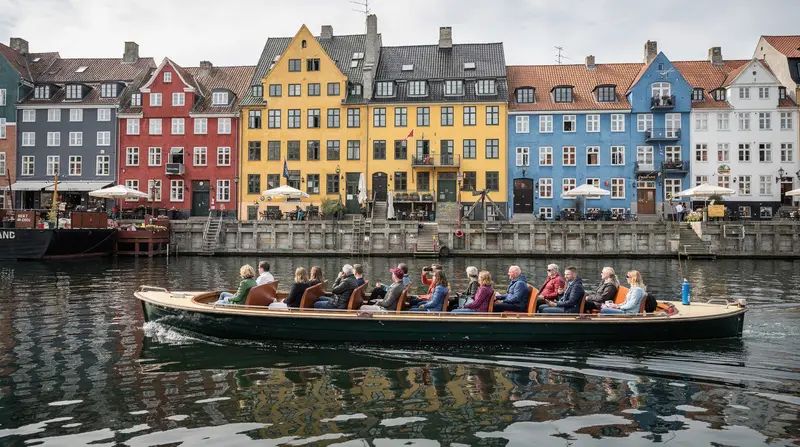
A canal cruise is arguably the best way to appreciate the Black Diamond and the Opera House, since both buildings were designed to be read from the harbour rather than the street. The best canal tours in Copenhagen guide covers the operators and routes that pass closest to both. For the Frederiksstaden end of the walking route — the Marble Church and the four Amalienborg palaces — the Frederiksstaden and Amalienborg destination guide has more detail on the district’s 18th-century planning, and Christianshavn is worth adding on if you continue south past the Playhouse.
Architecture and Danish design, together
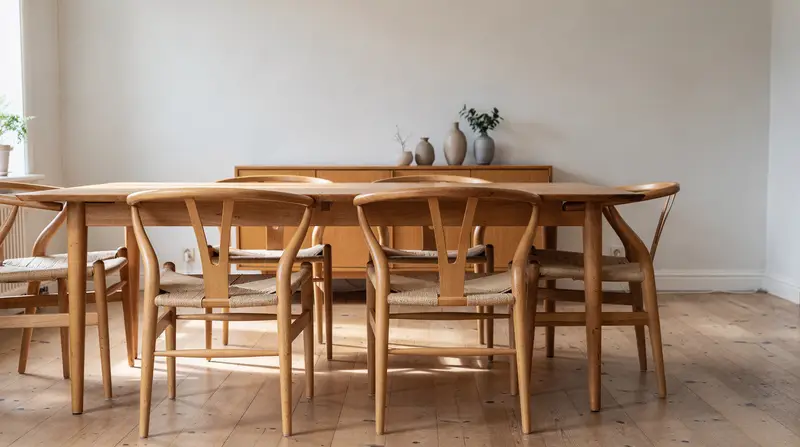
Copenhagen’s contemporary architecture and its furniture design tradition share the same intellectual roots — Kaare Klint’s rationalist approach at Grundtvig’s Church directly shaped the furniture school that trained most of the 20th century’s canonical Danish designers. If the buildings covered here spark an interest in the objects rather than just the structures, the Copenhagen design guide and the Danish design shops guide are the natural next stops — both cover where to see and buy the furniture and product design that grew out of the same design culture.
Frequently asked questions about Copenhagen architecture
What is BIG and why is it famous?
BIG (Bjarke Ingels Group) is a Copenhagen-based architecture firm founded by Bjarke Ingels in 2005. It is internationally famous for buildings that turn a conceptual idea — a ski slope on a power plant, a figure-eight residential complex — into literal form. BIG has built extensively in Copenhagen and globally, and is generally considered the most internationally recognised Danish architecture firm of the 21st century.
Can I visit CopenHill?
Yes. CopenHill is a waste-to-energy plant with a ski slope on the roof. The slope is open year-round — entry 85 DKK for the slope access. The facility also has an 85-metre climbing wall. Address: Vindmøllevej 6, Amager. Open daily.
Is the Copenhagen Opera House worth visiting?
From the outside and from the harbour, yes — the building’s scale and harbour position are impressive. The interior is accessible on guided tours (around 100 DKK) or by attending a performance. Designed by Henning Larsen Architects, opened in 2005, funded by the Mærsk shipping company.
What is the Black Diamond?
The Black Diamond is the extension to the Royal Library on the harbour at Slotsholmen, designed by Schmidt Hammer Lassen and opened in 1999. The polished black granite facade angles to reflect the harbour. The interior is publicly accessible — the atrium houses a café, bookshop and exhibition spaces.
What is 8 House?
8 House is a residential complex in Ørestad designed by BIG, completed in 2010, shaped as a figure eight on plan. The exterior walkway from ground level to the roof is publicly accessible. It won the World Architecture Festival’s Building of the Year award in 2011.
Who designed Grundtvig’s Church?
Grundtvig’s Church in Bispebjerg was designed by Peder Vilhelm Jensen-Klint (the exterior, 1913–1940) and completed by his son Kaare Klint (the interior, finished 1940). It is one of the most original church buildings in northern Europe — a massive Gothic expressionist structure in yellow brick. Kaare Klint went on to found the furniture design school that shaped Danish modern furniture design.
What about the Øresund Bridge?
The Øresund Bridge connects Copenhagen to Malmö, Sweden — partly a bridge and partly a submerged tunnel. It was designed by the Danish-Swedish consortium Arup/Georg Rotne and opened in 2000. The best view is from the beach at Kastrup Strandpark.
Frequently asked questions — Scandinavian architecture in Copenhagen: the buildings worth knowing
What is BIG and why is it famous?
BIG (Bjarke Ingels Group) is a Copenhagen-based architecture firm founded by Bjarke Ingels in 2005. It is internationally famous for buildings that turn a conceptual idea — a ski slope on a power plant, a figure-eight residential complex, a mountain housing block with terraced gardens — into literal form. BIG has built extensively in Copenhagen and globally, and is generally considered the most internationally recognised Danish architecture firm of the 21st century.Can I visit CopenHill?
Yes. CopenHill (officially Amager Bakke, also called Amager Resource Center) is a waste-to-energy plant in Amager with a ski slope on the roof. The slope is open year-round — a small ski area in summer operates as a hiking and running track (entry 85 DKK for the slope access); in winter there is snow-making. The facility also has a climbing wall (the tallest artificial climbing wall in the world at 85 metres). Address: Vindmøllevej 6, Amager. Open daily.Is the Copenhagen Opera House worth visiting?
From the outside and from the harbour, yes — the building's scale and harbour position are impressive. The interior is accessible on guided tours (offered several times a week, around 100 DKK) or by attending a performance. Designed by Henning Larsen Architects, opened in 2005, funded by the Mærsk shipping company at a cost of approximately 2.5 billion DKK — it remains one of the most expensive opera houses built in recent decades.What is the Black Diamond?
The Black Diamond (Det Sorte Diamant) is the extension to the Royal Library (Det Kongelige Bibliotek) on the harbour at Slotsholmen, designed by Schmidt Hammer Lassen and opened in 1999. The facade is polished black granite, angled to reflect the harbour. The interior is publicly accessible — the atrium houses a café, bookshop and exhibition spaces, and is open to visitors without a library card.What is 8 House?
8 House (8-Tallet) is a residential complex in Ørestad designed by BIG, completed in 2010 and shaped as a figure eight on plan. It won the World Architecture Festival award in 2011. The building is residential but the public walkway that circles the exterior from ground level to roof is accessible. Address: Richard Mortensens Vej 61, Ørestad.Who designed the Grundtvig's Church?
Grundtvig's Church (Grundtvigs Kirke) in Bispebjerg was designed by Peder Vilhelm Jensen-Klint (the exterior, 1913–1940) and completed by his son Kaare Klint (the interior, finished 1940). It is one of the most original church buildings in northern Europe — a massive Gothic expressionist structure in yellow brick that looks partly like a cathedral and partly like a pipe organ. Kaare Klint went on to found the furniture design school at the Royal Danish Academy and is considered the father of modern Danish furniture design.What about the Øresund Bridge?
The Øresund Bridge (Øresundsbron) connecting Copenhagen to Malmö in Sweden is partly a bridge and partly a submerged tunnel — the 7.8km bridge section transitions to a 4km artificial island (Peberholm) and then a 4km tunnel into the Copenhagen side. It was designed by the Danish-Swedish consortium Arup/Georg Rotne and opened in 2000. You can see it from the Amager coast; the best view is from the beach at Kastrup Strandpark, directly under the flight path.