Roskilde Day Trip from Copenhagen: Vikings, Cathedral & Fjord
Visit Roskilde's UNESCO cathedral and Viking Ship Museum in a half-day. Train takes 25 min. Honest tips on costs, what to skip, and doing it solo vs
Roskilde: The Big Viking Tour - Ships, Kings & Living History
Quick facts
- Distance from Copenhagen
- 35 km west — 25–30 min by train
- Train cost
- ~90 DKK return (zone 3, included on Copenhagen Card)
- Cathedral admission
- 75 DKK adults / free under 18
- Viking Ship Museum
- 175 DKK adults (combo 220 DKK with boat ride)
- Half-day or full day
- Half-day covers the essentials; full day for boat trip + town
Quick answer: Roskilde is the easiest and most rewarding half-day trip from Copenhagen. The train is 25 minutes, and you get two genuinely world-class sites — a UNESCO royal cathedral stuffed with Danish kings, and the best Viking ship museum in Scandinavia. Budget 4–6 hours and you’ll leave satisfied. Longer if you want the fjord boat trip.
| Where | 35 km west of Copenhagen, 25–30 min by train |
| Cost | ~90 DKK train return; cathedral 75 DKK; museum 175 DKK |
| Time needed | Half-day (4–6 hours) covers both sites comfortably |
| Getting there | Direct train from Copenhagen H, every 10 minutes |
| Best time | Weekday mornings; avoid late June/early July (festival crowds) |
Why Roskilde earns its reputation
Roskilde was Denmark’s capital before Copenhagen. For over 500 years, kings and queens were crowned here, and most of them are still here — buried under the floor of the cathedral. That continuity is what makes the place feel different from a typical day trip. You’re not looking at a replica or a reconstruction; you’re standing in the same space where Danish history was made for centuries.
The Viking Ship Museum adds a second dimension that Copenhagen’s own museums can’t match. The five ships on display were deliberately sunk in the fjord around the year 1070 to block an invasion route. They lay at the bottom for 900 years before being excavated in the 1960s. The fact that you can see the actual timbers — not a model — is what makes the visit worthwhile.
What makes Roskilde different from most European cathedral cities is that the density of historical significance is very high for the physical size of the place. The cathedral is an easy 7-minute walk from the Viking Ship Museum, and both are within 15 minutes of the train station. You don’t need a car, you don’t need a full day, and you don’t need to pre-book most things. It’s one of the few places in this part of Scandinavia where showing up with no plan and a train ticket actually works.
The town of Roskilde itself — population around 52,000 — has a pleasantly provincial feel. There are fewer tourists here than in Copenhagen or Helsingør, the cafes are cheaper, and the streets around the cathedral square have kept their scale. It’s not a theme-park version of Danish history; it’s a working Danish town where the cathedral happens to contain 1,000 years of royal burials.
Getting there from Copenhagen
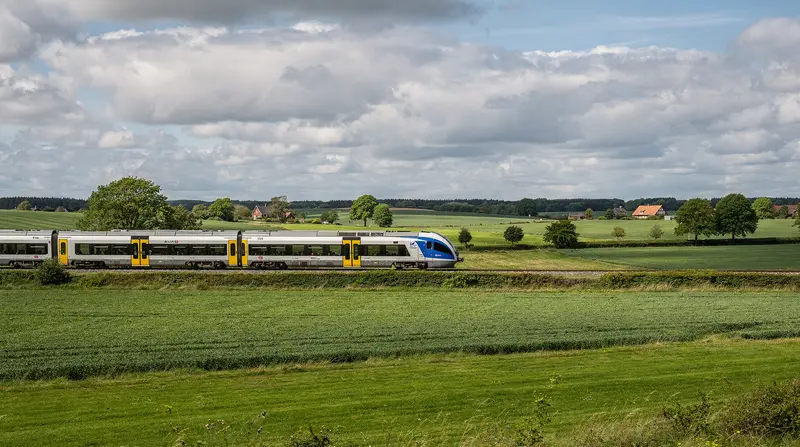
Take any train from Copenhagen Central Station (København H) towards Roskilde. Direct trains run every 10 minutes on most of the day and cost 90 DKK for a return ticket in zone 3. The journey takes 25–30 minutes.
If you have a Copenhagen Card, the train is included. The card also covers Roskilde Cathedral admission, so if you’re visiting multiple attractions over several days, that math can work in your favour. See our Copenhagen Card guide for an honest breakdown of whether it’s worth buying.
From Roskilde station, the cathedral is a 7-minute walk. The Viking Ship Museum is about 15 minutes on foot downhill toward the fjord, or a 5-minute taxi ride.
Skip the tourist train that runs between the station and the museum in summer. It’s slow, overpriced, and you miss the town centre entirely.
Roskilde Cathedral: what to know before you go
The guided Viking City Tour in English covers the cathedral well if you prefer context delivered on the spot, but the cathedral is perfectly manageable solo with the free audio guide available at the entrance.
The building dates from the 12th century but has been rebuilt and expanded so many times that it touches almost every architectural style from Romanesque to Baroque. UNESCO listed it in 1995 specifically because it represents the evolution of brick Gothic architecture across northern Europe — particularly the way bricks replaced stone as the primary material for Gothic church construction in Denmark and Northern Germany.
What you actually see inside:
- Royal sarcophagi dating back to the 15th century — 39 Danish monarchs are buried here
- Frederick IV’s elaborate alabaster tomb — genuinely impressive craftsmanship
- The astronomical clock from 1410, still functioning, with daily performances at noon
- St Birgitta’s Chapel — the oldest surviving part of the original structure
- Christian IV’s Chapel — a Renaissance side chapel with an ornate bronze chandelier, added in the 17th century
- The marble chapel of Frederik V — Neoclassical and relatively restrained compared to earlier royal chapels
A few things are worth knowing before you arrive. The audio guide (available in English, German, and several other languages, free with admission) is genuinely useful — without it, the different royal chapels can blur together. The most recent royal burial is Margrethe II’s father, Frederick IX, who died in 1972. The tradition of burying Danish royals here continues.
The architectural contrast between the 12th-century Romanesque apse and the later Gothic nave is visible from the outside as well as inside. Most visitors focus on the interior, but spend a few minutes walking around the exterior too — the changes in brick colour and construction technique tell the story of the building’s expansion across eight centuries.
Admission is 75 DKK for adults. Children under 18 enter free. The cathedral is closed during services on Sunday mornings (roughly 10:00–11:30) and for special ceremonies. Allow 60–90 minutes for a thorough visit; 45 minutes if you’re pressed for time.
Viking Ship Museum: honest assessment
The Big Viking Tour at the museum is worth doing if you want a guide who can explain the archaeology without you having to read every panel. The museum itself is well laid out with English signage throughout, so solo visitors manage fine.
The five ships — known collectively as the Skuldelev ships, after the nearby village — were excavated from the fjord between 1957 and 1962 using a cofferdam to drain the area. The find was extraordinary: five vessels in different states of preservation, ranging from a small fishing boat (Skuldelev 3) to a 30-metre ocean-going longship (Skuldelev 2).
Each ship has its own story and its own display bay in the museum hall:
- Skuldelev 1 — a broad-beamed ocean trader built in Norway, used to carry cargo across the North Sea
- Skuldelev 2 — the largest, built in Ireland around 1042 using Irish oak; a warship of impressive scale
- Skuldelev 3 — a small coastal trader, well-preserved, gives you a sense of the everyday scale of Viking maritime commerce
- Skuldelev 5 — a small longship, likely built locally in Denmark
- Skuldelev 6 — a fishing boat, the smallest of the five
The museum building itself is architecturally interesting — a long, open structure designed by the Danish firm Jørgen Bo and Vilhelm Wohlert, which also designed the Louisiana Museum of Modern Art north of Copenhagen. The hall maximises natural light to allow viewing the ships in conditions that approximate outdoor display.
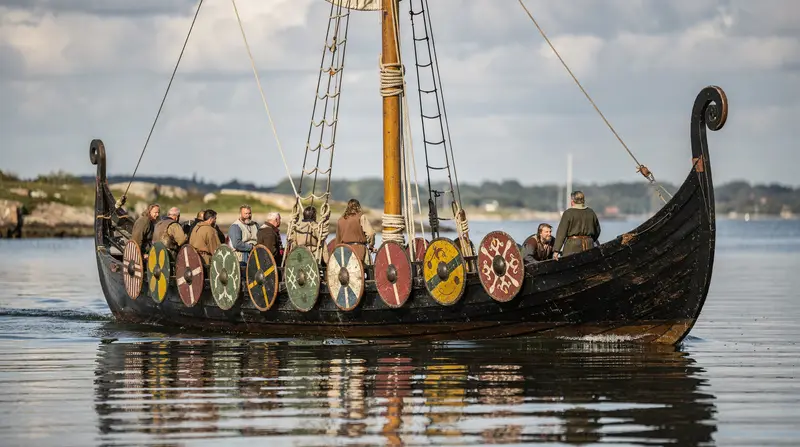
The boat-building workshop is an underrated part of the visit — you can watch craftspeople building full-scale replica vessels using traditional techniques. It’s not a performance; it’s an active long-term project that has produced several sailing replicas, some of which are now being used for fjord trips.
The fjord boat trip (add-on, ~100 DKK, June–August only) takes you out on a replica Viking ship. It’s a 45-minute experience and genuinely fun if you’re travelling with kids or anyone who would enjoy actually sailing rather than just looking at boats in a museum. The trip goes out across the Roskilde Fjord, which extends north for 40 km and was the main maritime highway for the region throughout the Viking Age. Book at the museum ticket desk on arrival — it sells out by mid-morning on summer weekends.
Museum admission: 175 DKK adults. Combo ticket with boat trip: 220 DKK. Under 18: 80 DKK. Open daily 10:00–17:00.
Worth it vs. skip: honest breakdown
Worth it:
- The cathedral, even if you’ve seen a lot of European churches — the royal burial density and continuous 900-year history is unusual anywhere in Europe
- The Viking ships — you can’t see anything like this in Copenhagen itself, and the Skuldelev 2 longship alone justifies the trip
- The boat-building workshop — watching craftspeople work on a full-scale replica is rare anywhere
- The fjord walk between the museum and the town centre (free, 20 minutes, excellent views of the fjord and the twin cathedral towers)
- The astronomical clock performance at noon — short but worth timing your visit around it
Skip:
- The Roskilde Museum in town (Museet for Samtidskunst) — competent local history but redundant if you’ve done the Viking Ship Museum, and the art collection is minor
- The Lejre Museum (Sagnlandet Lejre, Iron Age village) — interesting concept but adds 15 km of travel; better as its own dedicated trip rather than squeezed into a Roskilde day
- The tourist train between the station and the museum in summer — slow, overpriced, and you miss the town centre
- The waterfront restaurants immediately adjacent to the Viking Ship Museum — convenient but overpriced; walk 15 minutes back into town for significantly better value at similar prices
The Roskilde town centre: what else is worth seeing
Beyond the two headline sites, the town centre is worth 30–45 minutes of wandering. The pedestrian street (Algade) connects the cathedral to the station and has a mix of cafes, independent shops, and the occasional half-timbered building that survived the fires and modernisation that remade most Danish town centres in the 19th and 20th centuries.
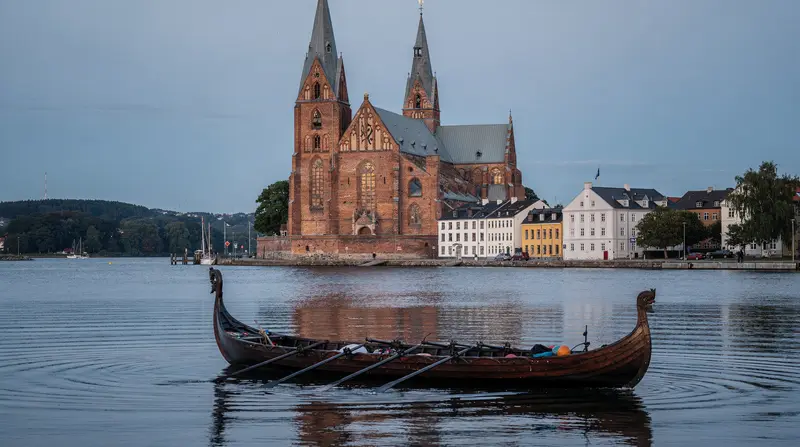
The harbour area (Roskilde Havn) below the Viking Ship Museum has been gradually redeveloped with cafes and green space. In summer it’s a pleasant place to sit by the water. The view from the harbour back up toward the cathedral towers — the twin spires are 85 metres tall and visible across the fjord — is one of the better photographs you can take in Roskilde.
The Roskilde Festival happens every year in late June or early July, making Roskilde one of the largest music festival sites in northern Europe. If you’re visiting Copenhagen in this window, be aware that the town fills significantly and accommodation prices in both Roskilde and Copenhagen spike. The festival itself is a separate trip, worth a dedicated article — but knowing the dates is useful for planning.
Planning your day: sample schedule
Half-day (arriving at 10:00):
- 10:00: Arrive Roskilde station, walk to cathedral
- 10:15–11:30: Roskilde Cathedral (with free audio guide)
- 11:30: Walk downhill to Viking Ship Museum (15 minutes)
- 12:00–13:30: Viking Ship Museum
- 13:30: Lunch at a cafe on Algade or in the museum café
- 14:30: Return train to Copenhagen (runs every 10 minutes)
Full day (arriving at 09:30):
- 09:30: Cathedral (before the crowds arrive, astronomical clock at noon means later visits can be timed around it)
- 11:00: Walk to Viking Ship Museum
- 11:30–13:00: Museum interior
- 13:00: Fjord boat trip (book at desk on arrival, June–August, ~45 minutes)
- 14:00: Lunch at harbour café
- 15:00: Harbour walk, cathedral square again for the afternoon light
- 16:30: Return train to Copenhagen
The half-day schedule is perfectly satisfying for most visitors. The full-day version adds the boat trip and more leisure time, and is better suited to families or anyone who wants to absorb the place at a slower pace.
Combining Roskilde with other stops
Roskilde makes a natural half-day, leaving the afternoon for Helsingør (another 60 minutes by train north) or for exploring Copenhagen’s own neighbourhoods. If you want to build a multi-stop day-trip week, our Copenhagen day trips itinerary shows how to sequence the Zealand destinations without doubling back.
If you’re driving, you could pair Roskilde with Møns Klint in a single long day, but it requires roughly 6 hours of actual visiting plus 3 hours of driving. Possible, but tiring.
Guided tours vs. doing it yourself
The small-group day trip from Copenhagen handles transfers and includes a guide who covers both sites in a logical sequence. It costs roughly €60–70 per person, compared to about 300 DKK (€40) if you go independently by train. The guided version saves time planning and is worth it if you’re short on trip-planning energy or want the narrative context.
The cruise special package combines Frederiksborg Palace, the cathedral, and the Viking Ship Museum in a single day — a long day, but efficient if you want to tick off North Zealand sights.
For most independent travellers, the DIY train approach is perfectly workable. Buy your train ticket at the station (or via the DSB app), walk to both sites, and return when you’re ready. There’s no logistical reason to book a tour unless you actively want a guide.
Practical information
Opening hours (2026):
- Cathedral: Mon–Sat 09:00–17:00 (Oct–Mar until 16:00), Sun 12:30–17:00
- Viking Ship Museum: Daily 10:00–17:00
Eating in Roskilde: The pedestrian street (Algade) running from the cathedral toward the town centre has several cafes and lunch spots. Café Vivaldi near the cathedral is reliable for a Danish smørrebrød lunch. Budget 120–150 DKK for a proper lunch with a beer.
Toilets: Free at the Viking Ship Museum and in the cathedral.
Accessibility: The cathedral has limited wheelchair access in some chapels; the main nave is accessible. The Viking Ship Museum is fully accessible.
Frequently asked questions about Roskilde
How far is Roskilde from Copenhagen?
Roskilde is 35 km west of Copenhagen. By direct train from Copenhagen Central Station, the journey takes 25–30 minutes. Trains run every 10 minutes throughout the day.
Is the Copenhagen Card worth it for a Roskilde day trip?
If you’re visiting Copenhagen for 3 or more days and plan multiple attractions, yes — the card covers the train to Roskilde and the cathedral admission. The Viking Ship Museum is not included. For a standalone day trip, buying individual tickets is likely cheaper.
How much time do you need in Roskilde?
A minimum of 4 hours covers both the cathedral (90 minutes) and the Viking Ship Museum (90 minutes) with transit time between them. Allow 6 hours if you want the fjord boat trip or a sit-down lunch in town.
Can you do Roskilde and Helsingør in the same day?
Technically yes — Helsingør is about 75 minutes north of Roskilde by train, via Copenhagen. It’s a long day with a lot of transit, but doable. Most travellers prefer to dedicate separate days to each.
Are there lockers at Roskilde station?
Yes, coin-operated lockers are available at Roskilde station (20–40 DKK depending on size). Useful if you’re arriving with luggage before continuing your journey.
Is Roskilde worth visiting in winter?
Yes, with caveats. The cathedral and Viking Ship Museum are open year-round. The fjord boat trips stop in October. Winter crowds are minimal, which actually improves the cathedral visit. Dress warmly — the walk between sites is exposed.
What’s the best way to buy train tickets to Roskilde?
Use the DSB app or buy at the station. Tickets cost the same either way. If you’re on a Copenhagen Card, you don’t need a separate ticket — just tap in with the card. Roskilde falls in zone 3 of the Copenhagen transit network.
Is Roskilde better than Møns Klint as a day trip?
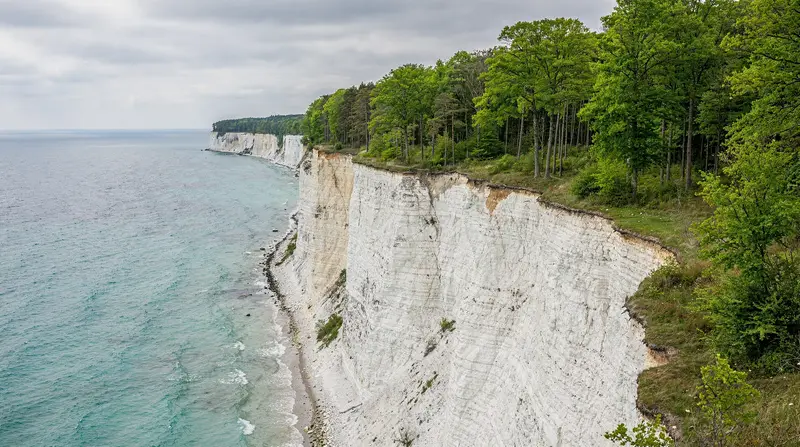
They serve different interests, so “better” depends on what you want. Roskilde is faster (25 minutes by train vs. 2 hours to Møns Klint) and pairs history and Viking archaeology with an easy, no-car itinerary. Møns Klint delivers dramatic chalk-cliff scenery but needs a full day and ideally a car. For a first Copenhagen visit with limited time, Roskilde is the lower-effort, higher-certainty choice.
Roskilde beyond the headline sites: is it worth a second visit?
Most visitors treat Roskilde as a one-time box to tick, but the town rewards a second look if you’re staying in Copenhagen for a week or more. The Roskilde Museum and the reconstructed Iron Age village at Sagnlandet Lejre (skipped on a first visit per the breakdown above) become more interesting once you’ve absorbed the cathedral and the ships and want a deeper dive into Danish history without repeating the same two sites. The town also makes a sensible base for the North Zealand castle route if you’re building a multi-day itinerary that avoids backtracking through central Copenhagen each night.
Top experiences
Bookable activities with verified prices and instant confirmation on GetYourGuide.