Nyhavn: Copenhagen's canal beyond the postcard
Nyhavn is beautiful and worth 30–60 minutes. Here's what to actually do there, where not to eat, and which canal cruise to take. Honest DKK prices.
Copenhagen: Canal Cruise with Guide
Duration: 1 hour
Quick facts
- Getting there
- Metro M1/M2 to Kongens Nytorv, 2 min walk
- How long to spend
- 30–60 min exploring; 1 hour for a canal cruise
- Best photo time
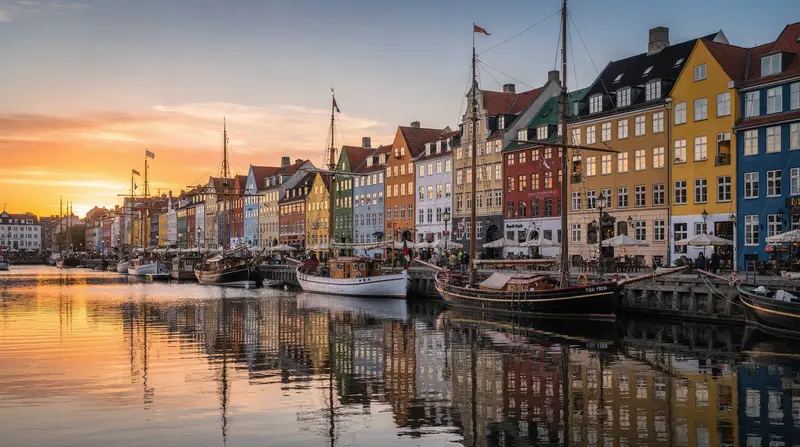
- Before 9:00 (no crowds) or golden hour evening
- Canal cruise price
- From 110 DKK (~15 €) for 1-hour standard cruise
- Food reality
- Restaurants on the quay are overpriced tourist traps
Quick answer: Nyhavn is genuinely worth visiting — the 17th-century canal lined with coloured townhouses is one of the most architecturally coherent harbour scenes in northern Europe. But the 30–60 minutes it deserves should not become two expensive hours sitting at a quayside table paying tourist-trap restaurant prices. Walk it, photograph it, take a canal cruise, then move on.
| Where | Copenhagen harbour, 2 min from Kongens Nytorv metro |
| Cost | Free to walk; canal cruise from ~110 DKK |
| Time needed | 30–60 minutes, or 90 min with a cruise |
| Getting there | Metro M1/M2 to Kongens Nytorv |
| Best time | Before 9:00 for photos; avoid quayside restaurants |
What Nyhavn actually is
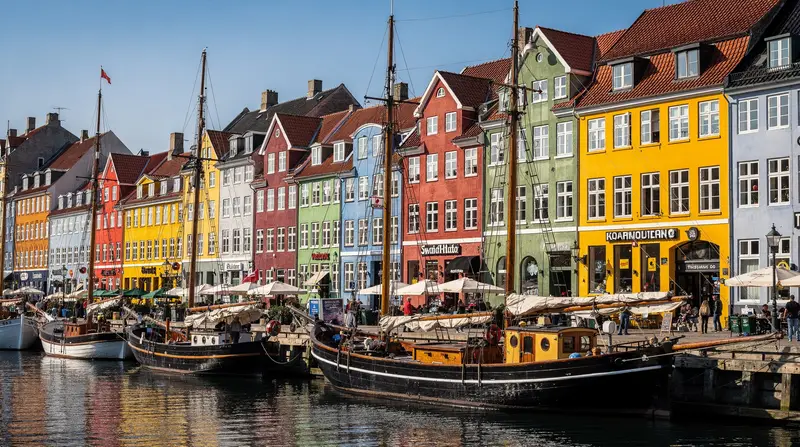
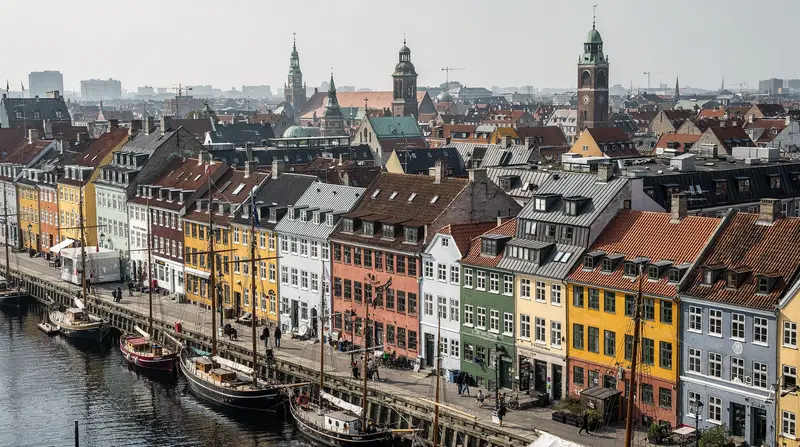
The name translates literally as “New Harbour” — a strange label for something that opened in 1673. King Christian V ordered the canal cut to connect Kongens Nytorv (King’s New Square) to the harbour, allowing ships to offload goods directly into the city. The warehouses and merchant houses on both sides of the 500-metre waterway were built in the 18th and early 19th centuries.
Hans Christian Andersen lived at three different addresses here (numbers 20, 67 and 18 at different points in his life), and there’s a plaque on number 67 to mark the fact. The canal was cleaned of its historic reputation as a working sailors’ quarter (brothels, taverns, rough trade) in the 1970s redevelopment that turned it into the tourist destination it is now.
The canal measures roughly 500 metres from the Kongens Nytorv end to the inner harbour. Walking the full length of one side and back takes about 25 minutes at a normal pace.
The food situation (and why it matters)
This is worth addressing immediately because it affects every visitor’s experience.
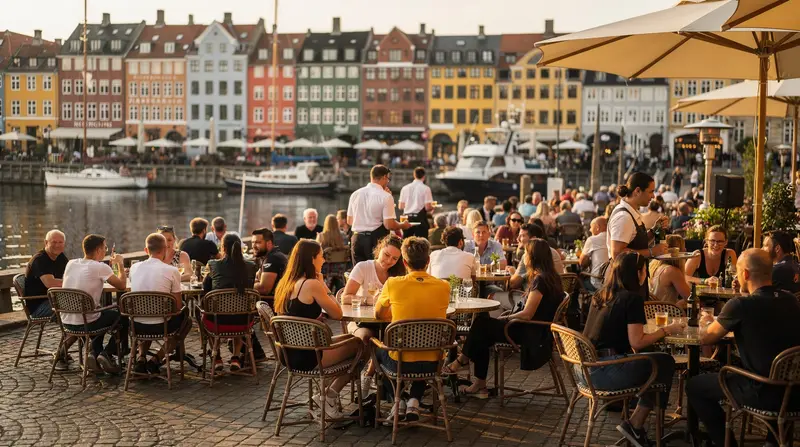
The restaurants with outdoor seating directly on the quay at Nyhavn are, without exception, operating in tourist-trap territory. Smørrebrød plates (open sandwiches on dark rye) run 180–260 DKK (24–35 €) for something you’d pay 95–130 DKK for in any neighbourhood café two minutes’ walk away. The herring platters are generic. The beer is standard Danish lager at inflated prices.
The setting is lovely. That’s what you’re paying for — the view, the outdoor seating, the coloured houses in the background. If you make that calculation consciously, fine. But visitors who sit down expecting good Danish food at reasonable prices will be disappointed.
Where to actually eat near Nyhavn:
- Slotskælderen hos Gitte Kik (Fortunstræde 4, a 7-minute walk inland): one of Copenhagen’s oldest smørrebrød lunches, serving traditional Danish open sandwiches in the 95–145 DKK range per piece. Lunch only, closed weekends. Book ahead.
- Café Halvvejen (Gothersgade, 8 min walk): neighbourhood café with daily lunch specials around 115–145 DKK.
- Torvehallerne (10–12 min walk via Gothersgade): the covered food market has multiple smørrebrød stalls, a fishmonger with fresh shrimp, and coffee roasters. Budget 130–180 DKK for a solid lunch.
If you want to eat at Nyhavn anyway: Restaurant Nyhavn 17 is relatively less extractive than the worst offenders and has a beer garden that gets afternoon sun. Do not confuse it with the generic operations that share the waterfront.
The canal cruise: what you need to know
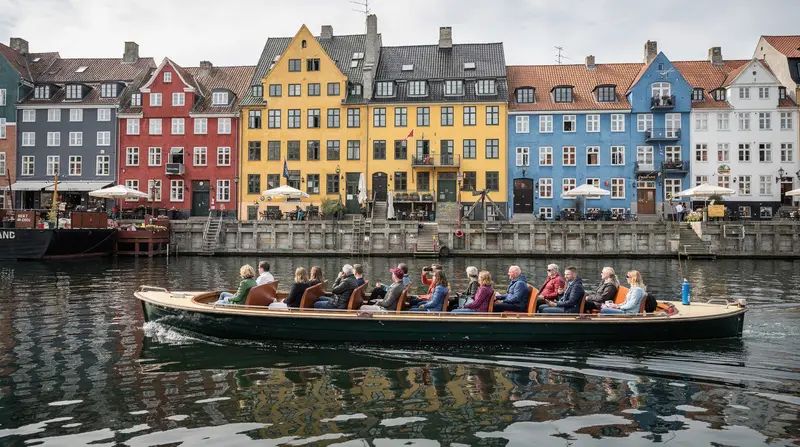
A canal cruise departing from near Nyhavn (most leave from Gammel Strand, a 5-minute walk west, or from Nyhavn quay itself) is the most efficient 60 minutes you can spend understanding Copenhagen’s geography. The route covers the inner harbour, the canals of Christianshavn, the Opera House designed by Henning Larsen (opened 2005), the harbour promenade and the Royal Library extension known as the Black Diamond.
The standard 1-hour canal cruise departing Gammel Strand runs from approximately 110 DKK (~15 €) per adult. Departures are frequent from April through October — roughly every 30–60 minutes at peak times. The covered boats run year-round; open-top versions operate seasonally.
The Classic Canal Tour and Harbour route covers a slightly different loop, including more of the outer harbour and the areas east of Christianshavn. Good if you want to see the newer harbour architecture (the corten-steel Opera House, the Playhouse designed by Lundgaard and Tranberg).
If you want something less structured, the public harbour bus routes 901 and 902 cross the harbour for a standard transport ticket (26 DKK on a Rejsekort card) and offer a different perspective on the waterway — not a substitute for the canal cruise but useful context.
Nyhavn vs. Gammel Strand departure: the Gammel Strand boats typically offer better multilingual audio guides and more consistent quality. Nyhavn departure boats are convenient but vary more in quality. If you care about commentary, book in advance via a specific operator rather than buying from the dock-side touts.
Walking Nyhavn properly
Most visitors arrive from Kongens Nytorv (the metro stop) and walk the north side of the canal toward the harbour. This is the side without the coloured houses — the view you came for is on the south side.
Walk the north side first toward the harbour (you’re looking at the coloured south bank houses as you walk). At the harbour end, cross the small bridge and walk back on the south side. Now you’re walking past the houses themselves, and you can look back toward Kongens Nytorv for the composition that appears on every Copenhagen postcard.
Two details worth stopping for:
- Number 9 (south bank): the tallest of the original merchant townhouses, now converted to apartments. The facade is from the 1780s.
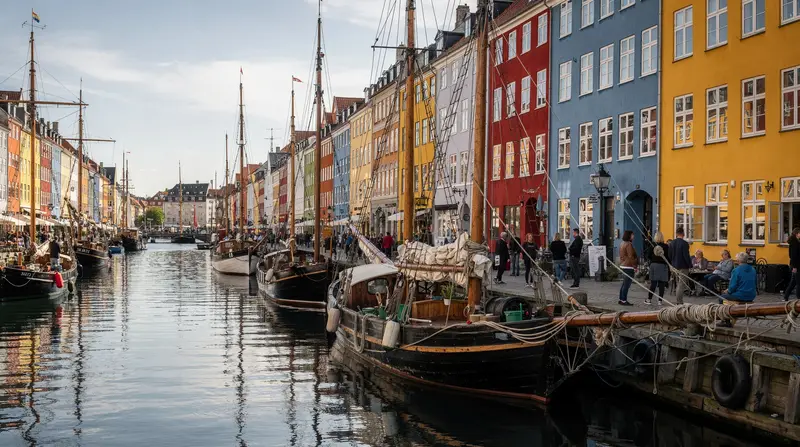
- The two old boats moored in the canal: the wooden vessels (including a three-masted barque and various smaller craft) are permanently moored and not for sale. They’re restoration projects by a nautical heritage foundation. In summer they’re often draped in laundry.
From the harbour end of Nyhavn, the walk north along the harbour promenade to the Little Mermaid takes about 25 minutes and passes Amalienborg Palace, the newly opened royal gardens behind it, and the marble church (Frederiks Kirke). The waterfront walk in this direction is more pleasant than it appears on maps.
Nyhavn for photos
The famous image — coloured houses reflected in the canal with a wooden boat in the foreground — requires:
- Morning light (before 10:00), when the sun hits the south bank houses directly from the east
- No crowds (before 9:00 in summer, or during rain)
- Position yourself on the north bank at roughly the midway point of the canal
If you arrive at 11:00 on a July Saturday, the photo exists only in other people’s albums. If you’re willing to be there at 08:00, you’ll have the composition to yourself.
Evening light (18:00–20:00 in summer) also works, though the south bank goes into partial shadow earlier. The restaurants light their outdoor tables with candles after dark, which creates a different but effective atmosphere.
After Nyhavn: where to go next
Nyhavn sits at a useful junction between several areas worth exploring:
- Indre By (Old Town): west from Kongens Nytorv, you’re in the historic city core — Strøget, the Round Tower, Rosenborg Castle. 10-minute walk.
- Christianshavn and Christiania: cross the harbour via the bridge south of the canal mouth. 15-minute walk into the canal district and the Freetown. The Christianshavn canal (Wilders Canal) is less crowded than Nyhavn and arguably prettier.
- Amalienborg and the Marble Church: north along the harbour promenade from the canal mouth. The palace square (four identical rococo palaces around an octagonal courtyard) is 15 minutes’ walk. The changing of the guard happens at noon daily.
- The King’s Garden (Kongens Have) and Rosenborg Castle: northwest from Kongens Nytorv, 15 minutes on foot. See the Indre By guide for context on Rosenborg.
Evening at Nyhavn
The canal’s south bank in summer evenings functions as an outdoor gathering place for locals as well as tourists. This is one context in which the overpriced beer at a canal-side table is partly justifiable — the atmosphere at 19:00 on a warm evening, with the boats lit and the sun still high, is genuinely pleasant. A beer here costs 75–100 DKK (10–13 €); doing it for one drink before dinner elsewhere is reasonable.
If you want a more interesting evening experience at the waterfront, consider:
An evening sip-and-sail canal cruise that departs from Nyhavn in the evening — combines the waterway experience with drinks on board. More memorable than sitting at a static quayside table and at a comparable cost.
The wine and food tasting in the Nyhavn area pairs a proper tasting experience with the neighbourhood — a better use of two hours than the generic quayside dining.
For a combined land and water circuit, the canal cruise and Nyhavn walking tour combo covers both the waterway and the neighbourhood history in a single 3-hour block.
The architecture and what to look at
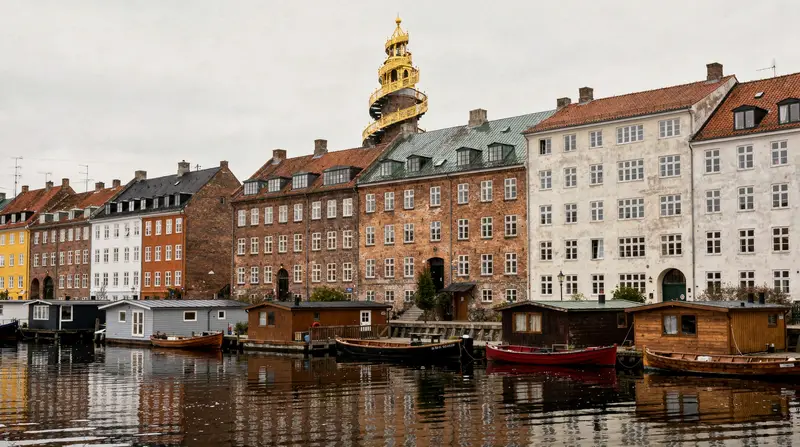
The townhouses on the south bank of Nyhavn were not built as a coherent block — they went up individually between the 1680s and the early 19th century, which is why no two facades are identical in colour or proportion. The widest houses were the most prosperous merchant premises; the narrower ones were lesser traders, ship chandlers, and the maritime services economy of the working harbour.
Several details are worth slowing down for:
Number 20 (south bank): where Hans Christian Andersen lived as a young man, arriving in Copenhagen from Odense in 1819. The building has a small plaque; Andersen’s actual apartment was on one of the upper floors. He wrote here during his most productive period in the 1830s and 1840s.
The figureheads: mounted on the wall of the maritime museum building at the harbour end of the canal’s north side are a series of wooden ship figureheads — painted, restored and illuminated at night. These are actual 18th- and 19th-century carvings from Danish merchant ships. Easy to miss; worth five minutes.
The anchor: the large naval anchor on the south quay is a memorial to Danish sailors who died in the Second World War. A modest monument for a significant fact — Denmark lost a disproportionate number of merchant sailors to Allied convoy duty and German submarine action.
The 1807 British bombardment: most of what you see in Copenhagen’s historic core postdates 1807, when the British navy bombarded the city for three days to prevent the Danish fleet from falling into Napoleon’s hands. This was controversial then and remains so in Danish historical memory. Nyhavn’s buildings mostly predate the bombardment; the area was on the edge of the damage zone.
Nyhavn in winter
The canal in winter is less crowded and in some ways more interesting. The floating restaurants move to indoor seating; the light on the coloured houses in low winter sun is different and often more photogenic than summer’s flat afternoon illumination.
The Tivoli Christmas market (late November through early January) is a 10-minute walk from Nyhavn and pulls the tourist density away from the waterfront during the holiday season. The canal in December, with lanterns lit and minimal crowds, is a genuinely pleasant walk.
Ice: occasionally the canal freezes completely — a rare occurrence but a dramatic one. This happened most recently in the winter of 2023 and locals were photographed walking on the ice surface in front of the coloured houses.
What’s open: all the canal cruise operators reduce frequency significantly from November through March, with some suspending operations entirely in January–February. Check ahead if you’re visiting off-season. The harbour bus runs year-round.
Beyond the canal: Kongens Nytorv
Kongens Nytorv (King’s New Square) at the head of Nyhavn is worth spending a few minutes in rather than walking straight past to the canal. The large equestrian statue in the centre is Christian V, cast in 1688 — one of the earliest bronze equestrian statues in Scandinavia. The square is surrounded by significant buildings: Det Kongelige Teater (the Royal Theatre, where the Royal Danish Ballet performs), Charlottenborg Palace (now an art gallery), and the Hotel d’Angleterre (the most expensive hotel in Copenhagen, operating since 1755).
The square is also where Copenhagen’s most reliable Christmas ice rink opens in November — a large outdoor rink with skate rental that operates through January. Entry and rental run around 90–120 DKK (12–16 €) depending on the period.
In summer Kongens Nytorv functions as a transit hub more than a destination, but in winter it becomes an active gathering place in a way that most of the tourist waterfront does not.
Nyhavn for people with limited time
If you have only 30 minutes at Nyhavn — a common situation for cruise passengers or anyone squeezing it between other sights — the efficient version is: walk the north side toward the harbour (looking at the coloured south bank), cross the small bridge at the harbour end, and walk back along the south side past the houses themselves. This covers both the classic photo composition and the historical detail (Number 20, the figureheads) in about 20 minutes without sitting down anywhere. Skip the canal cruise on this timeline — it adds a full hour and is better saved for a visit where you have time to enjoy it rather than rush it.
Comparing Nyhavn to Christianshavn’s canals
Visitors often ask whether it’s worth seeing both Nyhavn and the Christianshavn canals on the same trip. The honest answer is that they serve different purposes. Nyhavn is compact, instantly photogenic, and crowded — it’s the postcard image, seen in five minutes and best appreciated for what it is rather than lingered over. The Christianshavn canals (particularly Wilders Canal) are quieter, less visually uniform, and feel more like a residential neighbourhood that happens to have water running through it.
If you only have time for one, Nyhavn is the “must-see” for a first Copenhagen visit; Christianshavn is the better choice for a second visit or anyone who prefers atmosphere over the headline shot. Doing both takes about an hour total given their proximity — see the Christianshavn and Christiania guide for the fuller picture.
Getting to Nyhavn
Metro: M1 or M2 to Kongens Nytorv. The canal mouth is a 2-minute walk from the station exit. This is the simplest option.
Cycling: from Vesterbro or Nørrebro, it’s a 20–25 minute flat ride. Bike parking is available on both sides of Kongens Nytorv.
Walking: from Central Station, the walk via Strøget takes about 25 minutes and passes through the heart of Indre By. From Christianshavn, it’s 15 minutes across the harbour bridge.
Harbour bus: routes 901 and 902 stop at Nyhavn (the stop is called “Nyhavn”). Coming from the south (Christianshavn, Islands Brygge) this is a pleasant waterborne approach.
Frequently asked questions about Nyhavn
Is Nyhavn worth visiting?
Yes, for 30–60 minutes. The canal and townhouse architecture is genuinely attractive and photogenic. It becomes worth less the longer you stay — there’s no museum, no significant food culture (see the restaurant warning above), and the canal itself is short. Factor it in as a walk-through between Indre By and the harbour, not as a half-day destination.
Where should I eat near Nyhavn?
Not at the canal-side restaurants unless you’re consciously paying for the setting. Slotskælderen hos Gitte Kik (7 min walk), Torvehallerne (10 min walk) and the cafés on Gothersgade all offer better food at lower prices. Our Copenhagen tourist traps guide has more detail.
What time should I visit Nyhavn for photos?
Before 9:00 for the empty canal shot; the soft morning light on the south bank houses is from the east and excellent in summer. Golden hour (around 20:00–21:00 in June) also works. Midday in July is the worst time: maximum crowds, harsh overhead light.
Which canal cruise is best from Nyhavn?
The standard 1-hour Gammel Strand cruise (5 min walk from Nyhavn) is reliable and runs frequently. The Nyhavn-departing boats are convenient but vary in quality. Booking in advance via a specific operator gives you a confirmed departure time and usually a better guide than buying from a dock-side seller. See our best canal tours guide.
Is Nyhavn walkable from the city centre?
Yes. From Rådhuspladsen (Town Hall Square) via Strøget, the walk is about 20–25 minutes. From the metro station at Kongens Nytorv, the canal mouth is 2 minutes. Most major accommodation in central Copenhagen is within 25 minutes’ walk.
Can I take the harbour bus instead of a canal cruise?
The harbour bus (routes 901/902, 26 DKK per trip on a Rejsekort card) crosses the harbour and gives you views of the waterfront. It doesn’t go into the inner canals and has no commentary. It’s useful for transport, not as a replacement for a guided canal cruise if you want to understand what you’re looking at.
Top experiences
Bookable activities with verified prices and instant confirmation on GetYourGuide.