Aarhus Day Trip from Copenhagen
Aarhus from Copenhagen: ARoS Rainbow Panorama, Den Gamle By and a 3h train ride. An honest guide to Denmark's second city, with costs in DKK.
AarhusCARD (incl. ARoS, Den Gamle By, Moesgaard)
Quick facts
- From Copenhagen
- ~3 hours by InterCity train (IC)
- Train price
- ~DKK 250–450 return (DSB, advance booking)
- Currency
- DKK (Danish krone)
- Best for
- ARoS museum, Den Gamle By, Latin Quarter, street food
- Population
- ~350,000 (Denmark's second-largest city)
Quick answer: Aarhus is genuinely excellent and genuinely far. Three hours each way on the train means a day trip is logistically demanding — you’ll have 4–5 hours in the city before you need to head back. Two days is the honest recommendation: one full day in the city, an overnight, and a relaxed morning before returning. If you only have one day, it’s still worth it, but be clear-eyed about how much of the journey you’ll spend in transit.
| Where | East Jutland, on the Kattegat coast, ~3h from Copenhagen |
| Cost | ~DKK 250–450 return train; Aarhus Card DKK 289–349 |
| Time needed | One long day (rushed) or two days (comfortable) |
| Getting around | Walkable centre; Aarhus Letbane light rail for outlying sights |
| Best time | Year-round; summer for the Moesgaard forest-beach walk |
Getting to Aarhus from Copenhagen
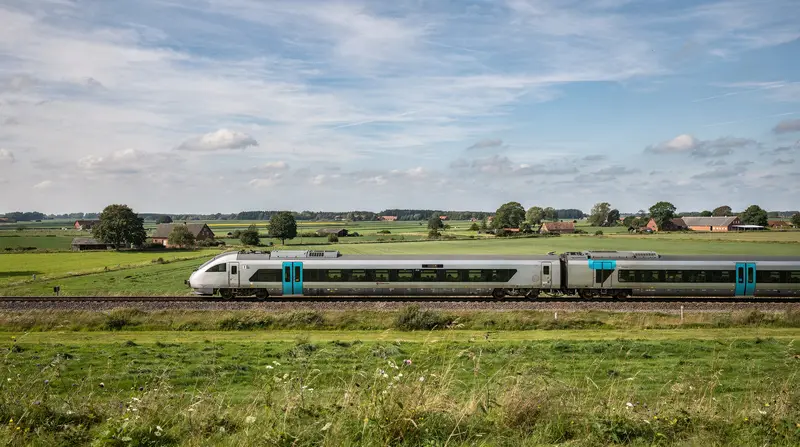
The fastest connection is the InterCity (IC) train from Copenhagen Central (København H), which runs every 30–60 minutes. Journey time is approximately 3 hours. The train crosses to Jutland via the Great Belt (Storebælt) bridge-tunnel and then continues north through Funen and on to Aarhus. Window seats on the Great Belt crossing are worth taking.
Return tickets range from DKK 250 with advance booking to DKK 450 or more for last-minute purchases. DSB’s Orange tickets (the cheapest tier) require booking days or weeks ahead and have no flexibility; regular tickets cost more but can be changed. Book via DSB.dk or the DSB app.
Aarhus Central station is right in the city centre. Everything described in this guide is either walkable or a short tram ride on the Aarhus Letbane (light rail) network.
The Aarhus Card gives unlimited public transport within Aarhus plus free or discounted entry to 17+ attractions including ARoS, Den Gamle By, the Moesgaard Museum, and others. A 1-day card costs around DKK 289; a 2-day card around DKK 349. If you’re planning a full day of museums, it pays for itself. If you’re only visiting one or two attractions, calculate whether individual entry adds up to more.
The Aarhus Card — unlimited transport and 17+ attractionsARoS Aarhus Art Museum
ARoS is the headline attraction and it deserves the reputation. The building itself — a cube of pale concrete with a circular glass walkway on the roof — is striking from the outside. Inside, the permanent collection spans Danish and international art from the 18th century through to the present, with particular strength in the 20th and 21st centuries.
The piece most people come for is Olafur Eliasson’s Your Rainbow Panorama, a circular glass walkway perched on the museum roof that wraps visitors in slowly transitioning spectrum colour. You see the city through red, orange, yellow, green, blue, and violet glass panels as you walk the loop. It’s simple as a concept and genuinely affecting in practice — one of those pieces that earns its fame rather than just having it.
Entry to ARoS costs DKK 160 for adults (2026 prices; included in the Aarhus Card). Allow at least 2 hours, more if you want to spend time with individual works in the permanent collection.
Walking tour: Aarhus from Viking village to modern metropolisDen Gamle By (The Old Town Open-Air Museum)
Den Gamle By is the best open-air urban museum in Denmark, and one of the best in Europe. Where most open-air museums concentrate on rural life, Den Gamle By reconstructs Danish town life across three centuries: the 18th-century town, the 1927 street, and a 1974 neighbourhood. The buildings are either original structures relocated here or meticulous reconstructions, and the level of period detail — right down to the contents of shop windows and the wallpaper patterns — is extraordinary.
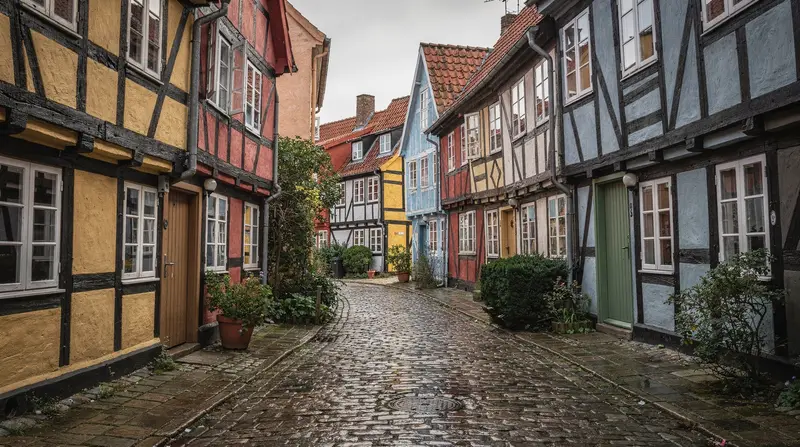
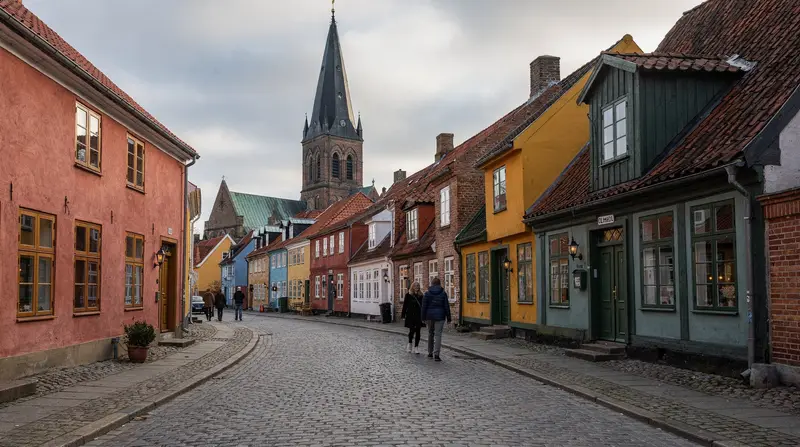
The 18th-century section feels lived-in: craftspeople work in some of the buildings during summer, and the cobblestone lanes and half-timbered houses are well enough preserved that you genuinely need to remind yourself you’re in a museum rather than a functioning neighbourhood. The 1927 and 1974 sections are less conventionally picturesque but arguably more interesting — most visitors have never seen a museum that treats 1974 as worthy of preservation.
Entry costs DKK 160 for adults, DKK 60 for children aged 4–14 (included in the Aarhus Card). Allow 2.5–3 hours. The museum’s café is good and inexpensive relative to city alternatives.
Self-guided audio walking tour of AarhusGetting Around Aarhus
Aarhus is walkable in its centre, but the city is larger than it appears on maps. The distance from the railway station to ARoS is about 15 minutes on foot; from ARoS to Den Gamle By is another 15 minutes. Moesgaard Museum is about 8 kilometres south — a 20-minute bus ride (route 18 from the city centre).
The Aarhus Letbane (light rail) runs through the city centre and out to the suburbs and the university campus. A single journey costs DKK 27; the Aarhus Card includes unlimited public transport. City bikes are available for hire at the station and several central points.
If you’re staying overnight, the compact city centre means most accommodation is within walking distance of the main attractions. Taxis and ride-hailing operate normally.
The Latin Quarter (Latinerkvarteret)
The Latin Quarter is the historic street grid south of the cathedral, now the most atmospheric neighbourhood in Aarhus for walking and eating. Narrow streets, independent shops, cafés, and the occasional art gallery — it’s the neighbourhood where Aarhus feels most like a city that has always been interesting rather than one trying to become interesting.
Aarhus Cathedral (Aarhus Domkirke) sits at the northern edge of the Latin Quarter. At 93 metres, it’s the longest church in Denmark; the interior contains some of the best-preserved medieval frescoes in the country, many of them restored after the Reformation when they were whitewashed over. Entry is free.
The street food market at Marselisborg Havn (a 15-minute tram or bus ride south) and the food hall at Nicolines Have are good lunch options. The Latin Quarter itself has enough independent lunch spots to keep you fed without needing to travel.
Moesgaard Museum
If you’re staying two days, the Moesgaard Museum (MOMU) is worth the 20-minute bus ride south of the city centre. It focuses on Danish prehistory, archaeology, and ethnography, and its building — designed by Henning Larsen Architects and built into a hillside — is as compelling as the collection inside. The bog bodies on display (including the Grauballe Man) are among the best-preserved human remains from the Iron Age anywhere in the world.
Entry costs DKK 160 for adults (included in the Aarhus Card). The walk back from Moesgaard to the city centre through the beech forest and along the beach at Moesgaard Strand is one of the best things you can do in Aarhus on a dry day — about 7 kilometres, taking 1.5–2 hours.
Aarhus craft beer walkOne Day vs Two Days
One day: Arrive by 10:00–10:30am. ARoS until lunchtime (2 hours). Latin Quarter for lunch. Den Gamle By (2.5 hours). Walk the old town briefly. Depart by 6:00pm. You’ll arrive back in Copenhagen by 9:00–9:30pm. This works but you are genuinely rushing and you’ll feel it.
Two days: Day one covers ARoS, the Latin Quarter, and the cathedral at a human pace. Day two: Den Gamle By in the morning, then either Moesgaard Museum or the forest-beach walk in the afternoon. Leave at 4–5pm and arrive home by 7–8pm. This is the itinerary that actually makes sense for a city this far away.
Overnight recommendation: Aarhus has a solid hotel scene at various price points. The city centre and Latin Quarter have good options in the mid-range. Booking ahead is strongly advised in summer.
Food in Aarhus
Aarhus has developed a serious food culture over the past decade. The city has received Michelin-starred restaurants (Gastromé has been a notable presence), but more relevant for most visitors is the density of high-quality mid-range restaurants in the Latin Quarter and around the waterfront.
The Aarhus Street Food market at Ny Banegårdsgade (near the station) is a good option for lunch if you want variety: around 30 vendors covering everything from Vietnamese street food to Danish smørrebrød to wood-fired pizza. Prices run DKK 80–150 for a full meal. It’s covered, which matters on wet days.
The Latin Quarter restaurants tend toward the mid-range (DKK 200–350 for a two-course dinner). Lunch in the same restaurants is better value; the two-course lunch menus (dagsret) typically run DKK 130–180. Look for the traditional Danish lunch restaurants (frokostrestauranter) for the full smørrebrød experience.
The Marselisborg Havn area, a 15-minute tram ride south of the centre, has a more waterfront-focused restaurant cluster — better for a summer evening meal with a view than a quick weekday lunch.
New Nordic in Aarhus: The Noma-influenced New Nordic cooking style that Copenhagen is famous for has genuinely taken root in Aarhus. Several mid-range restaurants cook seasonal Danish ingredients with precision and creativity at prices that would be considered cheap in Copenhagen. Look for seasonal tasting menus in the DKK 500–700 range — ambitious food at prices significantly below equivalent Copenhagen restaurants.
Shopping and everyday Aarhus
Beyond the museums, Aarhus has a genuinely good retail and everyday-life scene worth a slower look if you have the two-day version of the trip. Ryesgade and Mejlgade, running north from the Latin Quarter, have the highest concentration of independent shops — vintage clothing, Danish design homeware, and small galleries that don’t make it into most guidebooks. Bruuns Galleri, the shopping centre attached to the central station, is unremarkable but useful for practical purchases before a train.
Aarhus Street Food’s Saturday market extension and the weekend farmers’ market at Ingerslevs Boulevard (seasonal, spring through autumn) are worth timing a visit around if your trip falls on a Saturday — genuinely local, not tourist-oriented, and a good source of picnic supplies for the Moesgaard forest walk.
The university district around Nobelparken has a studenty, unpolished energy that contrasts with the polished museum quarter — cheap eateries, secondhand bookshops, and a general sense of a city that isn’t performing for visitors in this particular corner. It’s a 15-minute walk or a short Letbane ride from the centre and worth the detour if you want to see Aarhus as residents actually experience it, rather than only its headline attractions.
Aarhus Harbour and Dokk1
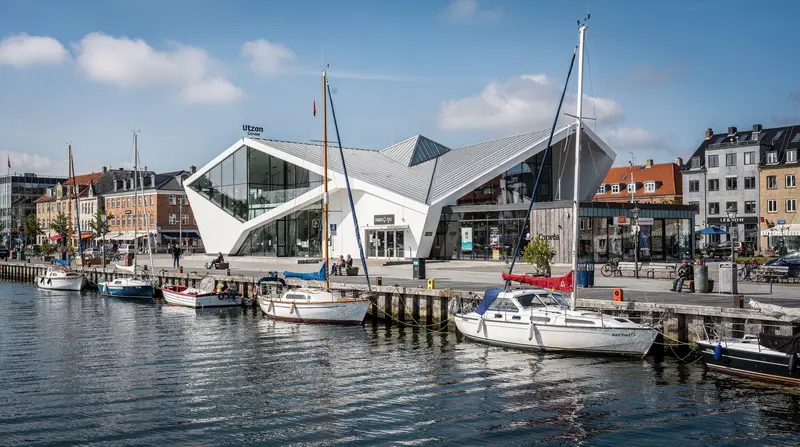
The Aarhus Ø (Aarhus Island) development on the former industrial docks east of the city centre is the most visible sign of the city’s current ambition. Dokk1 — a combined public library, citizen service centre, and cultural venue built on the waterfront and opened in 2015 — is the anchor building. It’s one of the largest and best-designed public libraries in Scandinavia, with a top floor that opens onto a public roof terrace with views across the harbour. Entry is free; the library is open to everyone regardless of residency.
The neighbourhood around Dokk1 is still under development but the existing waterfront promenade, the ferry connections to the Danish lake district, and the general quality of the public space make it worth a 30-minute walk. This is not a tourist experience so much as a window into how Aarhus thinks about its public life.
The Aarhus Viking Museum is a small but interesting stop underneath the city centre — literally under the street, accessible from the basement of a bank on Sankt Clemens Torv. It contains excavated Viking Age remains found when the building above was constructed, presented in situ. Entry is free, and it provides an interesting counterpoint to Den Gamle By’s later historical focus.
Aarhus, Aalborg or Odense: choosing your Jutland/Funen stop
Aarhus is the most efficient single day trip of Denmark’s three main Jutland/Funen cities, but it isn’t the only option if you’re building a longer route.
| Aarhus | Odense | Aalborg | |
|---|---|---|---|
| Time from Copenhagen | ~3h by train | ~1h30 by train | ~4h–4h30 by train |
| Headline draw | ARoS, Den Gamle By | H.C. Andersen sites, compact old town | Waterfront, Lindholm Høje Viking site |
| Standalone day trip? | Demanding but doable | Comfortable, the easiest of the three | Not realistic — plan an overnight |
| Honest verdict | Best single day if you commit to two museums | The genuinely easy half-day option | Better as part of a Jutland loop |
If your time is tight, Odense is the least demanding of the three and pairs naturally with a relaxed schedule; Aalborg only makes sense once you’re already committed to the extra travel time. The best day trips from Copenhagen ranked puts Aarhus in context against closer options, and the Copenhagen trip cost guide breaks down how a Jutland day (or overnight) affects the total budget.
For the practicalities of trains, buses and the Letbane once you’re on the ground, the getting around guide covers ticketing across operators. Billund and LEGOLAND is the other common add-on if you’re travelling with children and have a car.
What Aarhus Is Really Like
Aarhus has a dual identity it wears well: a historic university city (Aarhus University was founded in 1928 but the city’s academic culture goes back further) and an ambitious contemporary city that built world-class museums and a waterfront that has genuinely transformed its eastern edge. The harbour area — the Aarhus Ø development built on the former industrial docks — is still being completed, but the existing sections show how seriously the city has invested in its own future.
It is not trying to be Copenhagen. The pace is different, the city scale is human rather than metropolitan, and the food scene — particularly around the Latin Quarter and the street food markets — has developed its own distinct character rather than copying the capital. This is a feature, not a bug.
Frequently asked questions about Aarhus
How long does it take to get from Copenhagen to Aarhus by train?
Approximately 3 hours by InterCity (IC) train from Copenhagen Central (København H). Trains run every 30–60 minutes throughout the day. The journey crosses the Great Belt via the combined bridge and tunnel.
Is Aarhus worth visiting from Copenhagen as a day trip?
It’s possible but demanding — the 6-hour round journey leaves you 4–5 hours in the city. If you’re genuinely interested in ARoS and Den Gamle By, the day trip is worth making. If you’re on the fence, the honest recommendation is an overnight stay, which transforms the experience from a travel exercise into an actual visit.
What is the ARoS Rainbow Panorama?
It’s a circular glass walkway on the roof of the ARoS art museum, designed by artist Olafur Eliasson. As you walk the loop, you view Aarhus through glass panels that cycle through the spectrum of the rainbow. The effect is atmospheric and distinctly different from anything in Copenhagen. It’s included in standard ARoS entry.
What is Den Gamle By?
Den Gamle By (literally “the old town”) is an open-air urban history museum in Aarhus that reconstructs Danish city life from the 18th century through the 1970s. Original buildings were relocated here from across Denmark; others are reconstructions. It’s one of the best museums of this type in Europe and works well for both families and adults with a general interest in history.
Is the Aarhus Card worth buying?
If you’re planning to visit ARoS (DKK 160) and Den Gamle By (DKK 160) plus using public transport, the 1-day card at DKK 289 saves money and simplifies logistics. If you’re only visiting one museum, calculate individual costs first.
Can I do Aarhus and Odense in the same day trip from Copenhagen?
Technically yes by train, but it makes for an exhausting day with very little time at either destination. A better approach is to spend a day in Odense (1h30 from Copenhagen) and a separate day — ideally overnight — in Aarhus (3h from Copenhagen). The day trips week itinerary covers how to structure multiple Jutland/Funen destinations across your stay.
What is Aarhus like compared to Copenhagen?
Aarhus is smaller, calmer, and in some respects more architecturally coherent than Copenhagen. It lacks Copenhagen’s international scale but has a genuine cultural identity — particularly in its art and food scenes. Many visitors who spend time in both cities prefer Aarhus’s pace and feel that it shows a more authentic picture of how Denmark actually lives.
Top experiences
Bookable activities with verified prices and instant confirmation on GetYourGuide.