Nationalmuseet Copenhagen: Visitor Guide to Denmark's National Museum
Danish National Museum Copenhagen: Archeology & History Tour
Duration: 2 hours
Is the National Museum of Denmark free?
Yes. The permanent collection at Nationalmuseet (National Museum of Denmark) is entirely free. There is no admission charge. Some temporary exhibitions may require a ticket — check the website. Opening hours are typically Tuesday–Sunday 10:00–17:00; closed Mondays.
The National Museum of Denmark is free, and it is not a second-tier consolation for budget travellers — it is genuinely one of the best museums in northern Europe. The prehistoric collection alone, which runs from the first post-glacial settlers through the Bronze Age and into the Viking era, would justify a ticket price. The fact that entry costs nothing makes it arguably the best value cultural attraction in Copenhagen.
| Where | Ny Vestergade 10, Indre By — 5 min from Gammel Strand metro |
| Cost | Free (permanent collection); temporary exhibitions around 80–120 DKK |
| Time needed | 2.5–3 hours for highlights; 4+ hours comprehensive |
| Getting there | Metro M1/M2 to Gammel Strand, or walk from Christiansborg Palace |
| Best time | Weekday mornings, Tuesday–Thursday before noon |
A guided archaeology and history tour can add significant depth if you want context for the Bronze Age and Viking sections — the in-museum labelling is excellent, but a knowledgeable guide changes how you understand the Gundestrup Cauldron.
What Nationalmuseet actually is
The National Museum of Denmark (Nationalmuseet in Danish) opened in its current building — the former Crown Prince’s Palace — in 1892. The collections it holds are far older: systematic acquisition of Danish antiquities began in the late 18th century under King Frederik VI, who decreed that ancient finds should be sent to Copenhagen rather than sold or melted down.
The building is a large classical palace complex on Ny Vestergade, between Christiansborg Palace and Rådhuspladsen. It occupies an entire city block. Inside, the permanent collection spans approximately 14,000 years — from the earliest evidence of human habitation in Denmark (around 12,000 BCE, as the last ice sheet retreated) to the 20th century.
The museum has roughly 260 rooms and 14 million objects in its holdings, of which perhaps 10% are on permanent display. The sections most visitors prioritise are: Prehistory (Stone Age through Bronze Age), the Viking Age, Danish cultural history, Egyptian antiquities, and the children’s museum.
The Bronze Age floor: where to start
The prehistoric galleries covering the Bronze Age (approximately 1700–500 BCE in Denmark) are exceptional by any international standard. Danish Bronze Age culture produced objects of extraordinary quality and unusual preservation — the peat bogs of Jutland acted as natural conservation chambers, preserving organic materials that would ordinarily have decayed millennia ago.
The Sun Chariot (Solvognen): Cast around 1400 BCE, this is a small wheeled horse pulling a disc representing the sun, made from bronze with gold leaf on one side of the disc. It is a votive object — something placed in a bog as an offering. The level of craftsmanship is remarkable for the period, and the object’s function (possibly representing the sun’s journey across the sky by day, with the plain bronze reverse representing night) is still debated. It is in Room 9.
The Egtved Girl: A Bronze Age woman of approximately 16–18 years, buried around 1370 BCE, whose remains and burial goods were preserved in a bog. The reconstruction of her clothing, jewellery, and the birch-bark container with fermented drink buried beside her gives an unusually complete picture of a specific person from 3,400 years ago.
Bronze lurs: Long curved bronze instruments found in pairs, believed to have been used in ceremonial contexts. The museum has the best collection of these in the world. They produce a deep, resonant sound — recordings of them being played are available through the museum’s audio guide.
The Viking Age galleries
The Viking Age section covers approximately 793–1100 CE — the period when Scandinavian seafarers raided, traded, and settled across Europe, North America, and the Middle East. The National Museum’s Viking collections are strong but more focused than the dedicated Viking Ship Museum in Roskilde; the emphasis here is on material culture, trade networks, and daily life rather than naval technology.
Key objects:
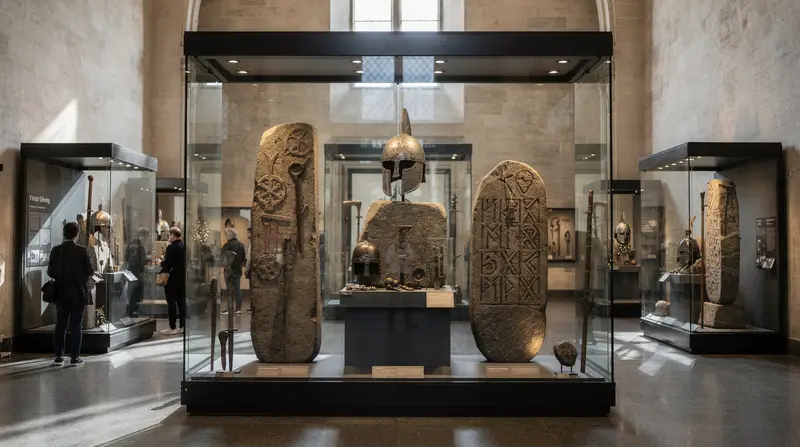
- Jelling Stone runic inscriptions (replicas — the originals are in Jutland): The Jelling Stones are Denmark’s “birth certificate,” marking the moment King Harald Bluetooth declared Denmark Christian in the 10th century. The replicas in the museum are full-scale and accurately reproduced.
- Viking-era jewellery and hoards: Multiple finds of silver arm rings, pendants, and coin hoards illustrate the trade networks connecting Scandinavia to the Byzantine Empire and the Islamic caliphate. Arabic coins from Baghdad appear regularly in Viking-era Danish finds.
- Rune stones and runestones replicas: The museum has several carved stones with runic inscriptions from the 8th–11th centuries.
The Viking section connects well to the medieval floor, which covers Denmark from the arrival of Christianity through the Reformation in 1536.
The Gundestrup Cauldron
One of the most significant Celtic artefacts ever discovered was found in a Danish bog in 1891. The Gundestrup Cauldron is a large silver vessel — approximately 69 cm in diameter — decorated with panels depicting gods, ritual scenes, animals, and warriors. It dates from approximately 150–50 BCE.
The iconography is distinctly Celtic (the antlered figure on one panel is strongly associated with the Gaulish deity Cernunnos), but the craftsmanship techniques suggest it was made in Thrace (modern Bulgaria/Romania) before being transported to Denmark — how, and why, remains unknown. It is in Room 25 of the Danish Prehistory floor.
Egyptian, Greek, and Roman antiquities
The antiquities section occupies the western wing and covers ancient Egypt (mummies, shabtis, canopic jars, steles), Greek ceramics and sculpture, and Roman finds including portrait busts and everyday domestic objects. The collection is smaller than those at the major European museums but is well-curated and labelled.
The Egyptian rooms include several intact mummies with accompanying cartonnage cases and funerary objects. They are genuine — not reconstructions. The oldest dates from approximately 2000 BCE.
Danish cultural history: 1000 years in 40 rooms
The largest section of the museum by floor space covers Danish cultural history from the early medieval period to the 1950s. This includes: medieval church art (carved altarpieces, fonts, and chalices), the Baroque and Rococo domestic interiors of the 17th–18th centuries, tools and trade from the pre-industrial period, and reconstructed domestic interiors from different social classes across the centuries.
This section is slower-paced and more suited to visitors with a specific interest in social history or Danish material culture. It is also where the museum feels most authentically Danish — the objects are not the great treasures of ancient civilisations but the everyday things of ordinary people across a thousand years.
The children’s museum (Børnemuseum)
Nationalmuseet has one of the better children’s museum sections in Denmark, covering the Viking Age with hands-on activities: dressing in period clothing, handling replica weapons and tools, and exploring a reconstructed Viking longhouse environment. It is designed for children aged 4–12, open during normal museum hours, and free.
If you are visiting with children, budget 45–60 minutes in this section.
Practical information
Address: Ny Vestergade 10, 1471 Copenhagen K
Hours: Tuesday–Sunday 10:00–17:00. Closed Mondays. Open on most public holidays (check the website for exceptions).
Admission: Free. Temporary exhibitions may require a paid ticket (typically 80–120 DKK) — check before visiting.
Getting there:
- Metro: Gammel Strand station (M1/M2), 5-minute walk north via Vindebrogade
- Bus: Routes 2A, 14, 26, 37 stop at or near Rådhuspladsen, 8 minutes’ walk east
- On foot from Tivoli/Central Station: 12–15 minutes via Strøget or Vester Voldgade
- On foot from Christiansborg Palace: 5 minutes west across Frederiksholms Kanal
Cloakroom: Compulsory for large bags. Free. Allow 5 minutes at entry.
Photography: Permitted in all permanent galleries without flash. Some temporary exhibitions prohibit photography — signage is clear.
Accessibility: Lifts connect all floors. The building’s historic structure means some areas have limited wheelchair access; the main prehistoric and Viking floors are fully accessible. Staff can provide assistance.
Audio guide: Available via the museum’s app (free download) and as a rental device (40 DKK). The audio guide for the prehistory and Viking sections is particularly strong.
Languages: All labels are in Danish and English throughout the permanent collection.
What is nearby
The National Museum sits between several other significant sites. Christiansborg Palace (seat of the Danish Parliament) is a 5-minute walk east. The Ny Carlsberg Glyptotek is a 10-minute walk east-southeast via Vester Voldgade. Tivoli Gardens is a 12-minute walk east-northeast. The canal district of Frederiksholms Kanal — one of the older parts of the city — runs along the museum’s eastern edge.
A logical morning route: National Museum (2.5–3 hours, free) → walk east to Glyptotek (arrive around 13:00, 2 hours, 125 DKK or free Tuesday) → walk north through Strøget to Nørreport or Kongens Nytorv for the afternoon. This covers two excellent museums in a single day without rushing either. If you are stacking several paid sights the same day, check whether the Copenhagen Card actually pays off, since the museum itself is already free.
The ethnographic collection and world cultures section
A section of the National Museum that many visitors overlook is the world cultures collection, which occupies part of the upper floors. It covers indigenous material culture from the Arctic (Inuit), the Pacific, Africa, the Americas, and Asia, with a particular focus on the areas that fell within Denmark’s historical sphere — Greenland and the former Danish colonies in the Caribbean (St. Croix, St. Thomas, St. John).
The Greenlandic section is particularly strong, with kayaks, hunting equipment, textiles, and objects documenting the long cultural exchange between Denmark and Greenland from the 18th century to the present. The colonial-era collections are presented with contemporary critical framing that acknowledges the context in which they were acquired.
This section adds 30–45 minutes to a comprehensive visit and provides a dimension of Danish history — the maritime and colonial reach of a small kingdom — that is easy to overlook when focused on the more spectacular prehistoric and Viking material.
Danish numismatics and royal treasures
For visitors with a specific interest in the history of money, Nationalmuseet holds one of Scandinavia’s most complete coin collections — covering Danish minting from the Viking Age through the modern period. This is a specialist interest, but it provides useful context for understanding the DKK (Danish krone) in historical perspective.
The museum’s collection also includes royal and ecclesiastical treasures from the medieval and early modern periods: chalices, processional crosses, reliquaries, and items from the Danish crown collections. These objects are housed in the Danish cultural history galleries and appear among the broader social history exhibits rather than in a dedicated treasury space.
Planning a visit with children
The Nationalmuseet is one of the more practical large museums in Europe for visitors with children. The children’s museum (Børnemuseet) is purpose-built for ages 4–12 and occupies a self-contained zone. Beyond that dedicated section, the prehistoric and Viking galleries have excellent labelling at adult height and well-designed display cases that allow children to see objects without straining.
Key practical points: strollers are permitted throughout (the building is largely flat or lift-connected). Family lockers are available at the cloakroom. The courtyard café has children’s menu options. The museum has clean and accessible family toilets on all main floors. Staff are used to families and are helpful if you ask for orientation or child-focused guidance.
The medieval and Reformation collections
Visitors focused on the prehistoric and Viking sections often pass through the medieval galleries too quickly. The period from approximately 1100 to 1600 CE in Denmark — covering the full medieval Catholic period and the Danish Reformation of 1536 — produced a significant body of ecclesiastical art that is well-represented at Nationalmuseet.
This period runs parallel to the royal collections on display at Rosenborg Castle and the fortifications of the Round Tower, both a short walk away — worth pairing if royal and ecclesiastical history interests you.
Key objects in the medieval section:
Church inventories from rural Danish parishes: When the Reformation reached Denmark in 1536, many rural parish churches were stripped of their Catholic furnishings — altarpieces, fonts, chalices, processional crosses. Some were sold, some destroyed, and some preserved. The National Museum holds a remarkable collection of wooden altarpieces and painted panels from 13th–15th century Danish parish churches, most of which would otherwise have been lost.
Goldsmith work: The museum’s collection of medieval Danish goldsmithing — chalices, reliquaries, and processional crosses — represents the highest technical achievement of the period. Several pieces survive because they were buried for safekeeping during periods of religious conflict and rediscovered centuries later.
Runestones: Beyond the Viking Age stones, the medieval sections include carved stone monuments from the early Christian period in Denmark, documenting the transition from runic to Latin script and from Nordic to Christian iconography.
Frequently asked questions about the National Museum of Denmark
Does the National Museum have a gift shop?
Yes, a well-stocked museum shop near the main entrance sells books on Danish history, Viking-era replicas, jewellery inspired by Bronze Age designs, and design objects. Prices are fair — comparable to other Scandinavian museum shops.
Is there a luggage storage option at the National Museum?
The compulsory cloakroom handles all bags. It is free. There are also lockers for smaller personal items.
Can I visit Nationalmuseet without a guide?
Absolutely. The English labelling throughout the permanent collection is excellent. The museum’s app provides room-by-room audio commentary for the most significant objects. A guided tour is a bonus, not a necessity.
Is the National Museum crowded?
Midweek mornings (Tuesday–Thursday before noon) are quietest. Saturday afternoons during summer are the busiest. Even at capacity the museum is large enough that the experience rarely feels crowded.
What are the best Bronze Age artefacts to prioritise?
The Sun Chariot (Solvognen) in Room 9 and the Egtved Girl in the adjacent room are the two objects most worth planning time around. The lur instruments displayed nearby give a sense of Bronze Age musical culture. After these, the Gundestrup Cauldron in the Iron Age section is the next must-see.
Is the Tollund Man at the National Museum?
No. The original Tollund Man is at the Silkeborg Museum in central Jutland, about 3 hours by train from Copenhagen. The National Museum has a high-quality replica of the head and neck, displayed with excellent contextual information about bog bodies in Denmark and Northern Europe.
How does Nationalmuseet compare to other history museums in Scandinavia?
It is among the top three, alongside the Norwegian Museum of Cultural History in Oslo and the Swedish History Museum in Stockholm. For the specific depth of its Bronze Age and Viking collections in relation to Danish soil, it has no peer.
Frequently asked questions — Nationalmuseet Copenhagen: Visitor Guide to Denmark's National Museum
What are the highlights of the National Museum of Denmark?
The Bronze Age Sun Chariot (Solvognen), the Gundestrup Cauldron, the Viking Age galleries, the mummified Tollund Man replica, the Egyptian collection, and the Danish cultural history floors covering 1000 years of daily life. The children's museum is also excellent.How long does it take to visit Nationalmuseet?
Plan 2.5–3 hours for the main highlights (prehistory, Vikings, medieval). Allow 4+ hours if you want to cover the Egyptian, ethnographic, and cultural history floors comprehensively.Is the National Museum Copenhagen covered by the Copenhagen Card?
Yes. The Copenhagen Card covers free entry to Nationalmuseet as part of its 80+ attractions. However, since the permanent collection is already free, the card is most useful for combining the museum with paid attractions and public transport on the same day.Where is the National Museum of Denmark?
Ny Vestergade 10, Indre By, Copenhagen. The closest metro station is Gammel Strand (M1/M2 Christianshavn direction), about 5 minutes' walk. From Rådhuspladsen it is about 8 minutes' walk south along Vester Voldgade.Is there a café at the National Museum?
Yes. The museum café is located in the inner courtyard and serves smørrebrød, pastries, and hot drinks at reasonable prices (85–145 DKK for a lunch plate). It is significantly cheaper than tourist-facing restaurants in the surrounding area.Can you see the Vikings section for free?
Yes. The entire permanent collection including the Viking Age galleries is free. No tickets, no booking required — you can walk in directly during opening hours.What is the Tollund Man at the National Museum?
The National Museum holds a high-quality replica of the Tollund Man, a 2,400-year-old Iron Age body found preserved in a Danish bog in 1950. The original is at the Silkeborg Museum in Jutland, but the Copenhagen replica is detailed and accompanied by excellent contextual displays.
Top experiences
Bookable activities with verified prices and instant confirmation on GetYourGuide.