Ny Carlsberg Glyptotek: The Copenhagen Museum You Didn't Know You Needed
Copenhagen Card: Access 80+ Attractions and Transportation
Is the Ny Carlsberg Glyptotek worth visiting?
Yes. The Glyptotek combines an exceptional collection of ancient Mediterranean art (Egypt, Etruria, Greece, Rome) with major French 19th-century works including Gauguin, Rodin, and Degas — all in a stunning 19th-century building with a famous palm-filled winter garden. Entry is 125 DKK; free on Tuesdays. Children under 18 are always free.
The Ny Carlsberg Glyptotek is the museum that most first-time visitors to Copenhagen do not know exists — and the one that many of them afterwards describe as the best thing they did in the city. It sits on Dantes Plads, a quiet square immediately behind Tivoli Gardens, in a pair of linked 19th-century buildings whose exterior gives no hint of what is inside.
If you are visiting on a Tuesday, entry to the permanent collection is free. Every other day it costs 125 DKK — still one of the better-value museum tickets in a city that generally does cultural institutions well.
The Copenhagen Card covers Glyptotek admission and is worth calculating if you are visiting multiple paid museums during your stay.
| Where | Dantes Plads 7, next to Tivoli, 7 min from Central Station |
| Cost | 125 DKK, free Tuesdays and under-18s |
| Time needed | 2-2.5 hrs focused, 3 hrs thorough |
| Best time | Weekday morning at opening; Thursday evening (open to 21:00) |
| Skip if | You have under an hour in Copenhagen — this rewards unhurried time |
The building: worth understanding before you go in
The Glyptotek consists of two buildings, linked by the famous winter garden.
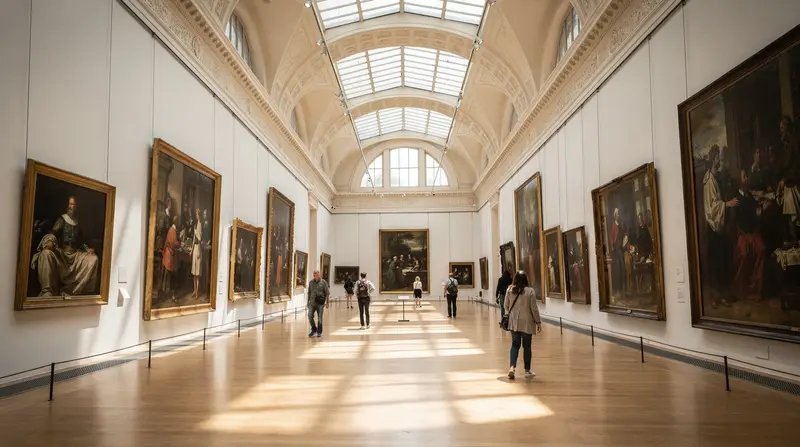
The original building was designed by Vilhelm Dahlerup and opened in 1897. Dahlerup also designed Tivoli Gardens and the Royal Danish Theatre; his style is confident late-19th-century eclecticism, with grand staircases, skylit galleries, and a weight and seriousness that feels appropriate to the collection.
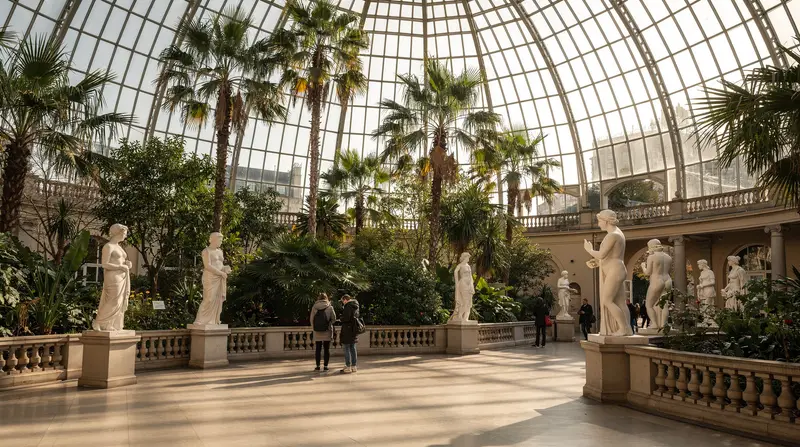
The 1906 extension, designed by Hack Kampmann, added the larger French art wing and — most importantly — the winter garden atrium that now connects the two buildings. The dome over the winter garden is one of the most atmospheric interior spaces in Copenhagen: 16 metres high, filled with palms and tropical plants, lit by the glass dome, with a small circular pool at the centre and café seating arranged among the greenery.
Allow yourself 10–15 minutes just to sit in the winter garden. It is genuinely one of the special spaces in the city.
The ancient Mediterranean collection: the Glyptotek’s real strength
Carl Jacobsen spent decades acquiring objects from Greece, Italy, and the Middle East. The resulting collection is the strongest holding of ancient Mediterranean art in Scandinavia, and it would be significant by the standards of any European museum.
Egyptian antiquities
The Egyptian section covers approximately 3,000 years of ancient Egyptian culture, from the early dynastic period through the Ptolemaic era. The highlights are:
- Portrait heads and royal statuary from multiple periods, many of them in very good condition
- Coffin sets and mummy cases with intact painted cartonnage — the decoration on these is detailed enough to allow close reading of the hieroglyphic texts
- Relief carvings from temple walls, displayed in a way that allows you to understand the artistic conventions
- Shabtis, canopic jars, and funerary objects in large numbers, giving an unusually comprehensive picture of elite Egyptian burial practice
The Egyptian section is in the basement of the 1906 building and is chronologically organised. Budget about 25–30 minutes if you find Egyptian antiquities genuinely interesting.
Etruscan collection
The Etruscan material at the Glyptotek is one of the most important outside Italy. The Etruscans inhabited central Italy (modern Tuscany and Lazio) from approximately the 8th century BCE until their absorption into the Roman world around 100 BCE. Their artistic culture was sophisticated and largely independent of Greek influence, though the two civilisations traded extensively.
The collection includes terracotta sarcophagi with life-sized reclining figures, bronze vessels, jewellery of remarkable technical quality, and painted funerary urns. The sarcophagus of a married couple from Cerveteri — a large terracotta piece showing two figures reclining at a feast — is one of the most frequently reproduced Etruscan objects in any collection.
Greek sculpture
The Greek galleries cover archaic (7th–6th century BCE) through Hellenistic (3rd–1st century BCE) sculpture. The standout pieces are the portrait heads — idealised in the Classical period but increasingly realistic in the Hellenistic era — and the collection of grave reliefs. The Glyptotek has several very good examples of Attic grave stelai from the 4th century BCE.
Roman portrait sculpture: the most important collection
The Glyptotek holds more than 100 Roman portrait busts — one of the largest and most consistent collections outside Rome and Naples. Roman portrait sculpture is distinctive among ancient art for its commitment to realism: these are genuine attempts at individual likeness, not idealised types. The museum has portraits spanning the Republican period through the late Empire, and the quality is consistently high.
If you have any interest in ancient portraiture, the Roman rooms alone are worth the 125 DKK admission. Even if you do not, spending 20 minutes looking at these faces from 2,000 years ago — warts, asymmetries, and all — is an arresting experience.
The French 19th-century collection: Gauguin, Rodin, Degas
Carl Jacobsen had a particular enthusiasm for French art of the 19th century, and the Glyptotek’s collection reflects this. The 1906 extension was built specifically to house acquisitions that had outgrown the original building.
Paul Gauguin
The Glyptotek has one of the more significant Gauguin holdings in Europe, including works from his Tahitian period. Gauguin’s large, flat areas of saturated colour and his synthesis of Polynesian iconography with European Post-Impressionist technique are well-represented. The paintings are displayed in a dedicated gallery with natural light; the quality of the originals is significantly higher than any reproduction suggests.
Auguste Rodin
The Rodin bronzes in the Glyptotek include major works: several figures related to the Burghers of Calais project, portrait busts of literary figures, and studies of the human form in motion. Rodin’s bronzes benefit from being seen in three dimensions — the play of light on the surface varies with your viewing angle in a way that makes moving around each piece important.
Edgar Degas
The Glyptotek’s Degas holdings include both paintings and bronze sculptures. Degas’s small bronze of the Little Dancer Aged Fourteen — the one with the original tutu attached — is represented here. The pastel drawings of dancers and domestic scenes are displayed in a gallery adjacent to the Gauguin room.
Other French artists
The collection also has significant works by Camille Pissarro, Paul Cézanne, and Claude Monet. The Cézanne landscapes are particularly strong. This section of the museum is often more crowded than the ancient collections — justifiably so — and benefits from a midweek morning visit.
The winter garden café
The café in the winter garden is one of the more pleasant places to eat or drink in central Copenhagen. It serves:
- Coffee and tea (50–65 DKK for a flat white or cappuccino)
- Danish pastries (45–60 DKK)
- Smørrebrød and light lunch plates (110–160 DKK)
- Cake and desserts (55–75 DKK)
These prices are high by the standards of a neighbourhood café but reasonable for a central Copenhagen museum. The setting — eating among the palms under the dome, surrounded by Rodin bronzes — compensates. The café is open during museum hours and occasionally accessible without museum admission; check the Glyptotek website for current policy.
The sculpture garden
Behind the 1906 building, a small sculpture garden (Glyptotekhaven) contains outdoor bronzes and is occasionally used for installations and events. It is open during museum hours and provides a quiet space between gallery time. In summer it has seating and is a pleasant 10–15 minute break.
Planning your visit
Address: Dantes Plads 7, 1556 Copenhagen V
Hours: Tuesday–Sunday 10:00–18:00 (Thursdays to 21:00). Closed Mondays.
Admission:
- Adults: 125 DKK (approximately 17 €)
- Children under 18: Free
- Tuesdays: Free (permanent collection)
- Copenhagen Card: Covered
Getting there:
- Central Station (Hovedbanegård): 7-minute walk along H.C. Andersens Boulevard
- Bus: Several routes stop at Rådhuspladsen, a 5-minute walk east
- Tivoli: 3-minute walk from the main Tivoli entrance
Photography: Permitted in permanent galleries without flash. Temporary exhibitions may restrict photography.
Cloakroom: Bags must be left in the free cloakroom at the entrance. Allow 5 minutes.
Accessibility: Lifts access all floors. The winter garden and main galleries are fully wheelchair accessible. The basement Egyptian section has lift access.
Carl Jacobsen’s acquisitions: a collector’s biography in objects
Understanding how Carl Jacobsen collected helps you understand why the Glyptotek’s collection is shaped as it is. Jacobsen was not an investor collecting for financial return, and he was not building a diplomatic collection for national prestige — he was a passionate, occasionally obsessive, private buyer who purchased what he loved and could afford at the time he encountered it.
His passion for ancient sculpture came first. He travelled repeatedly to Italy in the 1870s and 1880s, buying from dealers and from archaeological sites directly, at a period when the Italian art market was loosely regulated and major finds were still routinely sold into private hands. This is why the Glyptotek has such strong Etruscan and Roman material: Jacobsen was in Italy at the right moment, with money, taste, and a willingness to compete with British and American buyers.
His interest in French 19th-century art came later and was encouraged by his wife Ottilia and by a growing network of French contacts. The Gauguin paintings were purchased in the 1890s, when Gauguin’s work was still controversial and relatively affordable. The Rodin bronzes were acquired partly through a personal friendship between Jacobsen and Rodin, who corresponded over many years.
The result of this acquisitions biography is a collection that reads as a personality: strong in things Jacobsen loved (ancient Roman realism, Etruscan strangeness, the Post-Impressionist moment in France) and absent in things he was not drawn to (Renaissance painting, Baroque, the Dutch Golden Age, most of what fills the SMK). This makes the Glyptotek unusually coherent for a collection of its size — it has a point of view.
What to do around the Glyptotek
Tivoli Gardens is 3 minutes’ walk (entry from 110 DKK; Copenhagen Card covers it). The National Museum is a 10-minute walk north via Ny Vestergade. Copenhagen Central Station and the Strøget pedestrian shopping street are both within 10 minutes’ walk. Rådhuspladsen (City Hall Square) is 5 minutes east.
A logical route combining the area’s highlights: arrive at the Glyptotek when it opens (10:00), spend 2–2.5 hours inside, have lunch in the winter garden café, then walk to the National Museum (free) for an afternoon session. This covers two major museums without retracing steps and keeps you in a walkable area of the city. If you are building a full first day in the city, see Copenhagen in one day for how the Glyptotek slots in alongside Tivoli and Indre By, or the fuller best museums in Copenhagen roundup for how it stacks against the SMK and National Museum.
How the Glyptotek compares to Copenhagen’s other big museums
| Museum | Strength | Cost | Time needed |
|---|---|---|---|
| Ny Carlsberg Glyptotek | Ancient Mediterranean art + French 19th-century | 125 DKK, free Tuesdays | 2-2.5 hrs |
| SMK National Gallery | Danish art + European painting, Renaissance to now | Free permanent collection | 2-3 hrs |
| National Museum of Denmark | Danish and Nordic history, Viking artefacts | Free | 2-3 hrs |
| Designmuseum Danmark | Danish furniture and design | Around 115 DKK | 1.5-2 hrs |
None of these overlap meaningfully — visitors with a genuine interest in museums can comfortably do the Glyptotek plus one other on the same day, as the Glyptotek-to-National-Museum walk above shows.
Frequently asked questions about the Ny Carlsberg Glyptotek
Who was Carl Jacobsen and why did he build the Glyptotek?
Carl Jacobsen (1842–1914) was the son of Jacob Christian Jacobsen, who founded Carlsberg Brewery in 1847. Carl inherited both the brewery business and his father’s cultural ambitions. He began collecting ancient sculpture in the 1870s, initially for his private villa (Gl. Carlsberg), but the collection grew too large for private display. He donated it to the city of Copenhagen in 1888, and the Glyptotek building was constructed to house it. The word “glyptotek” comes from Greek, meaning a place where carved works (glyptos) are kept.
What is the most famous object at the Glyptotek?
No single object dominates the way the Sun Chariot dominates the National Museum, but the Roman portrait collection — particularly the bust believed to represent Julius Caesar — receives the most attention. The Etruscan sarcophagus of the reclining couple from Cerveteri is the most significant archaeological piece.
Is the Glyptotek suitable for children?
The permanent collection is not specifically designed for children, but older children (10+) with an interest in history or art typically engage well, particularly with the Egyptian mummies and the Etruscan sarcophagi. Children under 18 are free every day. The winter garden is genuinely enjoyable for all ages.
How does the Glyptotek compare to the SMK?
The Glyptotek and the SMK are very different museums with minimal overlap. The Glyptotek specialises in ancient Mediterranean art and French 19th-century painting and sculpture. The SMK focuses on European painting from the Renaissance through the 20th century and Danish art. Both are worth visiting; they complement rather than duplicate each other.
Are temporary exhibitions included in the ticket price?
Not always. Temporary exhibitions at the Glyptotek sometimes require an additional ticket (usually 30–60 DKK on top of the standard admission). This is not always well-advertised; check the website before your visit.
Is the Glyptotek open on public holidays?
It is open on most Danish public holidays, but hours may differ. The museum closes on Christmas Day (25 December) and New Year’s Day (1 January). Always verify hours on the Glyptotek website before visiting on a holiday.
Frequently asked questions — Ny Carlsberg Glyptotek: The Copenhagen Museum You Didn't Know You Needed
When is the Glyptotek free?
The permanent collection is free every Tuesday. Children under 18 are free every day. The rest of the week, entry is 125 DKK for adults. The Copenhagen Card also covers admission.How long does the Glyptotek take to visit?
Plan 2–2.5 hours for a focused visit covering the ancient Mediterranean and French 19th-century sections. Budget an additional 30 minutes if you want to sit in the winter garden café. Allow 3 hours for a thorough visit.Where is the Ny Carlsberg Glyptotek?
Dantes Plads 7, next to Tivoli Gardens and a 5-minute walk from Copenhagen Central Station. The H.C. Andersens Boulevard tram stop is directly outside.Who founded the Glyptotek?
Carl Jacobsen, son of the founder of Carlsberg Brewery, established the Glyptotek in 1897. He was an obsessive collector who personally acquired most of the original collection during his extensive travels in southern Europe and the Middle East.What is the winter garden at the Glyptotek?
The famous winter garden (vinterhaven) is a domed atrium linking the original 1897 building to the 1906 extension. Filled with palms, a small fountain, and a central marble pool, it functions as a meeting place, café seating area, and architectural highlight. It is the most Instagrammable space in any Copenhagen museum.Is the Copenhagen Card valid at the Glyptotek?
Yes. The Copenhagen Card covers full admission to the permanent collection. Temporary exhibitions may require an additional ticket — check when booking.Does the Glyptotek have a café?
Yes. The winter garden café serves coffee, pastries, smørrebrød, and light lunch plates. It is atmospheric and reasonably priced by Copenhagen standards (a coffee and pastry around 75–95 DKK). The café is accessible without paying museum admission on some days — check current policy.
Top experiences
Bookable activities with verified prices and instant confirmation on GetYourGuide.