Den Blå Planet Copenhagen: Guide to the National Aquarium Denmark
Copenhagen: The Blue Planet National Aquarium of Denmark
Is Den Blå Planet worth visiting?
Yes, particularly for families. Den Blå Planet (The Blue Planet) is the largest aquarium in Northern Europe, housed in an architecturally striking building near Copenhagen Airport on the M2 metro line. Entry is 185 DKK for adults, 110 DKK for children 3–11. The main ocean tank, touch pools, and Amazon section are the highlights. Allow 2–3 hours.
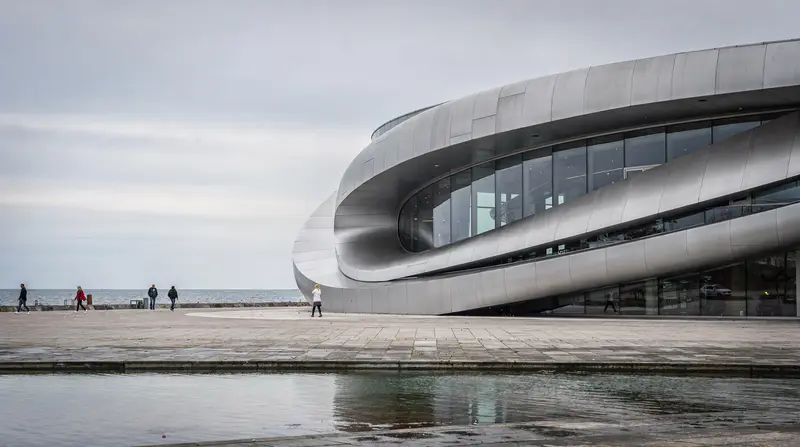
Den Blå Planet — The Blue Planet, formally the National Aquarium Denmark — opened in 2013 on the island of Amager, a short metro ride from central Copenhagen and a few hundred metres from the international airport. The building, designed by the Danish architecture firm 3XN, is shaped like a spinning whirlpool when seen from above, its five arms curving outward from a central hub. From the approach path, this is immediately apparent — the architecture announces itself.
Tickets for Den Blå Planet can be booked in advance via GetYourGuide, which is particularly useful for weekend visits when the box office queue can extend to 15–20 minutes.
| Where | Jacob Fortlingsvej 1, Kastrup (M2 metro) |
| Cost | 185 DKK adults / 110 DKK children 3–11 |
| Time needed | around 2–3 hours |
| Getting there | M2 metro to Kastrup, 2-minute walk |
| Best time | weekday mornings for the smallest crowds |
Getting there: the M2 metro
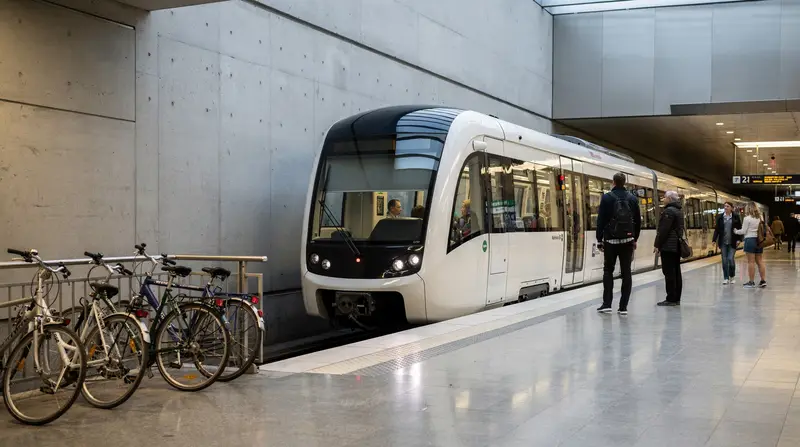
Den Blå Planet is one of the easiest major Copenhagen attractions to reach by public transport. The M2 metro line runs from the city centre (Vanløse/Frederiksberg at the west end, via Kongens Nytorv and then south toward the airport) with a station directly at the aquarium.
Practical details:
- Board the M2 towards Copenhagen Airport (Kastrup) at any central metro station
- Exit at Den Blå Planet station (note: the station name may appear on metro displays as Kastrup or with a combined label — verify on the Metro Copenhagen app before travelling, as naming conventions have changed over time)
- The aquarium is a 2-minute walk from the station exit
- Journey time from Kongens Nytorv: approximately 18 minutes
- Journey time from Copenhagen Central area (via Christianshavn): approximately 15 minutes
- Metro tickets: standard zone fares apply; the Copenhagen Card covers the journey
If you are flying in or out of Copenhagen Airport, Den Blå Planet is a logical stop on arrival or departure day — it is literally two metro stops from the airport terminal. With 2.5 hours to spare, you can visit the aquarium and return to the airport without stress.
The building: architecture worth noticing
The 3XN-designed building has won multiple architecture awards and is worth a few minutes’ attention before you go inside. The five curving wings extend from the central drum like arms of a starfish or blades of a turbine. The exterior cladding uses thousands of small metallic shingles that catch light differently depending on the angle and weather conditions.
The approach from the metro station takes you across a plaza with a canal view, giving you a full perspective on the building’s form. Inside, the circulation follows a circular logic — you move from section to section along curving corridors that follow the building’s arms. Natural light enters through clerestory windows in the main atrium; the gallery spaces themselves are darkened to prioritise the illuminated tanks.
The collection: what you will see
The main ocean tank
The largest exhibit at Den Blå Planet is the main ocean tank — 4.5 million litres of saltwater housing sand tiger sharks, large stingray and eagle ray species, schools of barracuda, and hundreds of reef fish species. The viewing tunnel beneath the tank gives you a 360-degree view of the water above and around you; the larger sharks move slowly overhead while smaller fish dart around them.
The tank is impressive. The sand tiger sharks (also called ragged-tooth sharks or grey nurse sharks) are the dominant draw — their open-mouthed appearance as they swim makes them visually arresting even for visitors who know that the species is not aggressive toward humans. Rays cruise the bottom; eagle rays occasionally perform slow spirals that draw gasps from visitors watching through the tunnel.
Budget 20–30 minutes in and around the main tank area. The viewing tunnel can be crowded; a weekday morning visit gives you the best chance of having the space to stand and watch without pressure.
Amazon section
The freshwater section devoted to the Amazon basin is one of the more distinctive parts of Den Blå Planet. The species mix is unusual for a Northern European aquarium:
- Arapaima (Arapaima gigas): One of the world’s largest freshwater fish, reaching up to 3 metres in the wild. Den Blå Planet holds several large specimens. Watching an arapaima surface to breathe (they are obligate air-breathers in addition to having gills) is a striking moment that surprises most visitors.
- Piranhas: Multiple tank habitats showing red-bellied piranhas in shoals. Their movement — fast, coordinated, explosive around feeding times — corrects the Hollywood impression of individual monsters and replaces it with something more interesting: a collective predatory organism.
- Giant river otters, turtles, and electric eels (exhibits vary — check current holdings at Den Blå Planet website)
Touch pools
The hands-on section is where younger children spend the most engaged time. The touch pools contain:
- Small smooth-hound sharks and skates/rays: Visitors can touch these under staff supervision. The sensation is different from what most people expect — smooth, not slimy, with the muscular movement of live animals clearly felt.
- Starfish: Multiple species in a shallow pool accessible to small children
- Sea urchins and other invertebrates (vary by season)
Staff are present at the touch pools throughout the day to supervise interactions and provide information. Children under 10 must be accompanied by an adult.
Nordic seas section
An often-underappreciated section of the aquarium covers the marine life of Nordic waters — the North Sea, the Baltic, and the Norwegian fjords. This includes:
- Atlantic wolffish: An intimidating-looking deep-water species with distinctive protruding teeth, displayed in tanks that replicate their rocky habitat
- Halibut and other flat fish: Enormous specimens in appropriately scaled tanks
- Norwegian lobster (langoustine) and other crustaceans
- Cold-water coral and deep-sea species
For visitors used to tropical aquarium displays, the Nordic section offers a different visual register — darker water, rockier environments, animals adapted to cold and pressure. It is worth spending 20 minutes here even if it is not the main draw.
Freshwater rivers of the world
A section covering rivers across multiple continents: Nile, Congo, Mekong, Ganges. Each habitat is designed to represent the specific water conditions, lighting, and species mix of the original environment. This section is less dramatically impressive than the ocean tank but provides good ecological context.
Tips for families
Timing: Open when the aquarium opens (typically 10:00) on weekdays for the smallest crowds. Saturday and Sunday afternoons in summer are the busiest periods — the touch pools in particular can be two or three children deep at the edge.
Children’s facilities: Baby-changing rooms are available on multiple floors. The aquarium café sells children’s meal options. There is a dedicated children’s activity area in some sections.
Duration: 2 hours is comfortable for most families with children under 10. Older children and adults who are genuinely interested in marine biology may want 2.5–3 hours.
What to skip if time is short: The temporary exhibition space (varies — check what is on) and the deepwater Nordic section if the children are already getting tired. The main ocean tank, Amazon section, and touch pools are the non-negotiable core.
Honest assessment for adults without children
Den Blå Planet is excellent. It is also primarily designed to be experienced by families, and the density of children on a Saturday afternoon is significant. If you are visiting as an adult couple or solo, a weekday morning visit transforms the experience: the main tank viewing tunnel without a crowd, the touch pools without a queue, the overall atmosphere more meditative.
The aquarium is genuinely strong on its biological holdings. The arapaima, the shark tunnel, and the Nordic cold-water section offer things you will not see in most European aquariums. But if you are weighing Den Blå Planet against the National Museum or the Glyptotek for a limited visit, the cultural institutions should take priority unless you specifically enjoy marine life.
Practical information
Address: Jacob Fortlingsvej 1, 2770 Kastrup
Hours: Monday 10:00–17:00; Tuesday–Sunday 10:00–21:00 (check website — seasonal variation applies)
Admission:
- Adults (12+): 185 DKK (~25 €)
- Children 3–11: 110 DKK
- Children under 3: Free
- Copenhagen Card: Covered (adults and children)
Getting there: M2 metro to Den Blå Planet / Kastrup station, approximately 15–20 minutes from the city centre. Walk 2 minutes to the entrance.
Booking in advance: GetYourGuide tickets are recommended for weekend and school holiday visits to avoid box office queues.
Photography: Permitted throughout. Flash is discouraged near sensitive species but the aquarium does not enforce a blanket no-flash policy.
Accessibility: Fully wheelchair accessible with lifts, accessible toilets, and a clearly signposted accessible route through all exhibits.
The 3XN building: architecture in detail
The building that houses Den Blå Planet was designed by the Copenhagen-based architecture firm 3XN (Gitte Andersen, Jan Ammundsen, Kim Herforth Nielsen) and completed in 2013. It won the World Architecture Festival award for best building of the year in its category.
The design logic starts with the programme — an aquarium is fundamentally about water, and specifically about the relationship between human movement and aquatic movement. 3XN’s response was to design a building in which the circulation paths spiral outward from a central point, creating a plan that resembles a vortex or whirlpool when seen from above. The five arms extend and curve; visitors move along these arms through alternating enclosed tank environments and transitional spaces.
From the exterior, the most noticeable feature is the cladding: thousands of small aluminium shingles arranged in rows, their angles varying slightly to catch light differently across the surface of the facade. In early morning or late afternoon light, the building appears almost to shimmer. In overcast conditions it reads as a muted grey-silver. The cladding is designed to reference fish scales, though the connection is suggestive rather than literal.
Inside, the central atrium rises through the full height of the building with a glazed roof that provides natural light to the entrance and circulation areas. The gallery arms are darkened — necessary for the health of the animals and for the visual contrast that makes the tanks readable — and move visitors between the scale of the main atrium and the intimate scale of individual tank environments.
Conservation and education at Den Blå Planet
Den Blå Planet is not purely a visitor attraction. It operates as a research and conservation facility with a particular focus on North Atlantic and Nordic marine species. The aquarium maintains breeding programmes for several threatened species, including European eels (Anguilla anguilla, now critically endangered in most of their range) and several freshwater species under pressure from habitat loss.
The conservation work is not prominently marketed to casual visitors but is visible if you look for it — information panels in the Nordic seas section describe the eel breeding programme, and staff in that area are knowledgeable about the underlying conservation context.
Educational programming runs year-round for school groups from across Denmark. The aquarium’s education department works with the Danish curriculum on marine biology, ecology, and environmental science. For visitors interested in the science behind the displays, the Nordic seas section staff are particularly willing to talk in depth.
Visiting with a baby or toddler
Den Blå Planet is genuinely usable with infants and toddlers in a way that many museum environments are not. Specific practical points:
- Prams and pushchairs (strollers) are permitted throughout the accessible route
- Baby-changing facilities are available on multiple floors in clearly signed locations
- The café has high chairs and children’s menu options
- The main aquarium route is relatively short and can be completed in 70–80 minutes if a child is getting tired
- The touch pools are fully accessible to a toddler accompanied by an adult
The large ocean tank viewing tunnel can be overstimulating for some very young children — the scale, movement, and darkness are pronounced. Most toddlers find it exciting; some find it frightening. Parent discretion applies.
The aquarium’s shop sells a well-edited range of marine-themed children’s books, toys, and stuffed animals. It is not a pure souvenir outlet — the selection skews toward educational materials.
Seasonal variation at Den Blå Planet
Den Blå Planet’s indoor exhibits do not change dramatically by season, but the visitor experience around them does. Summer (June–August) brings the heaviest footfall, particularly from Danish families on school holidays and international tourists combining a visit with the nearby beaches; queues at the ray touch pool and busier corridors are the main friction. Shoulder seasons (April–May, September–October) offer the best balance — full opening hours, comfortable crowd levels, and reasonable weather for the walk from Kastrup station. Winter (November–March) is quietest by far, though Monday’s reduced hours apply and the outdoor promenade seating at the café is less appealing in the cold.
Weekday mornings are consistently the best time regardless of season — a fact that holds even in peak summer, when arriving at opening (typically 10:00) can mean having the ocean tunnel largely to yourself for the first 20–30 minutes before coach groups and later arrivals build up.
A note on the outdoor summer area
In warmer months, Den Blå Planet sometimes opens a limited outdoor waterfront area adjacent to the main building, offering direct water access and additional seating with views across the Øresund. This is weather-dependent and not guaranteed on any given visit, but worth checking on arrival if you have young children who would benefit from a break outdoors between the darker indoor exhibition halls.
What sets Den Blå Planet apart from other European aquariums
Beyond scale, Den Blå Planet’s specific strength is the breadth of its regional coverage — few aquariums combine a genuinely strong tropical ocean tank with an equally serious Nordic cold-water section and a distinctive Amazon freshwater collection under one roof. Visitors who have seen a major tropical aquarium elsewhere (Lisbon’s Oceanário, for example) often find the Nordic seas section the most novel part of a Den Blå Planet visit, since cold-water displays of this quality are relatively rare internationally.
The conservation angle — active breeding programmes for critically endangered European eels among other species — also distinguishes it from purely entertainment-focused aquariums, though this is not heavily marketed to casual visitors, and staff in the Nordic seas section are usually happy to discuss it in more depth if you ask.
Combining Den Blå Planet with the rest of your trip
Den Blå Planet sits at the edge of the M2 metro line, which makes it easy to fold into a wider day rather than treating it as an isolated outing. Families already covering the Copenhagen with kids guide will find Den Blå Planet slots naturally alongside Tivoli and Experimentarium as one of the three core paid family attractions in the city. The Den Blå Planet with kids guide goes further into age-by-age tips if you are travelling with very young children.
If you are flying out of Copenhagen Airport the same day, the Copenhagen airport to city centre guide explains the M2 logistics in both directions — useful for timing a final aquarium visit around a flight. For visitors weighing up whether to buy individual tickets or a multi-attraction pass, the Copenhagen Card worth it guide has the full attraction-by-attraction breakdown, and the general getting around Copenhagen guide covers the wider public transport network beyond the M2.
For a broader sense of what else is worth doing with children in the city, things to do in Copenhagen places Den Blå Planet in context against Tivoli, the Zoo, and the museums.
Are there marine mammals at Den Blå Planet?
No. Den Blå Planet does not hold dolphins, seals, or whales. The collection focuses on fish, rays, sharks, invertebrates, and some reptiles. If marine mammals are the primary draw, a visit to a facility that keeps them is necessary — though none exist in the Copenhagen area.
Is Den Blå Planet worth it with the Copenhagen Card?
If you have the Copenhagen Card and are visiting with children, yes — the card covers the full family admission (typically a saving of 185 + 110 DKK = 295 DKK for an adult-child pair) and the metro journey. For adults without the card, the 185 DKK ticket is fair value for a 2.5-hour visit in a world-class facility.
What is the best day and time to visit Den Blå Planet?
Weekday mornings (Tuesday–Friday, 10:00–12:00) are the quietest. Monday is also possible but has slightly reduced hours. Avoid Saturday afternoons during school holidays and the summer months of July and August if you are sensitive to crowds.
Can I eat at Den Blå Planet?
The aquarium has a café serving hot food, sandwiches, and drinks at standard Copenhagen museum café prices (a meal around 130–170 DKK, coffee 55–65 DKK). The café has views over the water near the entrance. There is also a small snack point near the touch pool area.
How far is Den Blå Planet from Copenhagen Airport?
Two M2 metro stops. Walking distance is approximately 1.5 km along a pedestrian path but is not recommended with luggage. The metro is the practical option; the journey takes 3–4 minutes.
Is Den Blå Planet good for a rainy day?
Yes — it is entirely indoors and the experience is unaffected by weather. It is one of Copenhagen’s better rainy-day options for families.
Frequently asked questions — Den Blå Planet Copenhagen: Guide to the National Aquarium Denmark
How do you get to Den Blå Planet from Copenhagen?
Take the M2 metro from the city centre towards the Airport (Kastrup). Exit at Den Blå Planet station (or Kastrup if it is shown as the alternative name — verify current station name on the metro app). The aquarium is a 2-minute walk from the metro. Journey from Copenhagen Central area takes approximately 15–20 minutes.How much does Den Blå Planet cost?
Adults: 185 DKK. Children 3–11: 110 DKK. Children under 3: Free. The Copenhagen Card covers adult and child admission. Booking in advance via GetYourGuide can save queue time.Is Den Blå Planet covered by the Copenhagen Card?
Yes. The Copenhagen Card covers full admission to Den Blå Planet for adults and children. The M2 metro journey is also covered by the Copenhagen Card.Is Den Blå Planet good for families?
It is designed for families and is the best family museum in Copenhagen by most measures. Touch pools for hands-on interaction, a dedicated children's section, and highly visual exhibits make it engaging for children from about 4 years old. The building's dramatic architecture is also impressive for older children.How long does Den Blå Planet take?
2–3 hours for a thorough visit covering all sections. Families with young children may be satisfied in 2 hours; aquarium enthusiasts may want 3+. Budget 2.5 hours as a planning figure.What animals can you see at Den Blå Planet?
The collection covers approximately 450 species including sand tiger sharks, large rays, piranhas, arapaima, moray eels, octopus, seahorses, tropical reef fish, freshwater species from the Amazon and African great lakes, and a touch pool with starfish and small ray species. There are no marine mammals.Is Den Blå Planet the largest aquarium in Europe?
Den Blå Planet is marketed as the largest aquarium in Northern Europe. The L'Oceanogràfic in Valencia and the Georgia Aquarium in the United States are larger globally. The distinction is important: it is a world-class aquarium, but the 'largest in Northern Europe' designation reflects Scandinavian geography rather than global scale.
Top experiences
Bookable activities with verified prices and instant confirmation on GetYourGuide.