Den Blå Planet with kids: the national aquarium honestly reviewed for families
Copenhagen: The Blue Planet National Aquarium of Denmark
Is Den Blå Planet worth visiting with children?
Yes — it is consistently one of the best family attractions in the Copenhagen area. The ocean walk-through tunnel, the ray touch pool, and the vivid tropical section hold children's attention reliably from age 2 upward. Allow 2–3 hours. Adults 185 DKK, children 3–11 approximately 100 DKK, under-3 free. The Copenhagen Card includes entry. Combine with Amager Strandpark beach (10 minutes by metro) for a full day out.
Den Blå Planet entry tickets are available online and include timed entry — worth booking on school holiday days when the aquarium reaches visitor capacity by midday.
| Where | Kastrup, M2 metro (near the airport) |
| Cost | around 185 DKK adults / 100 DKK children 3–11 |
| Time needed | 1.5–3 hours depending on age and pace |
| Getting there | M2 metro to Kastrup, 10-minute walk |
| Best time | weekday mornings, avoid Saturday afternoons |
Den Blå Planet: what it is and why it works for families
Den Blå Planet — The Blue Planet — is the national aquarium of Denmark. It opened in 2013 in a purpose-built facility at Kastrup, adjacent to Copenhagen Airport, replacing the original aquarium that had operated in Charlottenlund since 1939.
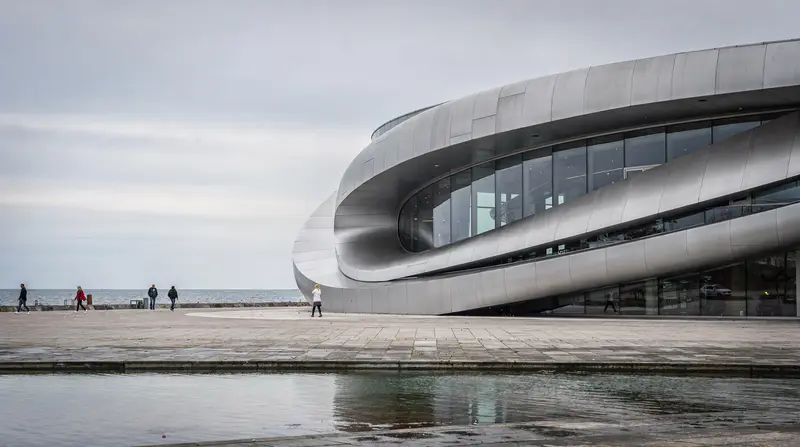
The building is the first thing most visitors notice: a 3XN-designed spiral structure with an aluminium scale-like exterior that references the form of a whirlpool. It is one of the more striking pieces of public architecture in the Copenhagen area. Adults with a design interest find it worth looking at from outside before going in — the building photographs well from the exterior promenade.
Inside, the aquarium covers 10,000 square metres and houses more than 20,000 animals across 53 tanks. It spans freshwater and marine environments from Danish fjords and rivers to tropical reefs and open ocean. For families, the practical question is how well the experience holds children’s attention — and on this, it delivers consistently across a wide age range.
The honest limitation: Den Blå Planet is not a large aquarium by international comparison. A purposeful family covering every section will complete the visit in 1.5–2 hours. Families who dawdle, read exhibit panels, and revisit the ocean tunnel multiple times will extend this to 3 hours. If you are comparing it to a major world aquarium (Monterey Bay, Georgia Aquarium, Okinawa Churaumi), it is smaller in scale. Within the Copenhagen area and Scandinavia, it is the best aquarium available.
Getting there from central Copenhagen
The M2 metro line runs directly from the city centre to Kastrup — the same line and direction as Copenhagen Airport, one stop before the terminal.
Journey times:
- From Kongens Nytorv: approximately 20 minutes
- From Copenhagen Central Station (interchange at Vanløse then M1, or direct from Nørreport): approximately 25–30 minutes
- From the Airport (Terminal 3): 3 minutes on M2 toward Vanløse
From Kastrup station to Den Blå Planet: 10-minute walk along a pedestrian path that is clearly signed. The path is flat for most of its length with a gradual ramp. It is fully pushchair-accessible with no stairs on the route if you use the metro level exits. In summer, seasonal bike rental stations operate at the station.
Parking: A car park exists at the aquarium for approximately 25–30 DKK per hour. On peak summer days, it can fill by mid-morning. The metro is the practical choice unless you are traveling with equipment that makes it necessary.
Combining with the airport: If your family is flying home from Copenhagen Airport on the same day, a final visit to Den Blå Planet is logistically convenient — the aquarium is 2km from the terminal. Store luggage at the airport, visit the aquarium, return to the terminal.
Section by section: what to see with children
The ocean tunnel
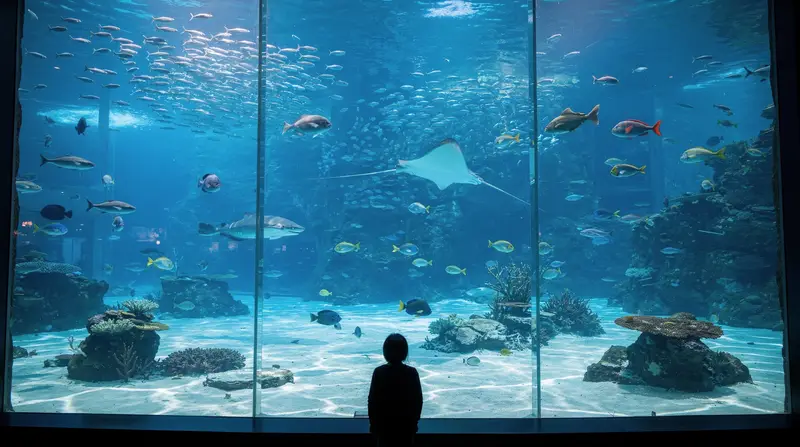
The ocean tunnel is the centrepiece of Den Blå Planet and the section that justifies the visit for most families. It is a walk-through acrylic tunnel — approximately 10 metres long, 4 metres wide — embedded within a 3-million-litre open ocean tank. Overhead and to both sides: sand tiger sharks (typically 6–8 individuals), large rays, shoals of fish, and various open-ocean species.
The scale of the animals is the primary impact. Sand tigers reach 2–3 metres; their near proximity through the glass consistently produces strong reactions in children and adults. The tunnel moves at walking pace — there is no conveyor belt. Families typically walk through once, then return against the flow of traffic for a second viewing from the opposite direction.
For toddlers: The low position of the tunnel (children look straight ahead at shark-level) means very young children do not need to crane their necks. Most toddlers aged 2–4 stop moving and stare — this is one of the most reliable moments of genuine awe available in the Copenhagen family experience.
For older children: The information panels adjacent to the tunnel explain shark anatomy and ecology at a level appropriate for ages 8–12. Good for children with a nature interest.
The ray touch pool
Located in the coldwater section near the aquarium entrance, the ray touch pool is a shallow open tank containing small thornback rays and other species that are safe for supervised touching. The pool is accessible at waist height for adults (knee height for young children on the provided stepping stools).
How it works: Rays swim continuously around the pool. Visitors dip one or two fingers in the water — not grabbing — and let rays pass by them. The sensation of ray skin (smooth on top, rough underneath) is distinctive and memorable. Staff supervise the pool and instruct on correct technique.
Queues: On peak school holiday days, the ray pool attracts the longest queue in the aquarium — 15–25 minutes is typical in July. Go directly to the ray pool early in the visit to avoid the worst waits.
Age: Children from approximately age 3 typically manage the touch pool without anxiety. Younger toddlers may find the splashing water and close animal proximity intense — gauge by your individual child’s sensitivity.
The tropical coral reef section
The tropical section occupies a large central space in the aquarium and contains multiple tanks with vivid coral reef species: clownfish, lionfish, napoleonfish, porcupinefish, and dense schooling species in vivid colours. Tank sizes range from walk-past panels to a large central showpiece approximately 3m × 3m × 3m.
This is the section with the most immediately recognisable animals for children who have watched nature documentaries — the “Finding Nemo” effect of seeing clownfish in anemones, and the dramatic visual impact of lionfish and their poisonous spines, which are explained clearly on the panels.
For young children: The colours and movement of schooling fish are visually compelling from age 2. This is typically the section where toddler attention is highest.
The freshwater section (Danish rivers and lakes)
The freshwater section covers pike, perch, trout, eels, and other species from Danish freshwater environments. This section is less visually dramatic than the tropical or ocean sections but is educationally relevant for Danish natural history.
For older children with nature interests: Pike are large, predatory, and impressive when displayed in large tanks. Children with an interest in fishing or ecology find this section engaging. For children primarily interested in dramatic colours or scale, this section is the weakest part of the aquarium.
The jellyfish section
A row of backlit circular tanks containing jellyfish in various species is positioned near the centre of the aquarium. The slow, pulsing movement of jellyfish in lit tanks is visually striking and calming — an effective counterpoint to the more intense ocean tunnel.
Ages: All ages. Toddlers and young children are usually transfixed by the rhythmic movement. Good as a quieter interlude if children are becoming overwhelmed.
The rainforest section
A smaller section covering freshwater rainforest environments — piranha, large freshwater turtles, arapaima (one of the world’s largest freshwater fish, up to 3 metres), and South American species. The arapaima is the highlight — seeing a fish the size of a person in a tank produces consistent surprise.
Logistics for families
Pushchair access
Den Blå Planet is fully accessible for pushchairs and wheelchairs. Corridors are wide throughout, designed to accommodate visitor flows in both directions even at peak times. Lifts connect floors. No sections of the aquarium require pushchair parking — you can push through the entire visit.
Stroller storage is available at the entrance if you prefer to leave it there.
The café
The on-site café serves hot meals, sandwiches, and snacks at prices consistent with museum catering (main dish 150–200 DKK, coffee 40–55 DKK, children’s lunch 85–95 DKK). Quality is adequate but not notable. The café has outdoor seating in summer on the promenade facing Øresund — the view is good.
Bringing food is simpler here than at LEGOLAND — there is no official prohibition, though the management prefers you use the café. A packed lunch eaten on the outdoor promenade is entirely practical.
Shop
The aquarium shop sells marine biology books, stuffed toy versions of the aquarium’s animals, and LEGO Ocean sets. Standard museum shop quality at above-supermarket prices. Children often want to purchase a ray or shark plush (approximately 120–200 DKK); managing expectations before entering is wise.
Combining Den Blå Planet with other attractions
Amager Strandpark beach
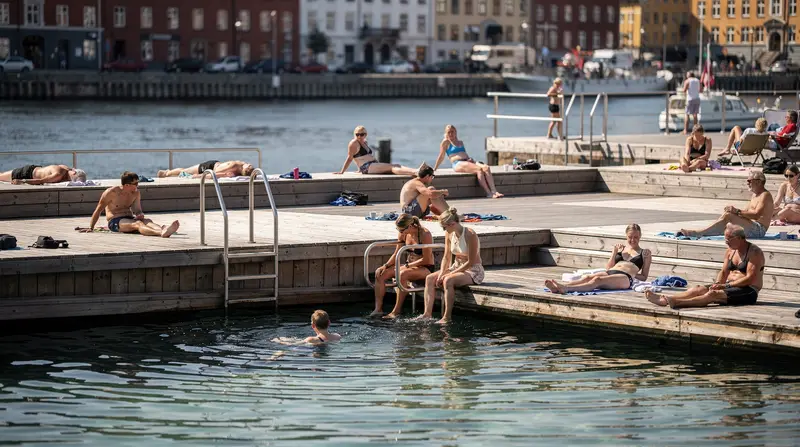
The closest beach to the aquarium is Amager Strandpark — Copenhagen’s 5km artificial beach on the Øresund coast, reachable by M2 metro (one stop south of Kastrup, to Amager Strand station). The inner lagoon is shallow (0.5–1.5m) and suitable for young children. In July and August, water temperatures reach 19–22°C.
Practical family day: Morning at Den Blå Planet (10:00–13:00), lunch at the café or packed lunch on the promenade, then M2 to Amager Strandpark for an afternoon on the beach (13:30–17:00). This covers two significant experiences without requiring a car and returns you to central Copenhagen by early evening.
Copenhagen Airport observation area
If you are flying out the same day, the airport observation terrace (Terminal 3, free access) gives children a close view of aircraft takeoffs and landings. Not a major attraction but functional for a 30-minute wait between the aquarium and check-in.
Is it worth combining with the Copenhagen Card?
The Copenhagen Card includes Den Blå Planet entry along with 80+ other attractions and unlimited metro travel. The card price (24h, 48h, 72h, 120h) depends on duration.
Calculation for families: If your family plans to visit Den Blå Planet plus three or more other Copenhagen Card attractions (Experimentarium, Rosenborg Castle, the National Museum, etc.) in the same day or two, the card pays for itself. The unlimited metro travel, which eliminates single-ticket purchase for each journey, adds significant value over a multi-day visit.
Tivoli Gardens is NOT included on the Copenhagen Card — this is the most important exception for families to note.
The Copenhagen Card worth it guide has a full attraction-by-attraction value calculation.
Managing group size and timing with multiple children
Families with more than two children benefit from a slightly different approach than the standard two-adult, two-child visit assumed by most pricing examples. If you have three or more children spanning a wide age range, consider splitting the group briefly at the ray touch pool and the tropical section — older children often want to linger and read the information panels, while toddlers are ready to move on after a few minutes. One parent can hold back with the toddler at the jellyfish tanks (calm, low-stimulation, endlessly watchable) while the other continues with older children through the Amazon and Nordic sections, then swap.
Nap timing matters more here than at many attractions, since the aquarium’s darkened corridors and gentle background sound can genuinely send an overtired toddler to sleep in a stroller — not a bad outcome if it happens naturally, but worth planning around if you specifically want your child awake for the ocean tunnel, which is the section most likely to produce a memorable reaction.
Seasonal considerations for family visits
Summer school holidays (late June through early August) bring the heaviest crowds, particularly at the ray touch pool, where queues can build to 20–25 minutes by early afternoon. Families visiting during this period should aim to arrive at opening and head directly to the touch pool before exploring the rest of the aquarium in a more relaxed order. Spring and autumn weekdays offer a noticeably calmer experience with the same exhibits and none of the queueing — worth prioritising if your travel dates are flexible and children are not tied to a school calendar.
Winter visits are the quietest overall, though check the Monday reduced-hours schedule before planning around it, and dress warmly for the walk from Kastrup station, which is exposed to wind off the water — a genuinely useful tip for families pushing a stroller along the exposed pedestrian path in December or January, when a windproof cover for the stroller is worth packing.
Fitting Den Blå Planet into a wider family itinerary
Den Blå Planet is one of three attractions — alongside Tivoli and Experimentarium — that anchor most family visits to Copenhagen; the Copenhagen with kids guide covers all three together with a realistic multi-day budget. For families who want more depth on the aquarium’s exhibits beyond what fits here, the Den Blå Planet aquarium guide covers the 3XN building’s architecture and the full species list section by section.
The Tivoli with kids guide covers ride-by-ride height restrictions if Tivoli is next on your list, and the best family activities in Copenhagen rounds up alternatives for days when the aquarium is already ticked off.
If you are visiting in the warmer months, pairing the aquarium with Amager Strandpark works especially well — see the Copenhagen in summer guide for water temperatures and beach logistics beyond the brief mention above.
Frequently asked questions about Den Blå Planet with kids
How much does Den Blå Planet cost?
Adults approximately 185 DKK, children 3–11 approximately 100 DKK, under-3 free. Family ticket (2+2) approximately 510 DKK. The Copenhagen Card includes entry.
How do I get to Den Blå Planet from the city centre?
M2 metro to Kastrup station, then 10 minutes’ walk. Journey from Kongens Nytorv takes approximately 20–25 minutes. Fully pushchair-accessible route.
What is the best section for young children?
The ocean tunnel (sharks overhead and to the sides) and the ray touch pool (supervised handling). Toddlers typically react most strongly to the ocean tunnel. The tropical coral reef section is the most visually vivid.
Can toddlers enjoy Den Blå Planet?
Yes — from age 2. The aquarium is pram-accessible throughout, nothing is frightening for young children, and the ocean tunnel and bright tropical fish produce strong reactions even in very young children. Most families with under-3s find 1.5 hours sufficient.
Is Den Blå Planet included on the Copenhagen Card?
Yes. The Copenhagen Card covers entry along with 80+ other attractions and all public transport.
What are the sharks like at Den Blå Planet?
Sand tiger sharks — large (2–3m), visible through walk-through tunnel glass. Impressive and dramatic but not frightening in context; children typically find them exciting.
Are there any downsides to Den Blå Planet?
It is smaller than it appears — cover everything in 1.5–3 hours depending on pace. The ray touch pool can have 15–25 minute queues on peak days. The café is adequate but unremarkable. For a major world aquarium comparison it is modest in scale.
Frequently asked questions — Den Blå Planet with kids: the national aquarium honestly reviewed for families
How much does Den Blå Planet cost?
Entry prices as of 2026: adults approximately 185 DKK; children aged 3–11 approximately 100 DKK; children under 3 free. A family ticket (2 adults + 2 children aged 3–11) costs approximately 510 DKK. The Copenhagen Card includes entry to Den Blå Planet. There is no free or reduced day for non-Copenhagen Card visitors.How do I get to Den Blå Planet from the city centre?
Take the M2 metro to Kastrup station. From the station, the aquarium is a 10-minute walk along a clearly marked pedestrian path — mostly flat with a brief ramp section. Alternatively, from Kastrup station there is a seasonal bike path to the entrance. The journey from Kongens Nytorv (central Copenhagen) takes approximately 20–25 minutes. No car parking is needed — the metro is the practical choice.What is the best section of Den Blå Planet for young children?
The ocean tunnel (walk-through acrylic tunnel surrounded by large pelagic fish and sharks) is the most impressive section for children of all ages — toddlers are typically mesmerised. The ray touch pool (shallow supervised pool where rays swim around visitors' hands) is the most memorable hands-on experience. The tropical coral reef section, with dense colour and schooling fish, is popular with ages 3–8.Can toddlers enjoy Den Blå Planet?
Yes — in fact, very young children (ages 2–4) often react more intensely than older children to the sensory experience of the ocean tunnel and the vivid fish colours. There is nothing at Den Blå Planet that is frightening or inappropriate for toddlers. The aquarium is fully pram-accessible (wide corridors, lifts where needed). The main limitation for toddlers is concentration span — most families with children under 3 find 1.5–2 hours sufficient.Is Den Blå Planet included on the Copenhagen Card?
Yes. The Copenhagen Card (24h, 48h, 72h, 120h options) includes entry to Den Blå Planet along with 80+ other attractions and unlimited public transport. For families visiting multiple attractions in 24–48 hours, the card is typically worth the cost. Check current card prices on the Copenhagen Card website before purchasing.What are the sharks like at Den Blå Planet?
The main aquarium at Den Blå Planet contains sand tiger sharks (Carcharias taurus) — large, impressive animals with visible teeth. They are among the most striking visual elements in the ocean tunnel. Sand tigers are not aggressive toward humans in aquarium conditions and are routinely maintained in large mixed-species tanks worldwide. The aquarium's shark section is well-explained with information panels on shark ecology and conservation. Children typically find them exciting rather than frightening when seen through glass.Are there any downsides to Den Blå Planet?
The aquarium is smaller than it appears from outside — it can be covered in 1.5 hours by a purposeful visitor, which can feel brief for the entry price. The outdoor Blue Planet summer area (access to the water, Øresund beachfront) adds value in summer but is not always open. On busy school holiday days the ray touch pool can have queues of 15–20 minutes. The café on site is adequate but unremarkable.
Top experiences
Bookable activities with verified prices and instant confirmation on GetYourGuide.