Hygge: What It Really Means (And What the Candle Shops Won't Tell You)
I Arrived Expecting Candles. I Found Something Else.
The airport shop near the gate had a hygge starter kit. Scented candle, woollen sock motif, a small notebook with a heron on the cover. It cost 285 DKK and had almost certainly never been touched by a Dane in any sincere capacity. I bought nothing and took the metro into town.
Hygge — pronounced somewhere between “hoo-gah” and “hew-gah”, never “higgy” — has been one of the most exported Danish words of the last decade. Books, seminars, branded throw pillows. The global appetite for it is real and understandable: the idea that cosiness, warmth and togetherness can be elevated to a life philosophy is genuinely appealing. But somewhere between Denmark and the international lifestyle market, something essential got lost.
So what does hygge actually mean?
| Pronunciation | Between “hoo-gah” and “hew-gah” |
| Requires | People, unhurried time, warm light |
| Does not require | Money, candles, curated photos |
| Best season | Winter (though summer has its own version) |
| Where to find it | See our hygge in Copenhagen guide for a mapped list |
Not a Noun. More of a Verb.
The first thing to understand is that hygge is not a product category. Danes do not buy hygge. They do it. Or rather, it happens — often unexpectedly — when the conditions are right. It is closer to a quality of an experience than a thing you can possess.
The word itself is related to the Old Norse word for wellbeing, comfort, and the sense of being sheltered from harm. In everyday Danish usage it means something like the warmth of a good moment shared with people you trust, in a space that feels safe and unhurried. A kitchen table with the right people around it. A living room where no one is performing. The feeling at 9 p.m. on a winter Tuesday when the wine is open and the conversation has stopped being polite and become real.
You will notice what is absent from that description: products. Also absent: performance, social media, ambience as spectacle.
The Light Is Not Incidental
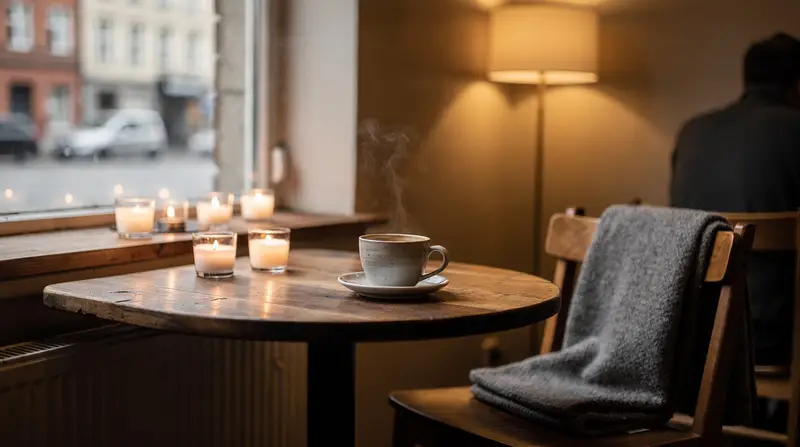
One thing the lifestyle industry has got right is the lighting. Danes are genuinely particular about it — soft, warm, layered. No overhead fluorescents in a Danish home if it can possibly be avoided. Candles everywhere from October to March, not as decoration but as necessity in a country where winter darkness arrives early and stays late.
Copenhagen sits at roughly the same latitude as Edinburgh and the southern tip of Alaska. By December, the sun rises around 8:30 and sets by 15:45. Those who have not experienced northern European winter often underestimate how this shapes culture. The darkness is not something Danes are merely tolerating. Hygge, in part, is how they answer it — by making indoors genuinely better than outdoors, by turning the long dark into an occasion.
This is also why hygge is somewhat less essential in summer. Danish summer, with its long evenings and light that lingers until nearly 10 p.m., has its own quality entirely — outdoor dinners, harbour swimming, the northern July that feels almost miraculous. Hygge in its deepest form is a winter practice.
What Hygge Is Not
It is not solitary. You can have a hyggelig (the adjective form) evening alone, technically, but the concept at its most fully realised requires other people. Connection is the point. Sitting in your own flat watching television is comfortable; it is not really hygge.
It is not Instagram-ready. The curation of aesthetic cosiness for external consumption is almost the opposite of what hygge involves. The moment you start arranging the candles for a photograph, you have exited the hyggelig state. Danes are not unconscious of this contradiction — it comes up in conversation when the topic of the hygge export industry arises, usually with a particular brand of quiet, dry humour.
It is not expensive. Some of the most hyggelig settings in Copenhagen are modest: a bakery where you sit at a wooden table with a coffee and a cardamom bun, no pressure to leave; a neighbourhood pub where the same people appear every week; a picnic on the grass at Frederiksberg Have with supermarket wine and bread. The money is irrelevant. The unhurriedness is everything.
It is not exclusively Danish. The Norwegians have koselig. The Swedes have mysig. The German Gemütlichkeit covers some of the same ground. Even in English, you can experience hygge without having a word for it — you have simply been calling it something else. What the Danes have done is codify it, name it, build it into their social architecture.
Where to Actually Feel It in Copenhagen
You will not find genuine hygge in a shop that sells hygge merchandise. You will find it, if you are paying attention, in a few specific places.
Torvehallerne on a grey morning. The covered market off Nørreport station is busy on weekends but quieter on weekday mornings. Sit at one of the counter stools inside with a coffee from one of the good roasters there. Watch the city move past. Nobody will rush you.
A neighbourhood bakery in Nørrebro or Vesterbro. Not the famous ones with queues and newspaper coverage — the local ones where the cardamom rolls are 22 DKK and the table has a crack in it and the same older gentleman appears to read the newspaper every morning. These places exist in every neighbourhood. Look for the one that is slightly scruffy and clearly well-loved.
Someone’s kitchen. If you are fortunate enough to be invited to a Danish home for dinner, go. This is where hygge lives most fully. Danes take the home environment seriously — lighting, food, the quality of the conversation. A dinner invitation is not casual. It is a considered offering.
Frederiksberg Have in winter. The royal gardens in the middle of the island are lovely in all seasons, but there is something particular about them on a cold, dry January day when the paths are empty and the lake is still and you can walk for an hour without feeling that you are performing tourism. That quiet, that sense of unhurried space — that is closer to hygge than any branded product.
A canal-side bar at 5 p.m. on a weekday. Not a tourist bar. Look for somewhere without a drinks menu in English on a board outside, where the regulars are ordering dark lager and settling in for the evening. Nørrebro and Vesterbro both have several.
The Speed of Hygge
Perhaps the most important thing to understand about hygge is that it requires a pace that modern travel often refuses to allow. You cannot hygge on a schedule. You cannot tick it off a list. It emerges from the kind of slowness that most city-break itineraries actively work against.
This does not mean you need a week. It means that within whatever time you have, you need to build in some hours that are genuinely unplanned. A morning with no museum admission booked, no restaurant reservation, nowhere to be except vaguely in a pleasant part of the city. The kind of morning where you end up talking to someone, or sitting somewhere longer than you meant to, or discovering a corner that did not appear on any list.
Copenhagen is, structurally, a city that rewards this kind of wandering. It is compact, navigable on foot or by bike, full of small streets that lead to smaller streets. The famous attractions are real and worth visiting. But the thing people often remember most is not the Little Mermaid or Rosenborg Castle. It is a coffee that took longer than expected. A bakery that smelled right. A conversation that happened by accident.
That, with reasonable precision, is what hygge actually is.
Hygge and Seasonal Eating
One area where the lifestyle export has captured something genuine is the connection between hygge and food. Danish food culture is seasonal in a way that most countries have largely abandoned, and the food that anchors winter hygge — dark rye bread, preserved herring, root vegetables, slow-cooked stews, æbleskiver (spherical pancakes eaten with jam and powdered sugar at Christmas) — is genuinely different from summer food. The shift is real and tied to the darkness, the cold, the turning inward.
The Danish Christmas table in particular is deeply hyggelig: rice porridge with an almond hidden inside (whoever finds it wins a prize), roast pork with crackling, caramelised potatoes, pickled red cabbage, rice cake with cherry sauce. Eating it is not just sustenance. It is a ritual that has barely changed across generations, which gives it a quality that meals prepared from recipes you found last week do not have.
For visitors, the easiest access to something like this is the smørrebrød lunch tradition — open sandwiches on dark rye bread, prepared with care, eaten slowly, washed down with snaps and beer. The best smørrebrød restaurants in Copenhagen (Schønnemann, Aamanns) are formal and require booking, but the concept is accessible anywhere that sells dark bread and good toppings. It is a lunch that requires time and the absence of screens.
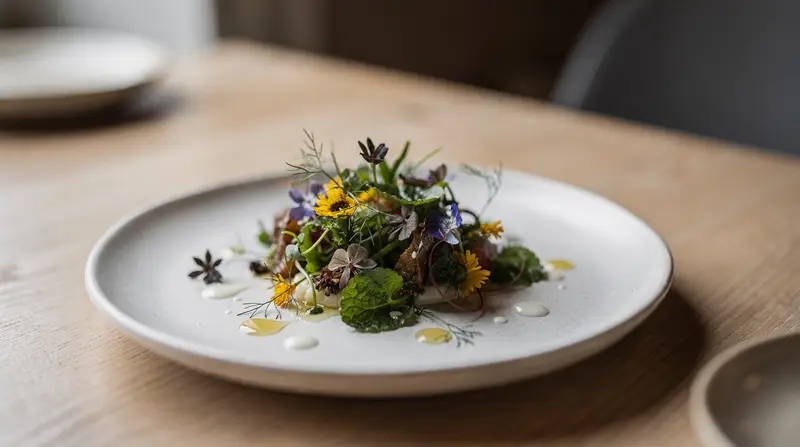
That requirement, built into the food itself, is a small piece of what hygge means. Our Copenhagen bakeries and pastry guide covers the bread-and-pastry side in more depth, and the New Nordic cuisine explained guide connects the same seasonal, unhurried instinct to Copenhagen’s fine-dining reputation.
The Concept in Practice: A Recipe for Failure
Here is what does not work, in the experience of many visitors who have read about hygge and tried to produce it deliberately.
Booking a “hygge experience” tour will not give you hygge. The presence of a guide, a schedule, and other tourists who are also trying to experience hygge simultaneously is almost definitionally anti-hyggelig.
Going to Nyhavn in the evening with the explicit intention of having a hyggelig time at one of the waterfront restaurants will probably not work either. Nyhavn is beautiful and worth visiting, but it is crowded, performative, and structured around the tourist experience rather than the resident one. Meals there tend toward the expensive and mediocre. This is not a secret: Copenhageners know Nyhavn is for tourists and they do not eat there.
What works better: find a neighbourhood that is not optimised for tourism, find a place that is clearly serving local people, and slow down. The hygge will either happen or it will not. The attempting to make it happen is the main obstacle.
A Note on the Export Version
None of this is to say that the candles are wrong. Or the throws, or the recipe books, or the lifestyle articles written by people who spent a weekend in Copenhagen and came home feeling something. The export version of hygge is imprecise, but it is pointing at something genuine. The feeling it is trying to recreate is real.
The gap is just this: hygge is fundamentally relational and unhurried, and the consumer version of it tends to be solitary and acquisition-focused. You cannot buy your way into it. You can only slow down enough to notice when it is already happening.
Which is, when you think about it, a fairly radical proposition for a product to make about itself.
For more on where to find genuinely good cafés in Copenhagen, see the best cafés for hygge guide or the best coffee in Copenhagen guide. The what is hygge guide goes deeper into the cultural context.