Copenhagen Bakeries and Pastries: Where to Find the Best Kanelsnegle
Copenhagen: Best of Danish Pastry Tasting Tour
Where are the best bakeries in Copenhagen?
Hart Bageri (Gammel Kongevej 109, Frederiksberg) is widely regarded as the best bakery in the city — exceptional sourdough and the finest kanelsnegle in Copenhagen. Juno the Bakery (Århusgade 48, Nørrebro) has a devoted following for its cardamom buns and pastry range. Andersen Bakery (multiple locations) is the most accessible for central visitors. Arrive before 10:00 for the best selection — popular items sell out.
Why Copenhagen bakeries deserve attention
The word “Danish” in “Danish pastry” refers to Denmark, which ought to mean something. In most of the world, it refers to a packaged, industrial product with a faint resemblance to the real thing. In Copenhagen, at a good bakery, a kanelsnegl or a spandauer is a genuinely serious piece of craft food — laminated dough made with exceptional butter, flavoured with restraint, baked to pull-apart perfection.
Copenhagen’s bakery culture has undergone a serious revival in the past decade. A new generation of bakers has pushed the craft forward — combining traditional Danish technique with influence from natural bread movements in San Francisco, France, and Scandinavia’s own growing sourdough culture. The result is a city where choosing where to have breakfast is a meaningful decision.
| Where | Frederiksberg (Hart), Nørrebro (Juno, Mirabelle, Lille), central locations (Andersen, Lagkagehuset) |
| Cost | Pastry + coffee around 90–115 DKK |
| Time needed | 20–40 minutes per stop |
| Best time | Before 09:00 on weekends; more relaxed on weekdays |
| Booking | None needed — just arrive early |
This guide covers the best bakeries by neighbourhood, the most important pastry types to know, and practical advice for getting the most from Copenhagen’s bakery scene.
If you want to try multiple bakeries in one morning, the Danish pastry tasting tour covers four to six bakeries with a guide — a good option for the genuinely pastry-focused.
The Danish pastries you need to know
Kanelsnegl (cinnamon swirl)
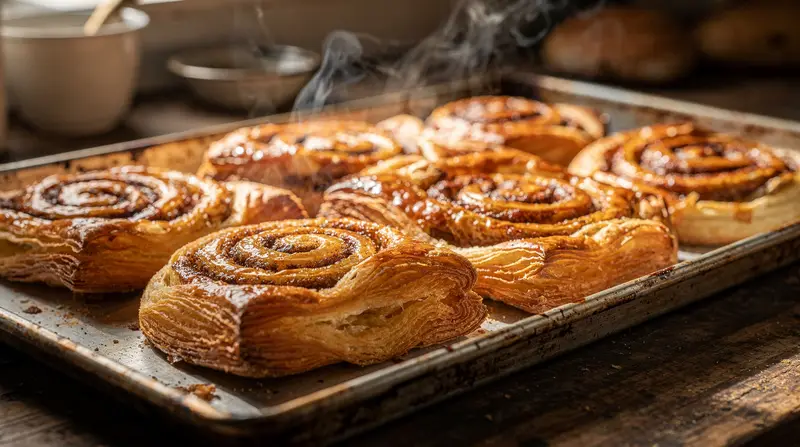
The iconic one. A laminated dough rolled with butter, cinnamon and sugar, formed into a tight spiral and baked until it has pull-apart layers inside and a slightly caramelised exterior. Some bakeries add cardamom to the spice mix; some finish with pearl sugar.
The best kanelsnegle are not excessively sweet — the cinnamon is present but not overwhelming, the butter is the dominant flavour, and the layers separate cleanly when you pull them apart. This is where most bakeries reveal their skill.
Price: 35–55 DKK. Eat: warm, the morning they are baked.
Spandauer (custard pastry)
A round pastry with a square-scored pattern, filled with vanilla custard and topped with icing, jam, or both. The name varies by filling: an æblefyldt spandauer has apple filling. One of the most common wienerbrød in Denmark — a benchmark for a bakery’s lamination technique and custard quality.
Price: 35–50 DKK.
Tebirkes (poppy seed pastry)
A rectangular pastry filled with remonce (a marzipan and butter mixture), topped with poppy seeds and often with a flaky, shatteringly crisp exterior. This is a Northern Zealand speciality — distinctly Danish, not found in most international bakeries, and genuinely excellent.
Price: 35–50 DKK.
Hindbærsnitte (raspberry slice)
Two pieces of shortcrust pastry encasing a raspberry jam filling, iced with white fondant and decorated with sprinkles. Sweet, simple, nostalgic — eaten by Danish children for generations. Bakeries vary considerably in how seriously they take it; the best versions use high-quality jam and properly made pastry.
Price: 30–45 DKK.
Croissant
The French influence on Danish baking is strong. Many quality Copenhagen bakeries make croissants that rival Paris equivalents — the butter quality and lamination technique translate well. Hart’s croissant is particularly famous.
Price: 35–50 DKK.
Rugbrød (rye bread)
Not a pastry, but any serious Copenhagen bakery also makes exceptional sourdough rye bread — the foundation of smørrebrød. A whole loaf costs 80–140 DKK and is one of the best edible souvenirs you can take from Copenhagen (it keeps for a week and travels reasonably well).
The best bakeries in Copenhagen
Hart Bageri — Frederiksberg
Gammel Kongevej 109, Frederiksberg (and a second location at Gammel Kongevej 5)
Richard Hart opened Hart Bageri in 2018 after years as head baker at Noma (yes, that Noma). The bakery quickly became the most-discussed in Copenhagen and has maintained that position. The croissants and kanelsnegle are frequently cited as the best in the city.
What distinguishes Hart: exceptional lamination technique, great butter sourcing, and a restraint in sweetness that makes the pastries surprisingly elegant. The sourdough bread (both rye and wheat) is among the best in Scandinavia.
Hours: Tuesday–Friday 07:00–17:00; Saturday–Sunday 07:00–15:00. Closed Monday.
Price: Kanelsnegl 45–52 DKK. Croissant 47–52 DKK. Sourdough loaf 110–140 DKK.
Practical note: Queue on weekend mornings. The kanelsnegle sell out by 09:30–10:00 at weekends. Arrive before 09:00 to guarantee them, or visit on a weekday.
Neighbourhood: Frederiksberg — 15–20 minutes from the centre by bus or Metro (Frederiksberg station on M1). Worth the journey.
Juno the Bakery — Nørrebro
Århusgade 48, Nørrebro (Inner Nørrebro)
Emil Glaser’s Juno opened in 2016 and built a following almost immediately. Juno is known for two things: an extraordinary cardamom bun (kardemommebolle) and a milk bun (mælkebolle) that became something of a Copenhagen cult object.
The cardamom bun differs from a kanelsnegl in spice and texture — rounder, tighter swirl, cardamom-forward flavour. If you have not thought about cardamom as a pastry spice before, this will change that.
Hours: Monday–Friday 07:30–17:00; Saturday 08:00–16:00; Sunday 08:00–15:00.
Price: Cardamom bun 45 DKK. Mælkebolle 35 DKK. Filter coffee 40 DKK.
Practical note: Small space — prepare to wait outside on weekend mornings. Worth it.
Neighbourhood: Nørrebro — a 10-minute walk from Nørreport, or take bus 5C.
Andersen Bakery — multiple locations
Centralstation (main station), Torvehallerne market, and elsewhere
Andersen is the most accessible quality bakery in Copenhagen — multiple central locations including the main train station, making it easy to grab a pastry with no detour. The quality is consistently good if not as exceptional as Hart or Juno: reliable kanelsnegle, solid spandauer, good coffee.
This is the pragmatic choice for a morning pastry before sightseeing. Do not go out of your way for it, but if it is nearby, it is significantly better than any chain.
Price: Kanelsnegl 40–50 DKK. Coffee 45–58 DKK.
Lagkagehuset (Ole & Steen) — central locations
Torvehallerne, Strøget, and multiple city-centre locations
The largest serious Danish bakery chain — what Andersen is to croissants, Lagkagehuset is to a broader pastry range. Kanelsnegle, spandauer, tebirkes, hindbærsnitte, rye bread — all available, all decent. Prices are slightly lower than the artisan bakeries (kanelsnegl 35–45 DKK).
Practical note: These are the most tourist-visible bakeries — you will pass them repeatedly. They are genuinely good and offer better value than a café; do not dismiss them because they are common.
Lille Bakery — Nørrebro and Frederiksberg
Ravnsborggade 8, Nørrebro (and other locations)
A smaller operation with a devoted following. Particularly known for laminated pastries — the croissant is excellent, and the seasonal specials (rhubarb danish in spring, various autumnal fillings) are creative and well-executed.
Hours: Typically 08:00–16:00; varies by location. Check before visiting.
Price: Croissant 42–48 DKK. Seasonal pastry 45–55 DKK.
Mirabelle — Nørrebro
Guldbergsgade 6, Nørrebro
Mirabelle doubles as a bakery and pasta restaurant (dinner). The morning pastry selection is focused and excellent — croissants with particular attention to lamination, a changing selection of filled pastries, and sourdough that is consistently strong.
Slightly less known to tourists than Hart or Juno, which means shorter queues. Worth knowing.
Price: Croissant 42–50 DKK. Filter coffee 40–45 DKK.
Which bakery for which visitor
| Bakery | Best for | Queue reality | Neighbourhood |
|---|---|---|---|
| Hart Bageri | Best-in-city croissant/kanelsnegl | Long, arrive before 09:00 | Frederiksberg |
| Juno the Bakery | Cardamom bun cult classic | Long, small space | Nørrebro |
| Andersen Bakery | Convenience near Central Station | Short | Multiple central |
| Lagkagehuset | Reliable, cheaper, full range | Short–moderate | Multiple central |
| Lille Bakery | Creative seasonal pastries | Moderate | Nørrebro/Frederiksberg |
| Mirabelle | Excellent, fewer tourists | Short | Nørrebro |
If you’re basing yourself in Nørrebro or Vesterbro, Juno, Lille Bakery and Mirabelle are all a short walk from most hotels in that area. For a wider view of Copenhagen’s food scene beyond pastry, see the best food in Copenhagen guide and the Torvehallerne market guide for a savoury counterpoint.
Coffee and pastry: the natural pairing
Most quality Copenhagen bakeries serve good coffee — speciality roasts from Danish roasters (Coffee Collective, La Cabra, Estate) are increasingly common even at smaller bakeries. A flat white from a bakery is often as good as what you would get at a dedicated café.
The flat white / filter coffee + pastry combination is the canonical Copenhagen breakfast. Budget 90–115 DKK for the combination at a quality bakery.
See the best coffee guide for dedicated café recommendations.
Guided pastry experiences
If comparing multiple bakeries in one session sounds appealing, the guided Danish pastry tasting tour visits four to six different bakeries, explains the history and technique behind each pastry type, and lets you taste products you might not have sought out independently.
For a private tour: the Danish pastry crawl with private guide allows you to set the pace and ask specific questions.
Both work well as morning experiences (starting 09:00–10:00) when the pastries are freshest.
Practical advice
Arrive early on weekends. The most popular bakeries sell out their signature items by 09:30–10:30 on Saturday and Sunday. On weekdays you have until early afternoon.
Eat the kanelsnegl warm. It is categorically better when fresh — the layers are soft and the cinnamon aroma is present. Do not buy one to eat two hours later.
Queue stoically. Weekend queues at Hart, Juno, and Andersen are a fact of life. The wait is rarely more than 10–15 minutes and the product justifies it.
Take a loaf of rye bread home. Rugbrød keeps for a week and is an excellent and practical food souvenir. Some bakeries will vacuum-seal it on request.
Pair with a window seat. The best bakery experience in Copenhagen is a kanelsnegl, a filter coffee, and a window seat watching the city wake up. This costs 90–110 DKK and is one of the better things you can do in the city.
Frequently asked questions about Copenhagen bakeries
What is a kanelsnegl?
Kanelsnegl (literally “cinnamon snail”) is the Danish cinnamon swirl — laminated pastry dough rolled with butter, cinnamon and sugar, formed into a spiral and baked. The best versions have crisp exteriors and pull-apart layers inside. Price: 35–55 DKK at quality bakeries.
What is wienerbrød?
Wienerbrød (literally “Vienna bread”) is the generic term for Danish viennoiserie — the laminated, butter-rich pastry style that the rest of the world calls “Danish pastry.” The style came from Austrian bakers in the 19th century and was adapted and refined by Danish bakers into something distinctly their own.
What time should I visit a Copenhagen bakery?
Arrive early. The best bakeries open at 07:00–08:00 and sell out their most popular items by 09:30–10:30 at weekends. On weekdays there is more time. Aim to arrive before 09:00 to be safe at Hart or Juno.
How much do pastries cost at Copenhagen bakeries?
Kanelsnegl or cardamom bun: 35–55 DKK. Croissant: 35–50 DKK. Coffee: 40–65 DKK. Breakfast for two (two pastries, two coffees): 200–260 DKK.
Are Danish pastries from Copenhagen different from what I know?
Yes, significantly. International “Danish pastries” bear little resemblance to proper wienerbrød. Real Danish pastry uses a properly laminated dough with multiple butter layers — the result is flakier, richer, and more complex. The kanelsnegl at Hart or Juno will probably redefine your expectations.
Can I take Danish pastries home?
Pastries are best eaten the day they are made — they do not survive a long journey well. Rugbrød (rye bread) travels better and keeps for a week. Some dry goods (certain cookies, crispbreads) also make practical souvenirs.
Is there a bakery tour in Copenhagen?
Yes — a guided Danish pastry tasting tour visits four to six bakeries with a guide who explains the history and technique behind each type. See the food tours guide for options.
Top experiences
Bookable activities with verified prices and instant confirmation on GetYourGuide.