Kronborg: The Hamlet Castle and Why It's Worth the Train Ride
The Train Out of Copenhagen
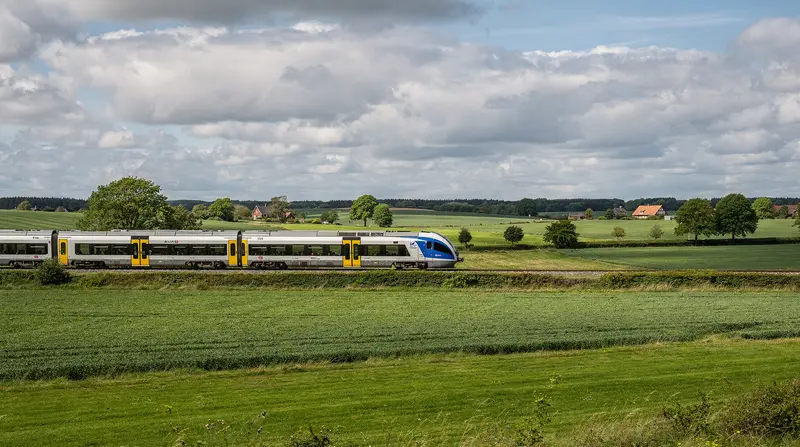
The regional train from Copenhagen H to Helsingør takes 46 minutes and travels through a sequence of coastal towns — Hellerup, Charlottenlund, Klampenborg — that get progressively quieter and more affluent as you move north along the Øresund coast. The sea appears on your right if you sit on the eastward side of the carriage. By the time you reach Helsingør, the water is very close and you can see Sweden across the strait.
We arrived on a Tuesday morning in June, which turned out to be the right choice. The castle was not empty — it is never empty in summer — but it was manageable. Weekends in peak season, we were told by a staff member in the ticket hall, can triple the visitor numbers.
| Where | Helsingør, 46 min by train from Copenhagen H |
| Cost | around 120 DKK, or free with the Copenhagen Card |
| Time needed | 2–2.5 hours at the castle, half a day round trip |
| Getting there | Regional train, hourly departures |
| Best time | Weekday mornings, before 10:00 in summer |
For the full practical rundown of this and other castles within reach of the capital, see our North Zealand castles route and the day trips from Copenhagen overview.
The Shakespeare Question
The first thing most visitors want to understand is how seriously to take the Hamlet connection.
William Shakespeare wrote Hamlet around 1600–1601. He almost certainly never visited Denmark. His knowledge of Elsinore (the anglicisation of Helsingør) came from Danish actors who performed at the Globe Theatre and from earlier sources — a twelfth-century chronicle called Gesta Danorum, in which the Hamlet-like figure appears in a much rawer, pre-Renaissance form.
The connection is real but literary. Shakespeare chose Kronborg because it was one of the most significant fortresses in northern Europe at the time — a strategic position controlling the passage of all shipping through the Øresund strait, with a toll system that made it one of the richest military installations in Europe. He used the reputation of the place, not the place itself.
This is not a disappointment. It is simply worth knowing: when you stand on the ramparts looking across to Sweden, you are standing where the historical setting would have been. The play exists in that geography even if the playwright did not.
The Exterior First
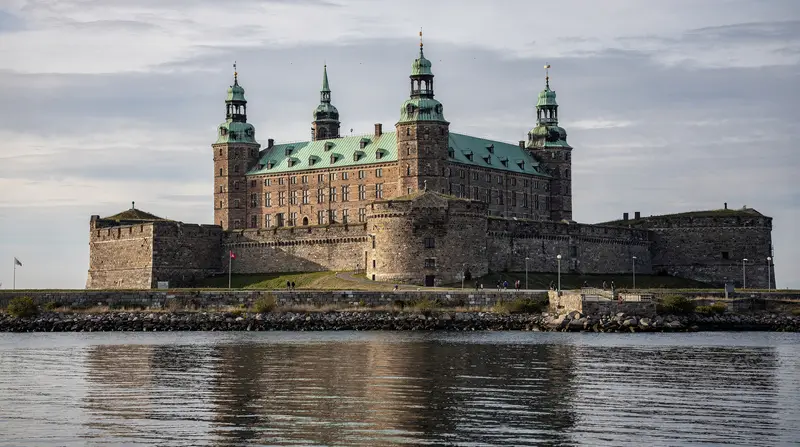
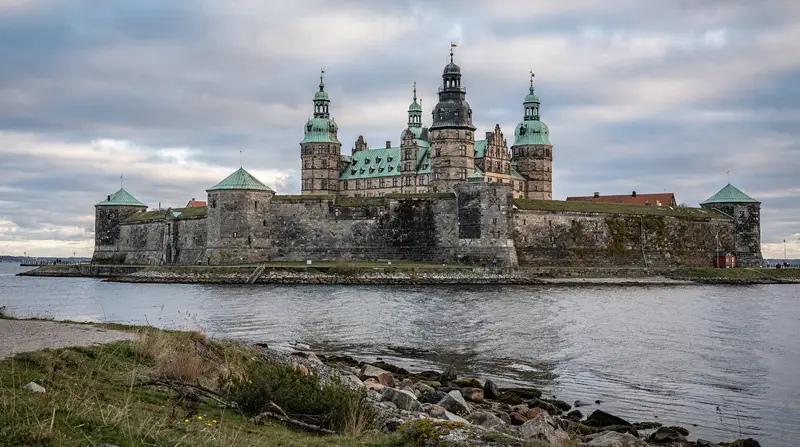
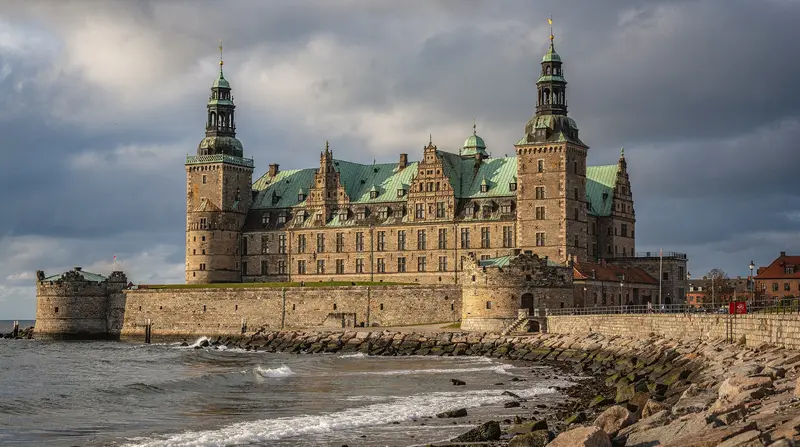
Walk around the outside before entering. Kronborg’s exterior — the green copper roofs, the sandstone towers, the moat — is best understood from the grass between the outer fortifications and the inner castle walls. From here you can read the castle’s layers: a Renaissance core from the 1580s, rebuilt after a devastating fire in 1629, sitting inside medieval defensive earthworks that date earlier still.
The position above the strait is striking. Three hundred metres of water separates Denmark from Sweden at this point, and the view to Helsingborg on the Swedish shore is continuous from the ramparts. In the sixteenth century, ships passing through this strait paid the Sound Dues to whoever held Kronborg — a toll that made Denmark extraordinarily wealthy and made Kronborg extraordinarily important. The castle was not just a residence or a fort; it was a customs checkpoint for the trade of all northern Europe.
Inside: What We Found
Entry is 120 DKK, or included with the Copenhagen Card — worth checking if you already have one, since Kronborg is one of the pricier single attractions it covers. The ticket includes access to the royal apartments, the great hall, and the casemates.
The Great Hall (Riddersalen): The largest hall in northern Europe when it was built, and it reads that way. Sixty-two metres long, with a dark wood ceiling and views across the strait through large windows. The original furnishings were lost to fire and later plunder; what you see now is sparsely furnished by deliberate choice — the scale of the room is the statement. Shakespeare’s players would have performed in a hall like this. The specific productions of Hamlet performed at Kronborg in later centuries — including a notable 1937 production with Laurence Olivier — are documented on panels around the room.
The Royal Apartments: A sequence of chambers with period furnishings and painted ceilings. The scale is intimate compared to the great hall. The tapestry hall upstairs, with its series of Flemish-woven portraits of Danish kings, is particularly good — the colours have stayed surprisingly vivid for seventeenth-century textiles.
The Casemates: This is the most atmospheric part of Kronborg, and it requires a moment of honest description. You go underground through a door at the base of the castle, into a series of vaulted brick corridors that once served as storage and refuge. The light is minimal (bring a torch or use your phone). The statue of Holger Danske — a legendary Norse hero who supposedly sleeps beneath the castle and will wake if Denmark faces mortal danger — sits at the end of one corridor. He is large and stone-faced, with a long beard, leaning on a sword.
The figure was added in the early twentieth century and is not ancient. But in the context of the dark casemates, at the end of a long corridor lit by weak bulbs, it does not feel like a tourist conceit. It feels appropriate.
Helsingør Town
The castle occupies about two and a half hours at a comfortable pace. After that, walk into the town — Helsingør’s old centre is ten minutes from the castle.
The main street (Stengade) is a medieval townhouse streetscape that has been preserved unusually well — narrow facades in red brick and painted render, interspersed with cafés and small shops. The Carmelite monastery (Skt. Marie Kirke og Kloster) dates to the fifteenth century and is one of the best-preserved monastic complexes in Scandinavia. Entry is free.
For lunch: We ate at a café on Stengade — open sandwiches at around 95–130 DKK each, a Danish beer, good bread. Nothing remarkable, but solid and reasonably priced for a tourist town. The harbour area has more options including a fish and chips stand (around 120 DKK) that was busy with Danes and Swedes — day-trippers from Helsingborg who cross by the fifteen-minute ferry specifically to buy cheaper food and goods.
Combining Kronborg with Frederiksborg
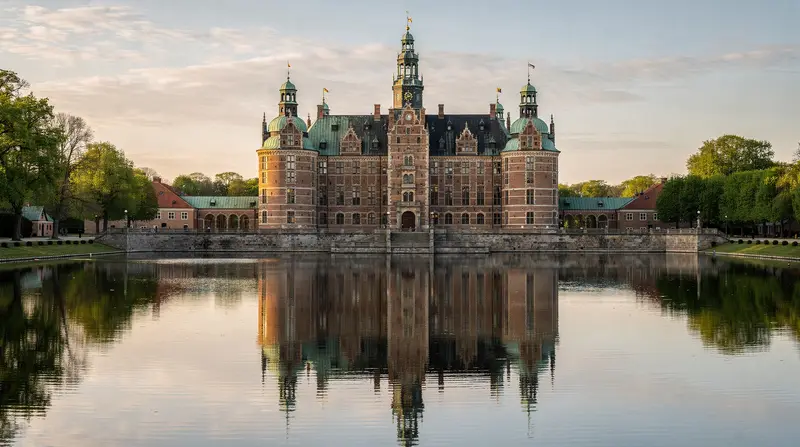
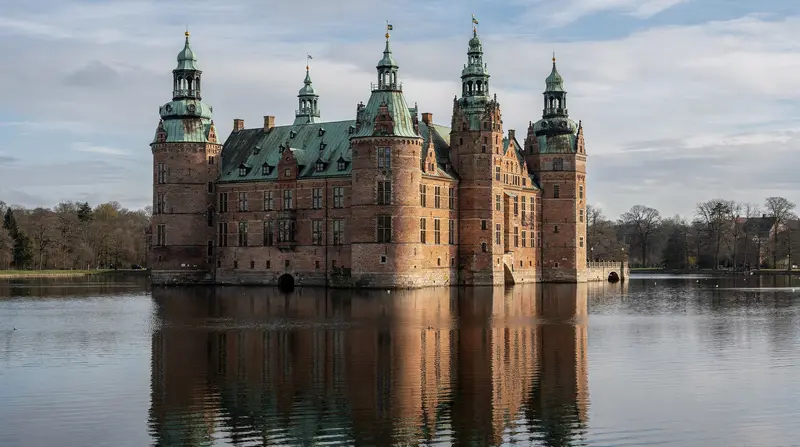
Helsingør to Hillerød (Frederiksborg Castle) takes about 30 minutes by regional train. The castle there is different in character — a Renaissance castle on a lake, housing the Museum of National History, with a baroque interior and a formal garden. If you are doing North Zealand’s castles properly, the two in combination make a full day.
Allow at least two hours at Kronborg, one hour in Helsingør town, then 30 minutes on the train to Hillerød and two hours at Frederiksborg. You will arrive back in Copenhagen by early evening.
Frederiksborg is the more visually ornate of the two — a red-brick Renaissance palace rebuilt largely in the early 1600s, sitting on three islets in a lake, with a formal Baroque garden that Kronborg does not have. Where Kronborg’s appeal is strategic and literary, Frederiksborg’s is decorative and painterly: the interior houses the Museum of National History, effectively a chronological gallery of Danish portraiture and royal iconography. Doing both in one day gives a useful contrast — a coastal fortress built for control of a strait, and an inland palace built to project royal wealth and taste.
The Kronborg and Frederiksborg castles day tour by car covers both sites with transport and a guide — more expensive than the train option but eliminates the scheduling question if you want a full guided experience.
The Kronborg Entry Ticket
The Kronborg Castle entry ticket can be bought in advance to avoid queue times at peak periods. In summer (June–August), arrival before 10:00 significantly reduces crowds.
For a guided tour of Helsingør and the castle, the Helsingør and Kronborg guided walking tour covers both the castle and the town with context that the self-guided option lacks.
What We Would Tell Someone Planning the Same Day
Go on a weekday. Arrive at the castle by 9:30 when it opens, before the first tour groups. Walk the exterior ramparts before going inside. Do not skip the casemates — they are dark and slightly damp and entirely worth it. Eat lunch in the town rather than the castle café (better value, same food quality). Take the train back along the coast in the late afternoon, when the light on the Øresund is different from the morning.
It is a good day. Kronborg earns its reputation.
For the full practical guide to the day trip — train times, ticket prices, what to do in Helsingør — see our Kronborg and Hamlet Castle guide and the day trips from Copenhagen overview.