Free Things to Do in Copenhagen (That Are Actually Worth Your Time)
Copenhagen is Expensive — But Not Everything Costs Money
The honest truth about Copenhagen’s reputation as a prohibitively expensive city is that it applies primarily to accommodation, restaurants, and the major paid attractions. Many of the things that make the city genuinely worth visiting cost nothing at all. This is not a collection of compromises; several items on this list are the best things Copenhagen offers at any price.
What follows is a curated list of genuinely good free experiences, not filler. If something is free but dull, it does not belong here.
| Best free museum | National Museum of Denmark (free since 2023) |
| Best free summer activity | Islands Brygge harbour baths (June–August) |
| Best free park | Frederiksberg Have |
| Best free neighbourhood walk | Nørrebro and the lakes |
| See also | Things to do in Copenhagen for the paid side |
The Harbour Waterfront: Islands Brygge and Sydhavn
The Copenhagen harbour waterfront is one of the city’s great assets, accessible entirely for free. The walk from Nyhavn south along Strandgade to Islands Brygge and then to the Islands Brygge Harbour Bath covers some of the most attractive urban waterfront in any European city.
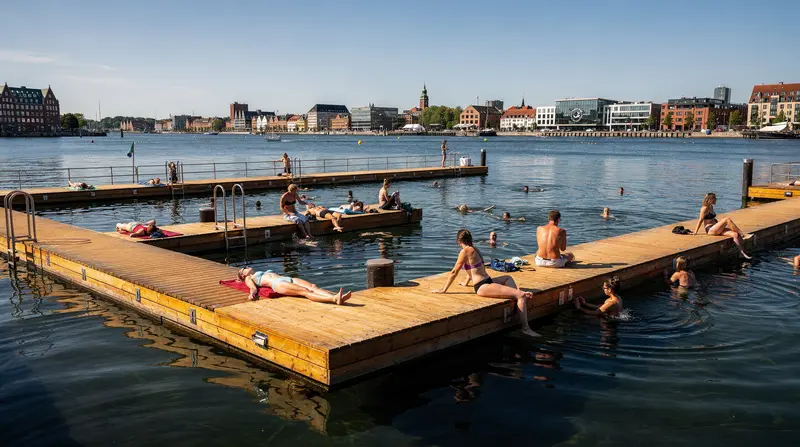
The Harbour Baths at Islands Brygge are free to use from June to August — a series of outdoor swimming pools built into the harbour where Copenhageners actually swim in clean water. This is not a tourist attraction in the staged sense; it is where the locals are. Bring a towel. The facilities include changing rooms, diving platforms at different heights, and a children’s pool. The water quality is maintained and monitored; you can look up the temperature and quality readings on the city website before you go.
In summer, the stretch of lawn alongside the harbour baths is covered in Copenhageners reading, sleeping, eating, and generally making excellent use of a rare northern European summer. This is the urban beach experience without the sea.
Frederiksberg Have: The Royal Gardens
Frederiksberg Have (Frederiksberg Gardens) is a free public park surrounding Frederiksberg Palace — and it is, without qualification, one of the loveliest urban parks in northern Europe. The palace itself requires a ticket to enter, but the gardens are freely open from sunrise to sunset year-round.
The park features a formal lake with rowing boats (rental fee), tree-lined promenades, a small Chinese summer house, and — in a pen visible from the path — red deer. The grounds were laid out in the English romantic landscape style in the 18th and 19th centuries, and they have the slightly melancholy, beautiful quality of Scandinavian formal gardens done well.
Access: M3 metro to Frederiksberg station, then 10 minutes’ walk. The café at the main entrance (Café Skovly) is inexpensive and has outdoor seating in warm weather.
The Churchills Park and Kastellet
Kastellet — the 17th-century star-shaped fortification in the Frederiksstaden area — is almost entirely free to walk through. The exterior ramparts, moat, and interior grounds (including the old barracks and windmill) can be explored without charge. The Little Mermaid statue is located at the end of the quay immediately adjacent to Kastellet, and while the statue itself is underwhelming for reasons documented elsewhere on this site, the walk through Kastellet to get there is genuinely pleasant.
The Churchill Park between Kastellet and the Gefion Fountain is also free and worth 30 minutes of your time.
The National Museum: Free Permanent Collection
This one surprises many visitors: the National Museum of Denmark (Nationalmuseet) offers free admission to its permanent collection. The museum holds one of the best archaeological and historical collections in Scandinavia — prehistoric artefacts, Viking Age metalwork, medieval history, and the extraordinary Sun Chariot (Solvognen), a 3,400-year-old Bronze Age religious object that is one of the most remarkable things you can see in any museum anywhere in Europe.
The museum is a former royal palace near Christiansborg — a grand building with spacious rooms, and rarely as crowded as comparable museums in other capitals. Budget 2–3 hours for a proper visit. Children’s sections are good.
Note: some temporary exhibitions carry a charge. The permanent collection is free.
SMK (National Gallery of Denmark): Free Permanent Collection
The Statens Museum for Kunst — Denmark’s national art museum — also offers free admission to its permanent collection. The collection spans Danish and Nordic art from the Golden Age forward, with a strong representation of Hammershøi (whose quiet, interior-light paintings have become very fashionable recently) and international works including Matisse, Picasso, and Rubens.
The building itself is worth seeing — the older wing is a grand 19th-century gallery building connected by a glass bridge to a modern extension that manages the transition elegantly. The sculpture garden between the two wings is accessible without entering the museum.
Opposite SMK is the Rosenborg Castle gardens (Kongens Have), also free — the oldest royal garden in Denmark, with formal hedgerows and a lovely central fountain area. The castle itself charges admission; the garden does not.
Nørrebro and the Lakes
The three Copenhagen lakes — Sortedams Sø, Peblinge Sø, and Sankt Jørgens Sø — run north-south just west of the inner city and are completely free to walk alongside. The circular lake path (roughly 7 km for all three lakes) is one of the best urban running and walking routes in Copenhagen, lined with trees, with views of Nørrebro on one side and the inner city on the other.
Nørrebro itself costs nothing to walk through, and walking through Nørrebro is one of the better ways to understand how the city actually lives — neighbourhood bakeries, green grocers, independent shops, street art on the railway bridges at Jægersborggade, the Assistens Cemetery (where Kierkegaard and Hans Christian Andersen are buried and where locals have picnics in summer, which is a very specific kind of Danish matter-of-factness about death).
Christiania: Mostly Free to Enter
Freetown Christiania, the self-governing alternative community in Christianshavn, is free to walk through on foot (do not take photographs on Pusher Street, as indicated by signage, and respect the community’s rules). The area has a genuine alternative urban culture, community gardens, a concert venue, workshops, and a character that is unlike anything else in Scandinavia.
It is not a tourist attraction in the conventional sense — it is a place where people live and work according to a specific set of collective principles. This is worth keeping in mind: be a respectful visitor rather than a curious observer. The outer areas of Christiania (by the moat, the lake, the community garden areas) are pleasant to walk and cost nothing.
The guided walking tours of Christiania are not free but are informative — see the guide links below for options.
Superkilen: Public Art Park in Nørrebro
Superkilen is a public park in Nørrebro designed by the Bjarke Ingels Group (BIG) in collaboration with artist collective Superflex. It is divided into three zones — red, black, and green — and populated with objects and furniture sourced from 60 countries represented by residents of the neighbourhood: a Thai boxing ring, an octopus roundabout from Iceland, a Moroccan fountain. It is the most interesting piece of urban public art in Copenhagen, free to walk through, and genuinely thought-provoking as a piece of design.
It is 15 minutes on foot from the M3 Nørrebro station.
The Harbour Promenade: North to Nordhavn
Nordhavn, the old northern harbour undergoing major residential redevelopment, has a free waterfront promenade accessible from Orientkaj (end of the M4 metro) that offers views of the strait toward Sweden, the Øresund Bridge visible in clear conditions, and the kind of industrial-meets-residential transformation that Copenhagen has been doing well for 20 years. It is not a tourist destination in the conventional sense but it is free, interesting, and 15 minutes from the city centre by metro.
Christiansborg Palace: Free Rooms
Christiansborg Palace — the seat of the Danish parliament, Supreme Court, and royal reception rooms — has free sections worth knowing about. The palace ruins (the remains of earlier castles on the site, accessed via the stables courtyard) are free. The Royal Stables are free on certain days. The main reception rooms require a ticket, but the exterior grounds, the riding ground, and access to the tower (the highest point in Copenhagen with panoramic views) are manageable on a budget — the tower has been free to access in recent years, though verify this before visiting.
Free Music and Events
Copenhagen has a strong tradition of free outdoor concerts and events, particularly in summer. The Copenhagen Jazz Festival in July, one of Europe’s largest jazz festivals, offers hundreds of free outdoor concerts across the city alongside ticketed events. The Distortion festival (street parties in different neighbourhoods each day in early June) is effectively free on the street level. Kulturhavn and other harbour events in summer often include free performances.
Check the Visit Copenhagen events calendar and the Copenhagen Jazz Festival programme if your dates overlap.
The Honest Caveat
Copenhagen is expensive. The things on this list are free, and they are genuinely worthwhile, but they do not eliminate the cost of a Copenhagen trip — they reduce it. Accommodation remains costly, and food outside supermarkets or street markets is expensive. If you are planning a budget Copenhagen trip, these free experiences are central to the strategy but the budget planning guide (linked below) covers the full picture.
A few of these — the harbour baths especially — are seasonal, so timing matters. Check the best time to visit Copenhagen before building a free-things-focused itinerary around summer-only activities.
See the Copenhagen on a budget guide, Copenhagen trip cost guide, and is Copenhagen expensive for the full budget breakdown. The Copenhagen tourist traps guide helps you avoid spending money on things that aren’t worth it.