Copenhagen Harbour Baths: Islands Brygge, Sandkaj, and Fisketorvet
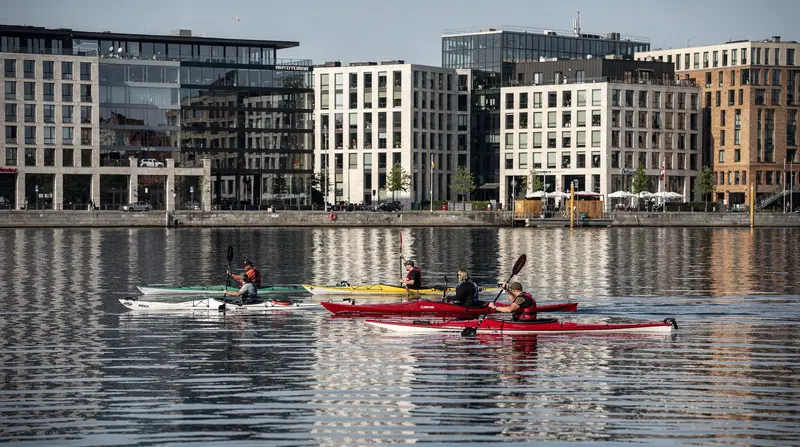
Kayak Tour in Copenhagen Harbor (June, July, August)
Duration: 2 hours
Are the Copenhagen harbour baths free?
Yes, completely free. Islands Brygge, Sandkaj (Nordhavn), and the Fisketorvet bath are all free to enter, no ticket, no reservation. Changing rooms and showers are provided at no cost. The harbour baths are open from late May or early June through August, with some locations extending into September depending on water temperature. Outdoor swimming in a clean, central harbour is one of the genuinely great free things Copenhagen offers.
| Where | Islands Brygge, Sandkaj (Nordhavn), Fisketorvet |
| Cost | Free — no ticket, no reservation |
| Time needed | 1-2 hrs for a swim, half a day with the surrounding park |
| Season | Roughly early June to late August |
| Best time | Weekday mornings before 09:30, or after 18:00 |
Swimming in the city centre: why it exists
Copenhagen’s harbour was an industrial working port for most of the 20th century. By the 1990s the water quality was poor enough that swimming had long been banned. The decision to invest in wastewater infrastructure — separating storm drainage from sewage — transformed the harbour over roughly a decade. By 2002 the water was clean enough for the city to open its first designated harbour bath at Islands Brygge, an event that was treated as a genuine civic occasion.
Twenty-four years later, swimming in the harbour in the middle of a European capital is simply a normal thing that Copenhageners do in summer. The baths are packed on warm days, the water quality consistently meets EU standards, and the city has expanded the number of designated swimming locations. For visitors, this is one of the most authentic free activities Copenhagen offers — genuinely popular with locals, genuinely unusual by European city standards.
This guide covers the three main harbour baths, how to reach them, what to expect, and a few practical points that most guidebooks omit.
Islands Brygge Harbour Bath
Location: Islands Brygge Havnepark, Islands Brygge, 2300 Copenhagen S
Getting there: Metro M2 to Islands Brygge station (1 stop from Kongens Nytorv), then an 8-minute walk through the park. Alternatively, the harbour bus route 992 stops nearby.
Open: Approximately 1 June – 31 August, 07:00–19:30 (lifeguard hours). The bath may open slightly earlier or later depending on the season.
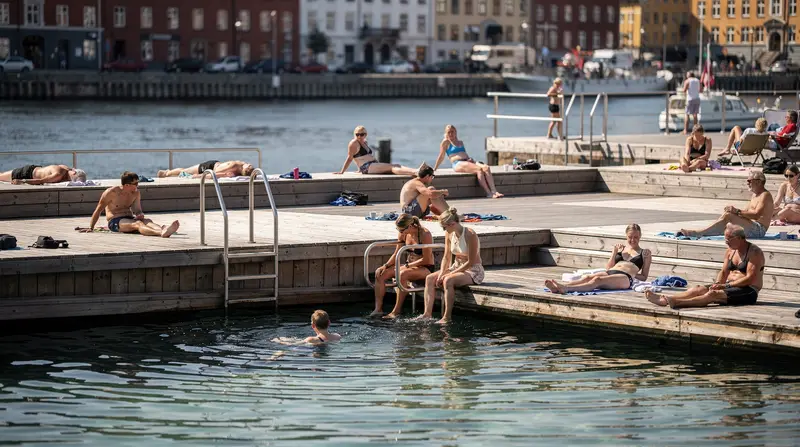
Islands Brygge is the original and most developed of the Copenhagen harbour baths. It has five pools:
- A 50-metre main pool suitable for lap swimming
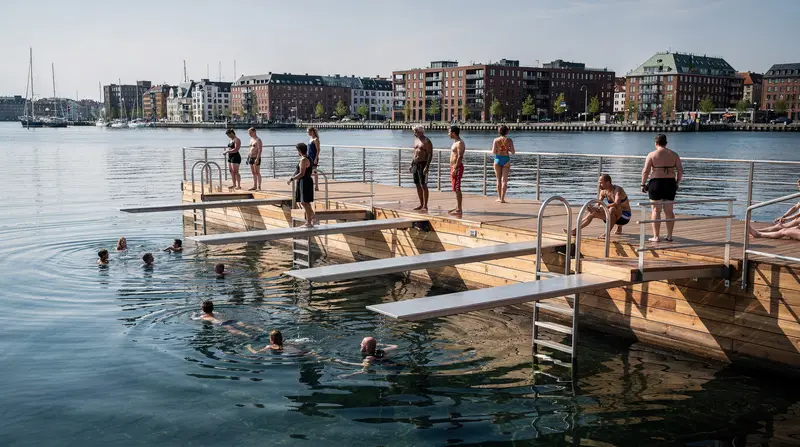
- A second pool with jumping platforms (3m, 5m, and 8m towers; the 8m tower is for committed jumpers)
- A shallower leisure pool
- A children’s pool (very shallow — appropriate for toddlers)
- An open swimming area with direct harbour access
The surrounding park has grass, benches, a café nearby, and space to spread out. On hot summer days this area fills quickly — arrive before 11:00 or after 17:00 to avoid the peak. At 15:00 on a July Saturday it is genuinely busy, particularly with Copenhagen’s young professional demographic.
Facilities: Free changing rooms (coin-operated lockers — bring a 20 DKK coin, returned on exit), free showers, toilets, accessible entry ramp, a children’s play area adjacent to the bath.
Honest note on the jumping towers: The 5m and 8m platforms feel significantly more serious in person than they look from the water. The 8m tower is not for the height-averse. The 3m platform is accessible for most adults comfortable with jumping.
Worth knowing: The park around Islands Brygge is a social hub in summer even without swimming — picnics, music, food vendors nearby. The harbour bath is the centrepiece but the whole area is worth spending an afternoon in.
If you’d rather see the harbour from the water than in it, the GoBoat rental guide and kayak Copenhagen harbour guide cover the two main self-drive options — both dock within reach of Islands Brygge.
Guided kayak tour of Copenhagen harbourSandkaj Harbour Bath, Nordhavn
Location: Sandkaj, 2150 Nordhavn
Getting there: S-train to Nordhavn station, then a 10-minute walk through the developing harbour district. The walk through Nordhavn is itself interesting — grain silos converted to apartments, new urban planning experiments, the contrasted architecture of industrial past and contemporary development.
Open: Similar season to Islands Brygge, approximately early June to late August.
Sandkaj is smaller and newer than Islands Brygge, built to serve Copenhagen’s expanding Nordhavn district. The design is rawer and more industrial in aesthetic — concrete, open water, less manicured park around it — which suits the character of the neighbourhood.
What it has: Main swimming pool with jump platform, changing facilities, showers. Less extensive than Islands Brygge but also significantly less crowded.
Why go here: If Islands Brygge is packed, Sandkaj is almost always quieter. The walk through Nordhavn is genuinely interesting for visitors curious about contemporary urban development — Copenhagen is building a new city district on reclaimed harbour land, and Nordhavn is the most advanced example of it. The combination of the urban architecture walk and the harbour bath makes for a more complete afternoon than a straight visit to Islands Brygge.
Honest note: The Nordhavn location means fewer food options close by compared to Islands Brygge. Bring food if you plan to make an afternoon of it.
Fisketorvet Harbour Bath
Location: Adjacent to Fisketorvet shopping centre, Kalvebod Brygge, 1560 Copenhagen V
Getting there: 15-minute walk from Copenhagen Central Station, or metro M3/M4 to the Enghave Brygge area.
Fisketorvet is the smallest and least visited of the three, positioned on the waterfront next to a large shopping centre. The location is less atmospheric than Islands Brygge or Sandkaj — the shopping centre architecture is uninspiring — but the water quality is identical and it is almost always less crowded than the other two.
Who it suits: Visitors staying in the Vesterbro or Kødbyen (meatpacking district) area who want a swim without the trek to Islands Brygge. The proximity to the shopping centre means food and toilets are easily accessible.
Water quality: what the monitoring actually means
Copenhagen’s harbour water quality is tested regularly during the swimming season. The city operates a monitoring system that posts results at the baths and online. Three conditions can affect the baths:
-
Normal operation: Water quality passes standards, baths fully open. This is the situation on the vast majority of days.
-
Temporary closure after heavy rain: When there is heavy rainfall (typically more than 15–20mm in a short period), storm drainage can temporarily increase contamination levels. The baths close for 1–3 days, then reopen when tests confirm quality has returned. This is the main closure risk in summer.
-
Algae blooms: Less common in the harbour (more of a coastal beach issue), but can occasionally affect water quality.
Practical advice: If you plan to swim on a specific day and there has been heavy rain in the previous 48 hours, check the Havnebad website or ask at the bathhouse entrance before changing. The closure system is well-managed — baths that are closed will have clear signage.
What locals actually do at the harbour baths
The harbour baths serve a function in Copenhagen that is genuinely social and not primarily tourist-oriented. On a warm July afternoon, you will see:
- Groups of friends who have cycled from nearby neighbourhoods with picnic supplies
- Office workers on lunch breaks (the 30-minute dip-and-back is a real phenomenon in summer)
- Parents with young children at the Islands Brygge children’s pool
- Older regular swimmers doing lengths in the 50m pool early in the morning
- Teenagers who treat the jump platforms as competitive sport
The baths are not curated as a tourist attraction — they are practical public infrastructure. That is what makes them interesting. You are using the same facility Copenhageners use; there is no tourist pricing or tourist-specific area.
Getting the most from a harbour bath visit
Timing
The harbour baths are most enjoyable when they are not at maximum capacity. On a warm July Saturday from 12:00 to 16:00, Islands Brygge is genuinely packed — all the deck space is taken, the children’s pool has a queue to enter, and the jump tower has a line. This is still a valid experience, but less relaxing.
Best times:
- Weekday mornings (07:00–09:30): predominantly local swimmers doing laps, quiet deck space, full lifeguard cover
- After 18:00 on weekdays: crowd drops significantly as families leave; the evening light on the harbour is excellent
- Any time on a day that is warm but overcast: locals still swim, tourists largely do not
Avoiding the school holidays crowd: Danish school summer holidays run roughly from late June to mid-August. During this period, especially in the final two weeks of July, Islands Brygge is at maximum capacity on warm days. If your visit falls in this window, arrive at opening time or visit Sandkaj instead.
What to bring
- Towel (no rental available)
- 20 DKK coin for locker (returned on exit)
- Sun cream (the deck has limited shade; you will underestimate sun exposure on the water’s reflection)
- Water bottle (no fountain at all locations; a café is nearby at Islands Brygge)
- Flip-flops or sandals for the deck
Cycling to the harbour baths
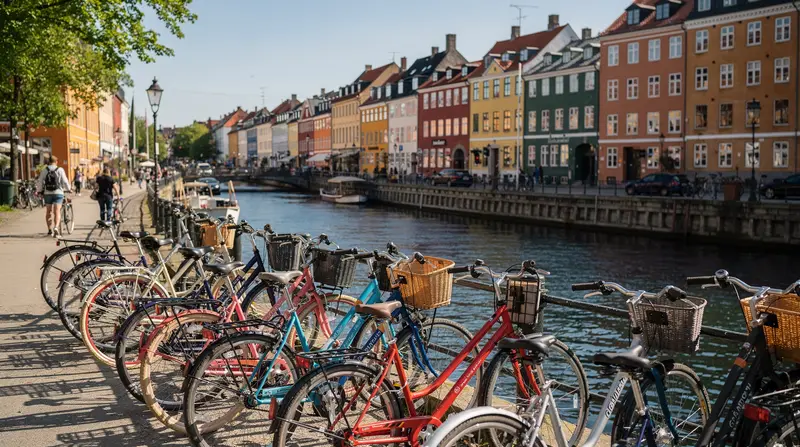
All three locations are well-served by Copenhagen’s cycle network. From Kongens Nytorv:
- Islands Brygge: 12–15 minutes by bike on the dedicated cycle lanes via Nyhavn and the Inderhavnsbroen bridge
- Sandkaj: 20 minutes via Østerbro cycle route
- Fisketorvet: 10 minutes via the city centre cycling routes
Lock bikes at the dedicated racks at each bathhouse. Do not lock to the fence or railings of the bathhouse structure — these are reserved for maintenance access.
Winter swimming in the harbour
Several winter swimming clubs operate in Copenhagen harbour through the cold months. This is not something most visitors should pursue — water temperatures drop to 2–5°C in January and February — but it is worth knowing exists.
The Helgoland Baths at Fælledvej (a year-round bathing establishment, different from the summer harbour baths) and several harbour-edge wooden pontoon structures are used by clubs. If you want to observe this distinctly Danish practice, walking along Islands Brygge or the harbour front on a winter morning will typically reveal a small group of hardy swimmers.
The free alternatives to the harbour baths
If the harbour baths are closed or crowded, two other free swimming options are within the city:
Amager Strand: A constructed artificial beach on the south side of the island, with calm lagoon water (separated from the open sea by a long artificial island). Metro M3 to Amager Strand or Øresund station. Sand beach, warmer water than the harbour in good conditions, and a notably longer season than the harbour baths — open for beach use all summer. Larger crowds on hot days; also has designated clothing-optional sections.
Bellevue Beach: North of the city (S-train towards Klampenborg, then walk). A more traditional beach with open sea conditions. Better for families comfortable with waves — it sits right by Klampenborg/Dyrehaven, so the two combine well into a day trip.
Both are good additions to a wider Copenhagen on a budget itinerary, and pair naturally with a visit built around Copenhagen in summer.
Practical information summary
Entry: Free at all three harbour baths. No reservation, no ticket.
Lockers: Islands Brygge has coin-operated lockers — bring a 20 DKK coin (refunded). Sandkaj and Fisketorvet have open changing areas; do not bring valuables.
Towels: Bring your own — no rental service.
Children’s pool: Islands Brygge only.
Jump towers: Islands Brygge (3m, 5m, 8m) and Sandkaj (platform jumping area).
Cycle access: All three are reachable by bike — Copenhagen’s cycle infrastructure makes this the most practical approach from most central neighbourhoods. Lock your bike at the racks provided.
Transport cards: The metro/bus (Rejsekort or city pass) covers access to both Islands Brygge and Nordhavn/Sandkaj. No additional cost.
Frequently asked questions about the Copenhagen harbour baths
Is the water in Copenhagen harbour clean enough to swim in?
Yes. The harbour water meets EU bathing water quality standards consistently and has done so since the baths opened in 2002. It is tested regularly during the swimming season. Temporary closures after heavy rain are the main exception — these last 1–3 days and are clearly signposted.
When do the harbour baths open and close?
Approximately early June to late August, with some variation by location and year. Islands Brygge typically runs 1 June – 31 August. Check Havnebad.dk for current-season dates.
Are there lifeguards at the harbour baths?
Yes, during staffed hours (typically 07:00–19:00 or 19:30 at Islands Brygge). Outside these hours the bath may remain accessible but without lifeguard cover.
What facilities are at the harbour baths?
Changing rooms, showers, toilets, and jump towers. Islands Brygge also has five distinct pools including a children’s shallow area. No food service on-site; cafés and food vendors are nearby.
Can children use the harbour baths?
Yes. Islands Brygge has a dedicated children’s shallow pool. All baths have lifeguards during staffed hours. Parental supervision is required, particularly near the deeper pools and jump towers.
Is there a nudist section at the harbour baths?
No. Standard swimwear is required at all three harbour baths. Amager Strand (a separate location) has a designated clothing-optional area.
What is the water temperature in the harbour baths?
June: 14–17°C. July–August: 18–22°C. Cold by southern European standards, comfortable for most active swimmers. No heating — the pools use harbour water directly.
Frequently asked questions — Copenhagen Harbour Baths: Islands Brygge, Sandkaj, and Fisketorvet
Is the water in Copenhagen harbour clean enough to swim in?
Yes. The harbour has been clean enough for safe swimming since 2002, following a major wastewater infrastructure upgrade. Water quality is monitored daily during the swimming season, and results are published at the bathhouses and on the city's water quality app. If quality drops below safety standards (rare, typically after heavy rain), the baths close temporarily and signs are posted. The harbour has passed all EU bathing water quality standards consistently.When do the Copenhagen harbour baths open and close?
Typically late May or early June through late August. Islands Brygge usually runs from around 1 June to 31 August. Sandkaj in Nordhavn has a similar window. Some locations remain open into September if water temperatures hold. Check the Copenhagen municipality website or Havnebad.dk for the exact dates each year — they vary by 1–2 weeks depending on conditions.Are there lifeguards at the harbour baths?
Yes. Lifeguards are present during staffed hours, typically 07:00–19:00 at Islands Brygge in peak season. Outside those hours the baths may technically remain open but without lifeguard supervision. Always check posted signs at the specific bathhouse on the day.What facilities are at the harbour baths?
Changing rooms, toilets, outdoor showers, and jump towers (different heights at different locations) are standard. Islands Brygge has five pools of different depths, a children's shallow area, and deck space. Sandkaj is smaller and newer, with a more open design suited to the Nordhavn industrial aesthetic. Fisketorvet has a compact footprint adjacent to the shopping centre.Can children use the harbour baths?
Yes. Islands Brygge has a dedicated shallow children's pool and is the most family-friendly option. Sandkaj is suitable for older children and adults. All locations have life rings posted, and lifeguards are trained for water rescue. Parental supervision of young children is expected — the children's pool at Islands Brygge is shallow but the main pools drop to considerable depth.Is there a nudist section at the harbour baths?
Not at the main public harbour baths. There is a designated clothing-optional area at Amager Strand (the beach south of the city centre), which is separate from the harbour baths. The harbour baths require standard swimwear.What is the water temperature in the harbour baths?
June water temperatures average 14–17°C — cold by Mediterranean standards but very swimmable. July and August warm to 18–22°C. Some Danish swimmers use the harbour year-round, including through winter (this is a distinctly local pursuit not recommended for most tourists). The open-air pools retain the ambient harbour water temperature — there is no heating.