Kayaking in Copenhagen Harbour: GreenKayak and Guided Tours
Kayak Tour in Copenhagen Harbor (June, July, August)
Duration: 2 hours
Can you kayak for free in Copenhagen?
Yes. GreenKayak is a non-profit scheme that lends kayaks for free in exchange for collecting harbour litter during your paddle. Register online, show up at one of three Copenhagen stations, and receive a kayak, paddle, and life jacket at no cost. Available from May to October, no experience required. If you want a guide and structured tour instead, paid guided kayak tours of the harbour run from around 500–600 DKK per person.
| Cost | Free (GreenKayak) or around 500-600 DKK/person (guided) |
| Time needed | 2 hours standard slot |
| Season | May-October (GreenKayak), June-August (guided) |
| Experience needed | None, but book GreenKayak well ahead in summer |
| Best paired with | Harbour baths or a GoBoat rental |
Two ways to kayak Copenhagen’s harbour
The city’s canals and inner harbour offer genuinely interesting water-level access to parts of the city that tours and GoBoats cannot easily reach. Kayaks are narrower, quieter, and slower than any motorised vessel — you can pause under a bridge, nose into a canal section too tight for boats, and approach the waterline architecture at a pace that lets you look.
There are two realistic options for most visitors:
-
GreenKayak — free, self-guided, exchange-for-litter scheme. By far the better deal for independent and budget-conscious travellers.
-
Guided kayak tours — paid, led by a local guide, typically 2 hours with a group of 8–12 paddlers.
Both have their place. This guide covers both honestly.
GreenKayak: free kayaking in exchange for litter collection
GreenKayak is a Danish non-profit that started in Copenhagen and has since expanded across Scandinavia. The model is elegant: the kayak loan is free, but you collect harbour litter during your paddle and return it to the station. Your cleanup work is the payment.
How it works in practice:
- Register at greenkayak.org (account required, free)
- Book a time slot at a Copenhagen station
- Arrive 10 minutes early at the station
- Collect kayak, paddle, life jacket, and a net bag for litter
- Paddle for 2 hours, collecting floating rubbish as you go
- Return the kayak and hand in your collected litter
The litter collection requirement does not ruin the paddle — you are not doing a deep cleaning operation. You pick up floating bottles, cans, and plastic as you encounter it. On most paddling days this takes a total of 10–15 minutes of the 2 hours; the rest is straightforward kayaking.
What you get: A sit-on-top or sit-in kayak depending on availability, a paddle, a life jacket. No dry bag, no camera mount, no guide. GreenKayak staff give a 5-minute orientation on the day.
Important: Book in advance. Popular time slots (weekend mornings in summer) fill up within hours of opening — some book out weeks ahead. Check the website regularly, or set an alarm for midnight when new slots open. Walk-in availability exists on slower days, but do not rely on it in July.
GreenKayak stations in Copenhagen (2026):
- Ofelia Beach, near the Copenhagen Opera House
- Islands Brygge Harbour Bath
- Check greenkayak.org for current station locations — these update seasonally
Guided kayak tour of the harbour
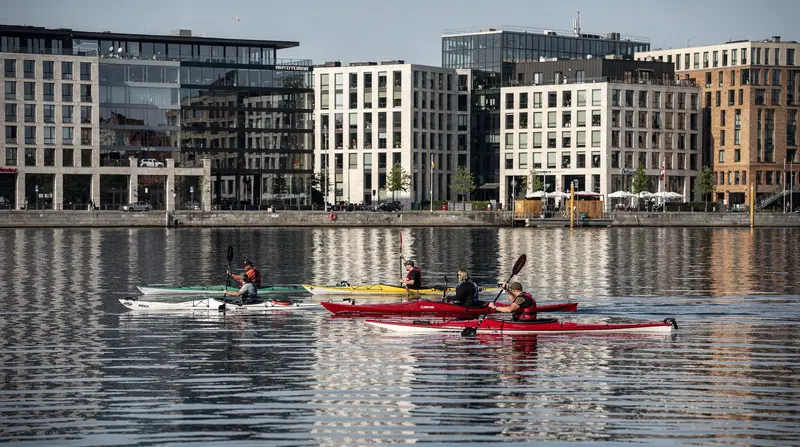
guided kayak tour in Copenhagen harbourThe guided kayak tour runs from June through August (water temperature and weather dependent). Groups of typically 8–12 paddlers follow a guide through the inner harbour and canal sections.
Duration: 2 hours.
Price: Approximately 500–600 DKK per person (~67–80 €).
What is included: Kayak, paddle, life jacket, guide, basic orientation. No prior experience required, though you will progress faster if you have paddled before.
Route: Varies by operator and conditions, but typically covers the inner harbour landmarks from water level — the Opera House, Amalienborg waterfront, Nyhavn from the harbour mouth, Christianshavn canal sections.
Honest assessment — Worth it if you want structure. The guided format is better for complete beginners who want someone to explain where they are and how to navigate the harbour safely. The guide manages the group, handles any navigation issues, and provides context on what you are paddling past.
If you are a comfortable paddler who does not need instruction or context, GreenKayak is a substantially better deal (free vs 500–600 DKK). If you have never kayaked and are nervous about self-guided harbour navigation, the guided tour is money well spent.
What you see from a kayak that you cannot see otherwise
The canals of Christianshavn were designed for boats — they are narrow enough that kayaks fit comfortably but motorised vessels must navigate carefully. From a kayak you can:
- Pass under the small bridges at water level, looking up at the brick arches
- Pull alongside the houseboats that line the Christianshavn canal and look directly at people’s front gardens (from a respectful distance)
- Access the mouth of the Nyhavn canal without the noise and wake of tour boats
- Paddle through the harbour areas between the islands where GoBoats cannot easily go
- Approach the Islands Brygge harbour bath from the water — the jump towers look different from below
The water-level perspective consistently surprises people who have already done a canal cruise from a conventional boat. The boats sit 1–1.5 metres above the waterline; a kayak sits at water level. The geometry of the city changes.
Practical notes for kayaking in Copenhagen
Water temperature: Copenhagen harbour averages 15–20°C in summer (July–August). A capsize is unpleasant but not immediately dangerous — you can swim, and the harbour edges are accessible. Wear clothes that dry quickly rather than denim. In May and September the water is 12–15°C; a wetsuit is not required but cold-water response is worth thinking about.
Harbour traffic: The inner harbour has tourist cruise boats, GoBoats, harbour buses, and occasional sailing vessels. All of these are larger and less manoeuvrable than you. Give way early and clearly — manoeuvre to one side when any motorised vessel approaches. The harbour buses (routes 991/992) run on a fixed schedule; learn roughly where their stops are to avoid anchoring in their path.
Wind on the open harbour: The enclosed canals are generally calm. The open inner harbour — the stretch between Christianshavn, Frederiksstaden, and the Opera House — can be choppy in wind. If it is windy when you arrive at the station, ask staff about conditions before heading out.
Navigation: Copenhagen’s harbour is not complicated. The main channels are wide and well-marked. The canals are small enough that you can always see the exit. GreenKayak provides basic map orientation; the guided tour guide handles navigation. A waterproof phone case for a maps app is worth bringing.
Litter collection reality (GreenKayak): You will collect some litter on every paddle — there is always something floating. The amount varies by location and wind direction. Collecting litter does not make the paddle unpleasant; it makes it purposeful. Most participants report the combination of paddling and light environmental work is actually more satisfying than straight-recreational kayaking.
GreenKayak vs guided tour: the honest comparison
| Factor | GreenKayak | Guided tour |
|---|---|---|
| Cost | Free | 500–600 DKK/person |
| Experience needed | Minimal (brief orientation) | None (full guidance) |
| Structure | Self-guided, 2 hours | Guided group, 2 hours |
| Availability | Book ahead — fills up | Book ahead in peak season |
| Best for | Independent, budget-conscious | Beginners wanting guidance |
| Season | May–October | June–August |
Combining kayak with other water activities
Kayaking pairs well with other harbour activities because the experience is complementary rather than overlapping:
Kayak in the morning + GoBoat in the afternoon: The kayak gives you the intimate, quiet view of the canals; the GoBoat gives you the social, harbour experience. Together they cover the water geography comprehensively.
Canal cruise first, then kayak: The cruise (see best canal tours) shows you the geography from above; the kayak then puts you at water level in the same places. Many visitors find this sequence gives the most complete sense of the city’s water infrastructure.
Kayak + harbour bath: GreenKayak’s Ofelia Beach and Islands Brygge stations are both adjacent to the harbour baths. Kayak your slot, return the boat, swim for the rest of the afternoon. The infrastructure is in the same place.
See the Copenhagen by boat guide for a full overview of every way to see the city from the water, including the harbour bus routes that extend the exploration further.
What to do if you cannot get a GreenKayak slot
GreenKayak slots in July and August fill up quickly — sometimes within minutes of opening for a popular time. If you cannot secure a slot:
Option A: Book a guided kayak tour. The paid guided tour has more capacity and operates on a rolling schedule. It is a different experience (structured, group-paced, with commentary) but gives you the same water level access.
Option B: Wait for a cancellation. GreenKayak cancellations happen — people’s plans change. Check the booking platform on the morning of the day you want to paddle; short-notice slots open regularly as confirmed bookings drop out.
Option C: Try a different station or time. The Ofelia Beach station tends to be booked faster than Islands Brygge in some periods. Early morning slots (07:00–09:00) are often the last to fill. A Tuesday morning kayak session is nearly always available when a Saturday afternoon is sold out for two weeks.
Option D: Try Amager Strand. Amager Strand has a beach kayak rental at certain points along the lagoon — private commercial rental, not GreenKayak, so paid. Water conditions in the Amager Strand lagoon are sheltered and calm, suitable for beginners.
The environmental dimension
GreenKayak has collected tens of thousands of kilograms of harbour litter since launching in Copenhagen. The scheme works because it makes litter collection part of an enjoyable activity rather than a civic duty — people who would not specifically volunteer to clean a harbour do collect litter when it is integrated into kayaking.
For visitors, this adds something to the experience that typical tourist activities do not: a tangible contribution to the place you are visiting, in exchange for free use of the infrastructure. Most participants report collecting anywhere from a few bottles and cans to a full bag of rubbish depending on wind direction and location. After heavy storms, yields are higher.
The litter data is tracked by GreenKayak by station, date, and weather conditions — they publish annual impact reports. The Copenhagen harbour has measurably cleaner water metrics in areas where GreenKayak operates regularly.
Whether or not you use GreenKayak specifically, the scheme represents something characteristic about Copenhagen’s approach to urban sustainability: practical incentives rather than moral exhortation.
Kayaking near Copenhagen: Amager Strand and beyond
If you want to kayak beyond the harbour and canals, the Amager coastline offers longer open-water paddling. Several kayak clubs operate from Amager Strand and the southern harbour area; day passes for non-members are available at some clubs on specific open-day sessions (check club websites for current arrangements).
The Øresund strait between Copenhagen and Malmö is paddleable by experienced kayakers — the crossing is approximately 20 km in each direction and requires planning for shipping traffic and tidal conditions. This is an expedition for experienced sea kayakers only, not a tourist activity.
For practical harbour and canal kayaking, the GreenKayak and guided tour options cover everything a visiting kayaker needs.
Frequently asked questions about kayaking in Copenhagen harbour
Is GreenKayak actually free?
Yes, completely free. You register online, arrive at the station, collect litter during your 2-hour paddle, and return it at the end. No payment, no deposit beyond a valid account.
Do you need kayaking experience for GreenKayak?
No prior experience is required, but it is not a lesson. The harbour and canals are calm water suitable for first-time paddlers. If you are genuinely nervous, the guided tour is a better starting point.
What are the GreenKayak stations in Copenhagen?
As of 2026: Ofelia Beach (near the Opera House) and Islands Brygge. Check greenkayak.org for the current season’s station locations.
How long can you take a GreenKayak for?
Standard slots are 2 hours. Book ahead — popular times fill up weeks in advance in summer.
When does GreenKayak operate?
Approximately May to October, weather permitting. Not available in winter months.
Is kayaking in Copenhagen harbour safe?
Generally yes. Calm water, no tides, minimal currents. The main considerations are harbour traffic (give way to motorised vessels), wind on the open harbour, and cold water if you capsize. Always wear the provided life jacket.
What should I wear for a kayak tour in Copenhagen?
Quick-drying clothes, sunscreen, a light layer in cooler months. Leave valuables ashore or use a waterproof case. No dry bag is provided.
Frequently asked questions — Kayaking in Copenhagen Harbour: GreenKayak and Guided Tours
Is GreenKayak actually free?
Yes, completely free. You register online (greenkayak.org), select a station and time slot, and exchange litter collection for the kayak rental. GreenKayak provides the kayak, paddle, and life jacket. The scheme runs on the principle that your cleanup work funds the service — you collect harbour litter during your paddle and return it to the station on arrival. No hidden fees, no deposit beyond a valid registration.Do you need kayaking experience for GreenKayak?
No prior experience is required, but GreenKayak is not a beginner lesson. You get a brief orientation from staff but are expected to manage the boat independently. The harbour and canals are calm water (no tides, gentle current, minimal waves) — suitable for first-time or occasional kayakers. If you have genuinely never been in a kayak, consider doing a short practice paddle in calm water before heading out.What are the GreenKayak stations in Copenhagen?
As of 2026, Copenhagen GreenKayak stations include locations at Ofelia Beach (near the Opera House), Islands Brygge Harbour Bath, and a third station at Nyhavn or Christianshavn depending on the season. Check greenkayak.org for the current list — stations are added and occasionally moved.How long can you take a GreenKayak for?
Standard slots are 2 hours. You can reserve back-to-back slots if availability allows, but the scheme is designed to share boats across many users. The 2-hour window is enough to cover a substantial stretch of the inner harbour or canals.When does GreenKayak operate in Copenhagen?
Approximately May to October, weather permitting. Peak availability is June–August. The scheme typically does not operate in winter months. Check the website for the current season's start and end dates.Is kayaking in Copenhagen harbour safe?
Generally yes. The harbour has no tides, minimal currents, and sheltered water in most of the canal network. The main hazards are harbour bus and tour boat traffic (always give way), occasional wind on the open harbour, and cold water temperature (around 15–20°C in summer — a capsize is unpleasant but not immediately dangerous if you can reach shore or signal for help). Always wear the provided life jacket.What should I wear for a kayak tour in Copenhagen?
Clothes you do not mind getting wet, particularly on your lower half. The cockpit is not fully waterproof. Quick-drying materials are preferable to denim. Sunscreen is essential in summer (no shade on the water). A light waterproof layer is useful in cooler months. Leave valuables ashore or in a dry bag — GreenKayak does not provide dry bags.
Top experiences
Bookable activities with verified prices and instant confirmation on GetYourGuide.