Cycling Rules and Etiquette in Copenhagen: What Tourists Get Wrong
Copenhagen: 1.5-Hour City Highlights Bike Tour
Duration: 1.5 hours
What are the most important cycling rules in Copenhagen?
Stay in the dedicated cycle lane (cykelsti — the red-surfaced lane between the pavement and the road), always signal turns using arm signals, do not cycle with both earphones in, do not use a handheld phone while cycling (700 DKK fine), and always give way to larger vehicles in the harbour and canal areas. Helmets are not legally required for adults. Cycling on the pavement is illegal for adults unless signed otherwise.
| Where it applies | the cykelsti (red-surfaced lane) citywide |
| Biggest fine | 1,000 DKK for running a red light on a bike |
| Helmet | not legally required for adults |
| Rental cost | around 100–250 DKK/day, cargo bikes 350–550 DKK/day |
| Learn it in | about 20–30 minutes of riding |
Why Copenhagen’s cycling rules matter more than most places
In most cities, a tourist cycling awkwardly is merely inconvenient. In Copenhagen, the cycle lane is a functioning commuter infrastructure used by hundreds of thousands of people who depend on it to get to work on time. A tourist blocking the lane, going the wrong way, or stopping unexpectedly is causing the same disruption as stopping in the middle of a motorway lane.
This is not an exaggeration. Surveys consistently show Copenhageners rank “cycling tourists who do not know the rules” as one of their top urban frustrations. It is not hostility toward tourists — it is the frustration of people whose commute is disrupted by someone who has entered their infrastructure without knowing how it works.
This guide covers what you actually need to know to cycle in Copenhagen without creating problems. Read it before you get on a bike.
The cycle lane: what it is and how it works
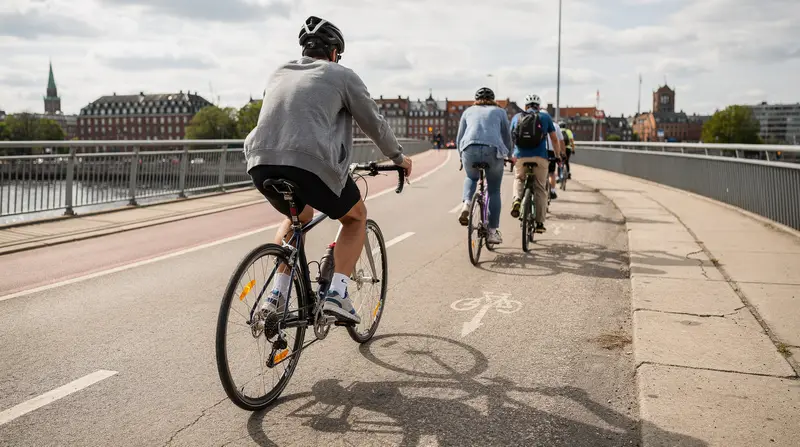
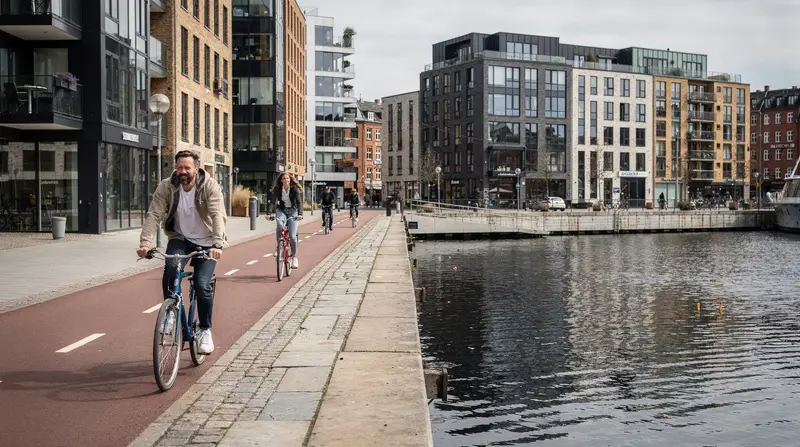
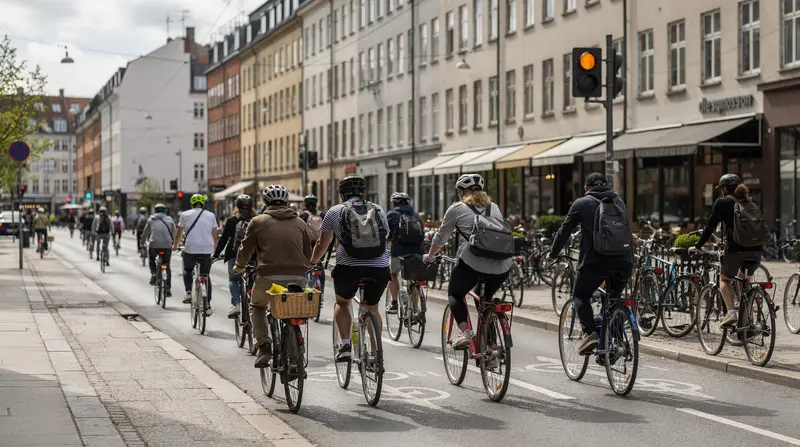
The cykelsti is the dedicated cycle lane. In Copenhagen it is typically:
- Red-surfaced (the red asphalt distinguishes it from the road)
- 2–3 metres wide on major arteries
- Positioned between the pavement (pedestrians) and the road (cars)
- One-directional, following the flow of car traffic
The cycle lane is a lane with rules. It is not a suggestion or a recommendation — it is where cyclists are required to be on streets with designated cycle infrastructure.
You must:
- Ride in the cycle lane when one is present
- Ride in the same direction as car traffic
- Follow cycle-lane traffic signals (the smaller signal boxes mounted at cyclists’ eye level at intersections)
You must not:
- Cycle on the pavement (illegal for adults, fine applies)
- Ride in the road when there is a cycle lane present
- Ride against the direction of traffic
- Stop in the lane without moving to the side and making clear you are stopping
Hand signals: the complete guide
Hand signals are legal requirements when turning in Denmark. In practice, every Copenhagen cyclist uses them — they are as automatic as indicating in a car. Tourists who do not signal are immediately identifiable and create risk for the riders behind them.
Left turn: Extend your left arm out horizontally, at shoulder height. Hold for at least 2 seconds before the turn. Return your arm before the actual manoeuvre.
Right turn: Extend your right arm out horizontally, at shoulder height. Same timing.
Slowing down or stopping suddenly: Briefly raise one arm (either arm) to signal the riders behind you. This is not legally codified the same way as turn signals, but it is the standard Copenhagener practice.
Overtaking: No hand signal is required, but looking over your shoulder before moving left (road side) is expected. Make eye contact with the cyclist you are overtaking before pulling alongside.
When to signal: before every turn, before stopping when it might affect riders behind you, before changing position in the lane. When in doubt, signal.
The left turn problem
Left turns in Copenhagen on a bicycle work differently from most cyclists’ expectations.
You cannot turn left directly from the cycle lane in most intersections. The cycle lane runs on the right side of the road. To turn left, you would need to cross car traffic — which is not permitted from the cycle lane.
The solution is the toucan box — a designated waiting area at the far-right corner of an intersection where cyclists wait to complete a left turn in two stages:
- Ride straight through the intersection (following your green signal)
- Pause in the toucan box area (marked on the road)
- Wait for the traffic signal in your new direction to turn green
- Proceed forward (which is now your left-turn direction)
This is identical to how a pedestrian navigates a two-phase crossing. It takes longer than a direct left turn but keeps cyclists out of car traffic.
If you are on a quieter side street: Direct left turns may be more straightforward, but they still require merging with or crossing car traffic. Always yield and ensure the road is clear before crossing.
Common tourist mistakes (and their consequences)
1. Cycling on the pavement
What tourists do: Assume the pavement is safer than the lane.
Why it is wrong: Adults cycling on pavements in Denmark face a fine. More practically, pedestrian infrastructure cannot handle a cyclist arriving at cycling speed. Copenhageners walking with children, dogs, or pushchairs are not expecting cyclists.
What to do instead: Use the cycle lane. It is safer than it looks from the outside — you are with other cyclists moving at similar speeds, separated from car traffic.
2. Not signalling before turning
What tourists do: Turn or stop without arm signals.
Why it is wrong: Riders behind you have no warning. If the rider 2 metres behind you is moving at 18 km/h and you turn without warning, the collision risk is real.
What to do instead: Signal every turn. It becomes automatic after the first 20 minutes.
3. Cycling two abreast on busy lanes
What tourists do: Ride side by side with a companion, having a conversation.
Why it is wrong: The cycle lane on major streets is wide enough for two bikes side by side, but the lane needs to remain passable for faster riders. Blocking the full width of the lane means nobody behind you can overtake.
What to do instead: Single file on any lane where traffic behind you exists. Save side-by-side cycling for dedicated parks and quieter routes.
4. Using a smartphone while cycling
What tourists do: Check Google Maps while cycling, or take photos while moving.
Why it is wrong: It is illegal in Denmark — 700 DKK fine. It is also genuinely dangerous (intersections approach faster than expected at cycling speed).
What to do instead: Mount your phone in a handlebar holder before you start cycling, and use voice navigation or glance at the screen while stationary. When you need to check the route, pull fully off the lane (onto a side street or into a designated stopping area) before looking at your phone.
5. Cycling with headphones in both ears
What tourists do: Listen to music with both earphones in.
Why it is wrong: Illegal in Denmark (one earbud is permitted; two are not). More critically, you cannot hear bells, warnings, or vehicle sounds behind you.
What to do instead: One earbud only. Or no earphones on unfamiliar routes — the first 30 minutes on Copenhagen’s lanes requires full situational awareness.
6. Stopping in the cycle lane
What tourists do: Stop mid-lane to check a map, wait for a companion, or look at something.
Why it is wrong: Stopping unexpectedly in the lane blocks riders behind you and creates rear collision risk.
What to do instead: If you need to stop, move to the very right edge of the lane and signal with a raised arm, then quickly pull off the lane entirely onto the pavement or a side street.
7. Not yielding to pedestrians at crossings
What tourists do: Cycle through pedestrian crossings when the path appears clear.
Why it is wrong: Danish law requires cyclists to yield to pedestrians who are at or about to enter a crossing. Pedestrians have priority.
What to do instead: When approaching a pedestrian crossing, slow and look for pedestrians. If anyone is at or near the crossing, stop and allow them to cross before proceeding.
8. Cycling the wrong way
What tourists do: Cycle against traffic on a one-way street because it is shorter.
Why it is wrong: Illegal, and genuinely dangerous. Even on a one-way street, cycle infrastructure typically flows in one direction only.
What to do instead: Follow the flow. If a route requires going the “wrong way,” use the pavement and walk the bike for that section, then remount.
At intersections: the cycle signal box
Intersections in Copenhagen have two sets of signals: car signals (larger, at car height) and cycle signals (smaller, mounted at cyclists’ eye level or on a separate pole at knee height at the front of the lane).
The cycle signals often differ from the car signals. Common patterns:
- Cycle gets green 2–3 seconds before cars: Called the “head start” — cyclists clear the intersection before car traffic moves. Use this head start; it is designed for you.
- Cycle gets green while cars are still red: Some intersections give cyclists a dedicated movement phase. Do not wait for the car signal.
Rule: Follow the cycle signal, not the car signal. If there is no dedicated cycle signal at an intersection, follow the same signal as car traffic.
Lights after dark: the legal requirement
Danish law requires:
- A white (or yellow) light at the front
- A red light at the rear
- Both must be visible from 300 metres
Rental bikes typically have dynamo lights (powered by pedalling) or battery lights. Check them before leaving if you plan to cycle after sunset. In summer, Copenhagen barely gets dark — but in autumn, dusk falls earlier than tourists expect.
Fine for cycling without lights: 700 DKK. Police in Copenhagen cycle actively and enforce lights in the autumn and winter months in particular.
Bells: required equipment
Danish law requires all bicycles to have a functioning bell. Rental bikes include them. The bell is used:
- To warn pedestrians who are entering the cycle lane
- As a warning to other cyclists before overtaking (one ring, sufficient warning)
- As a general attention signal
Bells are not horns — a brief ring is polite; multiple aggressive rings is not. The Copenhagen cycling culture has a specific bell etiquette: one ring = “please be aware of me”; no ring at all = you are responsible if a collision occurs.
Summary: the 10-second rules checklist
Before you start cycling in Copenhagen, check:
- Am I in the cycle lane (red surface, same direction as traffic)?
- Do I know the arm signal for left and right turns?
- Is my phone in a holder (not in my hand)?
- Do I have one earphone out (or both out)?
- Are my lights working (if cycling after dark)?
- Does my bike have a bell?
This is all you need to cycle respectfully in Copenhagen. The infrastructure does the rest.
What Copenhagen’s cycling infrastructure actually looks like on the ground
Understanding the physical layout of the cycle lane helps the rules make sense rather than feeling arbitrary. On most major streets, the sequence from the building line outward is: pavement, cycle lane, parked cars (sometimes), then the road for moving traffic. This means the cycle lane frequently sits directly against a row of parked cars — a genuine hazard if a car door opens without warning (“dooring”). Experienced Copenhagen cyclists watch parked cars for any sign of movement (brake lights, a driver visible in the seat) as they pass, and give a little extra clearance where possible without drifting into the path of overtaking cyclists.
At major junctions, look for the raised kerb section separating the cycle lane from the road — this is deliberately designed so a cyclist glancing down can tell instantly whether they are still in the lane or have drifted. Some newer cycle “superhighways” (cykelsuperstier) connecting the suburbs to the centre are wider and faster-flowing than standard urban lanes, with green-light synchronisation timed to a cycling pace of around 20 km/h during peak commuting hours — arrive at the right speed and you can ride through several consecutive green lights without stopping.
Where to rent a bike that fits these rules
Rental shops brief tourists on the basics, but not always in enough depth. The bike rental guide for Copenhagen covers the main providers, price ranges, and what to check before you cycle off — helmet availability, lock quality, and whether lights are dynamo or battery powered. If you would rather not navigate the rules solo on your first ride, a guided bike tour puts an experienced local ahead of you who models the signals, the toucan-box left turns, and the yielding etiquette in real traffic before you try it alone.
Copenhagen 90-minute guided bike tour is a practical way to learn the lane discipline and hand signals from a local guide before cycling independently for the rest of your trip.
Choosing routes that match your confidence level
Not every street in Copenhagen has the same lane width or traffic intensity, and the rules above matter more on some routes than others. Nørrebrogade and Vesterbrogade are the busiest commuter arteries — full lane discipline (single file, clear signalling) is essential there during rush hour (07:30–09:00 and 16:00–18:00).
The waterfront and park routes covered in the Copenhagen cycling routes guide are calmer and more forgiving for a first ride. If you are still deciding between cycling and public transport for getting around, the bike vs metro comparison breaks down when each makes more sense, and the general biking in Copenhagen guide covers rental logistics beyond the rules covered here.
What locals actually notice about tourists on bikes
Ask any Copenhagener what irritates them about visiting cyclists and the list is short and consistent: wobbling because of unfamiliarity with the bike, stopping abruptly to check a phone, and drifting into the middle of the lane while looking at scenery instead of the road ahead. None of these require special skill to fix — they require awareness that the cycle lane is shared, working infrastructure, not a novelty experience. The Copenhagen mistakes to avoid guide covers this same theme across the whole visit, not just on two wheels, and is worth reading alongside this one if you plan to cycle for more than a single afternoon.
Frequently asked questions about cycling rules in Copenhagen
What is the fine for cycling with a phone?
700 DKK (approximately 94€). Handheld use is illegal; mounted use is permitted.
Can you cycle on the pavement in Copenhagen?
No, not as an adult. Pavements are for pedestrians. Cycle in the cykelsti (cycle lane).
Is running a red light on a bike illegal?
Yes. Fine: 1,000 DKK. Traffic signals apply fully to cyclists.
What is the speed limit for cyclists?
No posted numerical limit, but cycling at a speed inconsistent with conditions is considered dangerous driving. Practical city cycling speed is 15–20 km/h.
Do you have to give way to pedestrians?
Yes, at all pedestrian crossings. Cyclists must yield to pedestrians who are at or about to enter the crossing.
Can two cyclists ride side by side?
On quiet routes, yes. On busy urban cycle lanes, single file is the standard.
What should you do if your rental bike breaks down?
Contact the rental provider immediately. Do not leave the bike unlocked in the lane. Move it to the pavement (walking it is permitted) and lock it while waiting for assistance.
Frequently asked questions — Cycling Rules and Etiquette in Copenhagen: What Tourists Get Wrong
What is the fine for cycling with a phone in Copenhagen?
700 DKK (approximately 94€ at 7.46 DKK = 1€). Danish police enforce this actively in city areas. Using a phone mounted in a holder and controlled by voice or a single tap is legal; holding a phone in your hand while cycling is not.Can you cycle on the pavement in Copenhagen?
No, not as an adult. Adults cycling on pavements can be fined. The pavement (fortov) is for pedestrians; the cycle lane (cykelsti) is for cyclists. Exceptions exist on some roads where a shared path is signed (the sign shows both a walking figure and a bicycle). If in doubt, cycle in the road or the dedicated lane, not on the pavement.Is running a red light on a bike illegal in Denmark?
Yes. Traffic signals apply to cyclists in Denmark. The fine for running a red light on a bicycle is 1,000 DKK (approximately 134€). Cycling through a red light is also dangerous — right-turning vehicles may not expect you. Many intersections have separate cyclist traffic lights; use the smaller cycle signal box, not the larger car signal.What is the speed limit for cyclists in Copenhagen?
There is no specific numerical speed limit posted for cyclists in Denmark. The practical expectation is to ride at a speed consistent with conditions — meaning safely for pedestrians and other cyclists nearby. Cycling at 5 km/h in a fast-moving lane is inconsiderate; cycling at 40 km/h in a shared zone is dangerous. The standard city cycling pace is 15–20 km/h.Do you have to give way to pedestrians as a cyclist?
Yes. At designated pedestrian crossings, cyclists must give way to pedestrians who are crossing or about to cross. This applies even if you are on a green cycle signal — pedestrians in the crossing take priority. Danish cyclists typically yield smoothly and early; arriving at speed and expecting pedestrians to wait is culturally incorrect and legally questionable.Can two cyclists ride side by side in Copenhagen?
On quiet routes and in cycle lanes with sufficient width, cycling two abreast is tolerated. On busy urban cycle lanes (Nørrebrogade, Vesterbrogade, the inner harbour routes), riding two abreast blocks the lane for faster riders and is inconsiderate. The standard is single file on busy lanes.What should you do if your bike is not working on a rental?
For Donkey Republic app bikes: report the issue through the app and end the rental. You will not be charged for a broken bike. For Baisikeli or shop rentals: call the shop number (should be on your rental document) and follow their procedure. If you are far from the shop, they may send assistance or ask you to lock the bike and come to collect a replacement.