Amalienborg Palace and the Changing of the Guard in Copenhagen
Copenhagen: Marble Church Architecture Private Walking Tour
When is the changing of the guard at Amalienborg Palace in Copenhagen?
The changing of the guard happens at 12:00 (noon) daily when the royal family is in residence. The Royal Guard (Den Kongelige Livgarde) marches from Rosenborg Castle at approximately 11:30, arriving at Amalienborg at noon. The ceremony lasts about 30 minutes. Arrive by 11:45 for a good position at the palace square.
Explore the Frederiksstaden neighbourhood — Amalienborg, the Marble Church, and the architecture of royal Copenhagen — this private walking tour covers the district’s design and history in depth.
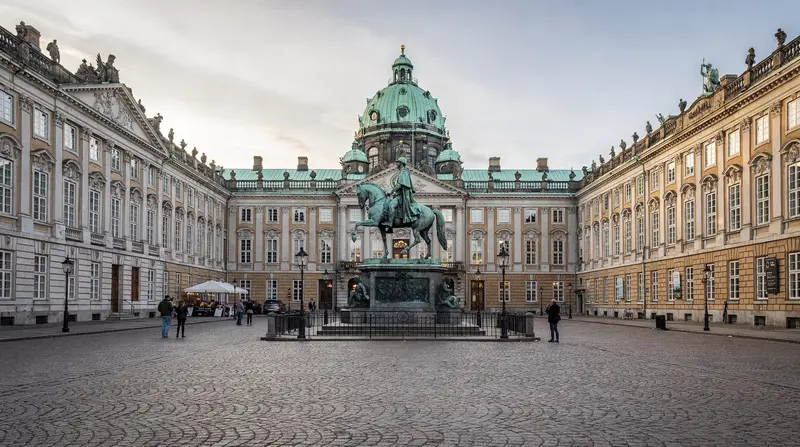
Amalienborg is the winter residence of the Danish royal family and one of the finest examples of Scandinavian rococo architecture in existence. Four identical palace buildings, designed by the architect Nicolai Eigtved and completed in the 1750s, face each other across an octagonal courtyard defined by a central equestrian statue of Frederick V (1771). The geometry is deliberately perfect: if you stand at the centre of the square on Frederiks V’s horse and look in any direction, the sightlines are aligned with the Marble Church behind, the harbour in front, and the palaces on either side.
The royal connection came by accident. The palaces were built for wealthy Danish noble families; when Christiansborg burned in 1794, the royal family had no residence and purchased all four buildings at once.
| Where | Amalienborg Slotsplads, Frederiksstaden district |
| Cost to watch | Free (museum entry around 95 DKK) |
| Time needed | 30 min for the ceremony, 45–60 min for the district |
| Getting there | Metro to Kongens Nytorv, 8 min on foot |
| Best time | Arrive by 11:45 for the 12:00 ceremony |
The changing of the guard
What happens
At 12:00 noon, the Royal Guard changes at the palace. The ceremony involves the outgoing guard (who have been on duty since the previous day) being relieved by the incoming guard, with full military formality. When the monarch is in residence, the Guard marches from Rosenborg Castle with its own band; when the palace is unoccupied, a smaller guard change takes place without the full march.
The ceremony takes approximately 30 minutes, during which the platoons exchange positions at each of the four palaces, perform formal military salutes, and march in formation within the square. It is genuinely military — not theatrical performance — and the precision is worth watching.
The march route (when in residence)
The Guard departs Rosenborg Castle (in the King’s Garden, Nørreport area) at approximately 11:30. The route:
- Rosenborg Castle (11:30 departure)
- East along Gothersgade
- Through Kongens Nytorv (approximately 11:45)
- South along Bredgade
- Arrival at Amalienborg (12:00)
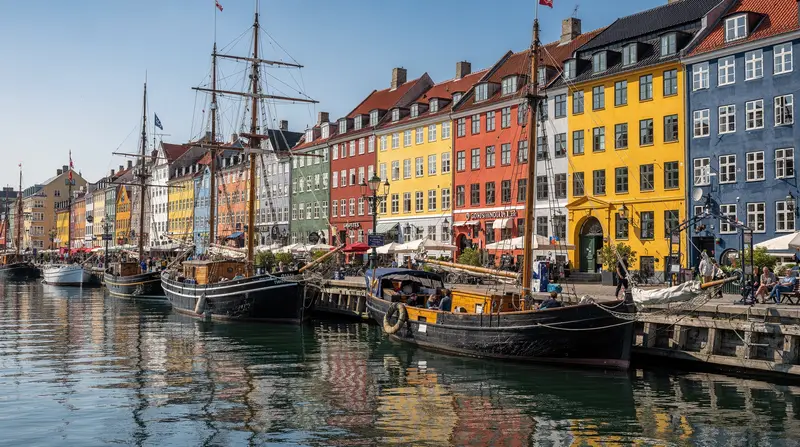
You can position yourself anywhere along this route to watch the march. Kongens Nytorv (the large square where Nyhavn begins) provides a good intermediate view at around 11:45. The march through the square itself is the most photogenic moment.
The best viewing position at Amalienborg
The octagonal palace square is open to the public. Arrive by 11:45 for a position along the perimeter railings. The Guard enters from the north (from Bredgade) and the ceremony takes place across the central courtyard.
Recommended positions:
- Along the northeast railing: You face the incoming Guard’s direction of march and have the equestrian statue as foreground.
- At the harbour-side (south) entrance: You see the Guard in formation against the palace facades with the harbour behind.
Avoid standing in the centre of the square during the ceremony — the Guard needs the space.
Photography
Long focal length (or phone zoom, 3x-5x) from the perimeter railings gives the cleanest shots. The equestrian statue of Frederick V in the centre makes a natural framing element. In winter, the low midday sun comes from the south and lights the palace facades evenly; in summer, midday light is flat but the ceremony colours (bearskin hats, red uniforms) provide their own contrast.
Best time of year to watch
| Season | Crowds | Notes |
|---|---|---|
| Winter (Dec–Feb) | Light | Guard wears full-length grey coats; low sun flatters photos |
| Spring/autumn | Moderate | Comfortable standing weather, good visibility |
| Summer (Jun–Aug) | Heavy | Arrive by 11:30 to get a railing spot; cruise-ship days are busiest |
| Danish public holidays | Variable | Museum may close; ceremony usually still runs — check kongehuset.dk |
The ceremony is short, so even at its busiest the crowd disperses within minutes of the Guard reaching the square.
The Amalienborg Museum
One of the four palaces — Christian VIII’s Palace — is open to visitors as a museum. Entry: 95 DKK (~13 €) for adults, children under 18 free.
The museum covers the Danish royal family from 1863 to the present day, displayed through personal objects, state gifts, historical furniture, and photographs. Key rooms include:
Queen Margrethe II’s study: Decorated and used by the former queen (who abdicated in January 2024 in favour of her son Frederik X) — personal objects, her own artwork, and the working atmosphere of a real royal residence rather than a formal state room.
Frederik VIII’s apartments: Intact 19th-century royal apartments with original furniture, documenting the transition from Victorian court style to early 20th-century modernism.
Christian IX’s drawing room: Used for family gatherings; the walls are hung with photographs of the European royal families connected to the Danish line by marriage — Queen Victoria’s family tree is substantially represented here, reflecting that Christian IX’s children married into most of Europe’s royal houses.
The museum takes 1–1.5 hours at a careful pace.
The Marble Church (Frederiks Kirke)
Behind Amalienborg — visually connected to the palace square by a deliberate axial alignment — stands the Marble Church. More formally Frederiks Kirke, it was begun in 1749 (the same year as the palaces), halted for lack of funds for 150 years, and finally completed in 1894.
The dome is 31 metres in diameter and 80 metres high — one of the largest in Scandinavia. The exterior, in Scandinavian marble and limestone, is severe in its classicism. The interior is warmer: the dome interior is painted, and 16 statues of religious figures occupy niches around the base. It is genuinely impressive at scale, which is rare for a church that most visitors skip in favour of the palace square.
The church is free to enter. It can be climbed for a view (the dome walkway, when open) for a small fee. Services are held on Sundays; the church is otherwise accessible to visitors most days.
The Frederiksstaden district
Amalienborg sits in Frederiksstaden — a planned district built in the 1750s as a royal quarter, laid out on a grid with palace, church, and canal as its focal points. The neighbourhood extends to Bredgade (with antique shops and embassies) and the harbour.
Walking the area takes 45–60 minutes. Useful circuit: Kongens Nytorv → Bredgade south → Amalienborg square → harbour view → Marble Church → Amaliegade north → back to Kongens Nytorv. The streets are largely traffic-free, the buildings intact 18th-century, and the area markedly quieter than Nyhavn despite being three minutes’ walk from it.
The Frederiksstaden and Amalienborg destination guide covers the neighbourhood in more detail.
Combining Amalienborg with other sights
Natural combinations
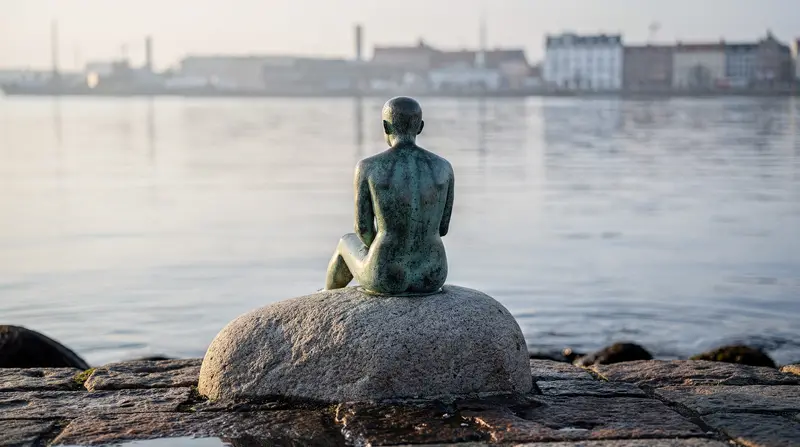
Little Mermaid loop: From Amalienborg, the Little Mermaid is a 10-minute walk north along the harbour. Kastellet fortress is between them. This loop (Kongens Nytorv → Amalienborg → Kastellet → Little Mermaid → return via harbour front) takes about 90 minutes.
Canal cruise: Canal cruise boats pass Amalienborg’s harbour front during the standard one-hour route. You see the waterfront facade of the palace and get the harbour view without a detour. See the canal tour guide.
Rosenborg: The Guard marches from Rosenborg to Amalienborg — watching from Rosenborg at 11:30, then following to Amalienborg, is a logical combination. Total: 2–2.5 hours including the Guard march and palace exterior. The Rosenborg Castle guide covers the crown jewels and gardens in depth, and a guided option covers both palaces in one outing.
Old town, Christiansborg and Rosenborg guided tour by carIf you’re planning a wider itinerary, both stops fit naturally into a one-day Copenhagen plan alongside Nyhavn and the broader things to do in Copenhagen overview. For the parliament and royal reception rooms across town, see the Christiansborg Palace guide.
Practical information
Address: Amalienborg Slotsplads, 1257 Copenhagen K. On the harbour front in the Frederiksstaden district.
Getting there: Metro M1/M2 to Kongens Nytorv, then 8 minutes on foot east via Bredgade. Hop-on hop-off buses stop directly at Amalienborg. From Nyhavn: 5 minutes’ walk south along the harbour.
Changing of the guard: Daily at 12:00. Free. No booking required.
Museum entry: 95 DKK adults, children free. Open daily 10:00–17:00 in season; check closures on Danish public holidays.
Copenhagen Card: Covers museum entry.
Photography: The palace square is public and photographable at all times. The changing of the guard is fully photographable.
Frequently asked questions about Amalienborg and the changing of the guard
Does the changing of the guard happen when it rains?
Yes. The ceremony proceeds regardless of weather. The Guard wears waterproof capes in rain. If anything, rainy-day ceremonies have shorter crowds and can make for dramatic photography.
Who is the current Danish royal family?
King Frederik X (born 1968) ascended to the throne on 14 January 2024 after Queen Margrethe II abdicated after 52 years. His wife Queen Mary (born in Australia, 1972) is well-known internationally. Their four children include Crown Prince Christian, born 2005. The royal family lives between Amalienborg (winter), Fredensborg (spring/autumn), and Marselisborg in Aarhus (summer).
Can you visit Amalienborg Palace when the royal family is not in residence?
Yes. The palace square is always open. The museum in Christian VIII’s Palace is open year-round. When the family is absent, the guard change is smaller (without the full march from Rosenborg), but the ceremony still happens daily at noon.
Is Amalienborg Palace the oldest in Copenhagen?
No. Rosenborg Castle (1606–1633) is older. Christiansborg stands on the oldest royal site (since 1167). Amalienborg’s palaces were built in the 1750s and became the royal family’s primary residence only in 1794 after the first Christiansborg fire.
How do I know if the royal family is in residence?
When the royal family is in residence at Amalienborg, the royal flag (the Dannebrog split flag, rather than the standard Danish flag) flies from the relevant palace building. The Royal House website (kongehuset.dk) also lists the current residence.
Are there guided tours of Amalienborg?
Yes — private walking tours of the Frederiksstaden area and the palace exterior are available. The palace museum has an audio guide included with entry. Private architectural tours of the Marble Church and surrounding district provide the most historical depth.
Frequently asked questions — Amalienborg Palace and the Changing of the Guard in Copenhagen
Does the changing of the guard happen every day?
Yes, daily at 12:00 (noon), regardless of weather. The ceremony is the same whether the royal family is in residence or not, though the Guard marches with full band and parade when the Queen or Crown Prince is at the palace. Check the Royal House website (kongehuset.dk) for the current residence schedule.What time does the Royal Guard leave Rosenborg Castle?
The Guard departs Rosenborg Castle at approximately 11:30. The march takes about 25–30 minutes along Gothersgade, through Kongens Nytorv, and down Bredgade to Amalienborg. You can watch the march en route — a good vantage point is Kongens Nytorv (about 11:45).Is the changing of the guard free?
Yes. The Amalienborg palace square is publicly accessible at all times. The changing of the guard ceremony is free to watch. The palace museum (one of the four palace buildings) charges 95 DKK (~13 €) for entry.How do I get a good spot at Amalienborg?
Arrive by 11:45 at the latest. Position yourself along the railing at the edge of the octagonal square, ideally on the side facing the direction the Guard enters (from Bredgade, the north side). The equestrian statue of Frederick V in the centre of the square will be in your frame — position yourself to use it as foreground.What is the Amalienborg Palace?
Four identical rococo palaces arranged around an octagonal courtyard, built in the 1750s for Danish noble families and purchased by the royal family after Christiansborg burned in 1794. They have been the winter residence of the Danish royal family since then. The current monarch, King Frederik X (since January 2024), uses Christian IX's Palace (the northwest building).Can you go inside Amalienborg Palace?
One of the four palace buildings — Christian VIII's Palace — functions as the Amalienborg Museum, open to visitors for 95 DKK (~13 €). It contains royal apartments from 1863 to the present, including personal objects of recent monarchs. The other three palaces are private royal residences.Is the Marble Church (Frederiks Kirke) next to Amalienborg worth visiting?
Yes — it is one of Copenhagen's most architecturally impressive buildings, free to enter, and directly behind Amalienborg. The dome is 31 metres in diameter and inspired by St Peter's in Rome. The interior is less ornate than you might expect but the scale is remarkable. Open to visitors most days; check for service times.
Top experiences
Bookable activities with verified prices and instant confirmation on GetYourGuide.