Stevns Klint Day Trip from Copenhagen: UNESCO Cliffs & Højerup Church
Stevns Klint UNESCO chalk cliffs and Højerup Old Church from Copenhagen. 1 hour by car or bus. Honest guide to tours, hiking costs, and what to skip.
Stevns Klint UNESCO World Heritage Site Tour from Copenhagen
Quick facts
- Distance from Copenhagen
- 55 km south — about 55 minutes by car
- UNESCO status
- Listed 2014 for K-Pg mass extinction boundary record
- Public transport
- Train to Køge + bus 261/264 (1.5–2 hours total)
- Entry
- Cliff path free; Stevns Museum 100 DKK adults
- Højerup Old Church
- Free to visit (church itself)
Quick answer: Stevns Klint is Denmark’s most scientifically significant cliff, UNESCO-listed for the visible record of the asteroid impact that killed the dinosaurs 66 million years ago. It’s 55 km from Copenhagen — closer and faster to reach than Møns Klint — and pairs well with a stop in Køge. The cliff walk is free, dramatic, and genuinely unlike anything else within easy reach of the capital.
| Where | 55 km south of Copenhagen |
| Cost | Cliff path free; Stevns Museum 100 DKK |
| Time needed | 2 hours minimum; 4–5 hours for the fuller hike + bunker |
| Getting there | ~55 min by car, or train to Køge + bus 261 (1.5–2h) |
| Best time | Spring and autumn for photography; summer for full facilities |
Why Stevns Klint is more than a pretty cliff
Most cliff scenery is impressive because of scale. Stevns Klint is impressive for a different reason: you can see the exact geological moment when 75% of all life on Earth was wiped out. The K-Pg boundary — a thin layer of dark clay containing iridium from the asteroid impact 66 million years ago — runs through the chalk at eye level along the cliff face. UNESCO recognised this in 2014 as one of the clearest continuous records of that event anywhere on Earth.
You don’t need to be a geologist to appreciate it. Standing at the base of the cliff and having someone show you the dark layer — “that’s it, that’s the moment” — is one of those experiences that reframes your sense of geological and biological time in a useful way. The layer itself is typically 2–5 cm thick, dark greenish-grey, and sits between the white Cretaceous chalk below and the lighter Paleocene sediment above.
What makes Stevns Klint particularly valuable scientifically is the continuity of the exposure. The cliff extends 15 km along the coastline with minimal interruption, providing geologists with a long, unbroken cross-section through exactly the moment of impact and its immediate aftermath. The iridium concentration in the clay layer is far higher than normal crustal rock — this iridium is the chemical fingerprint of the asteroid itself.
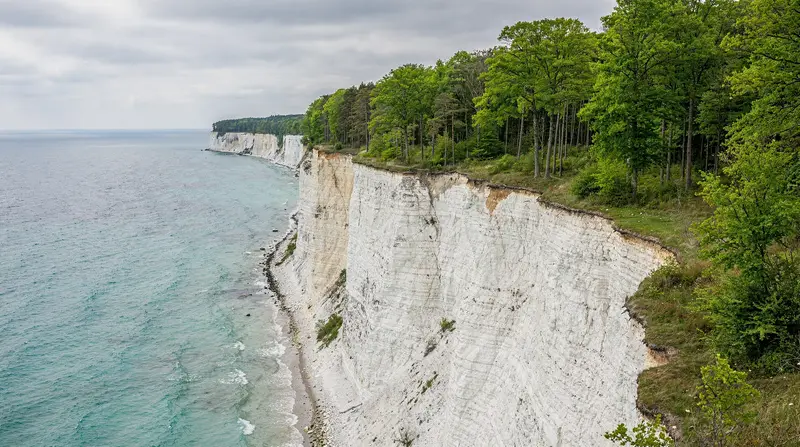
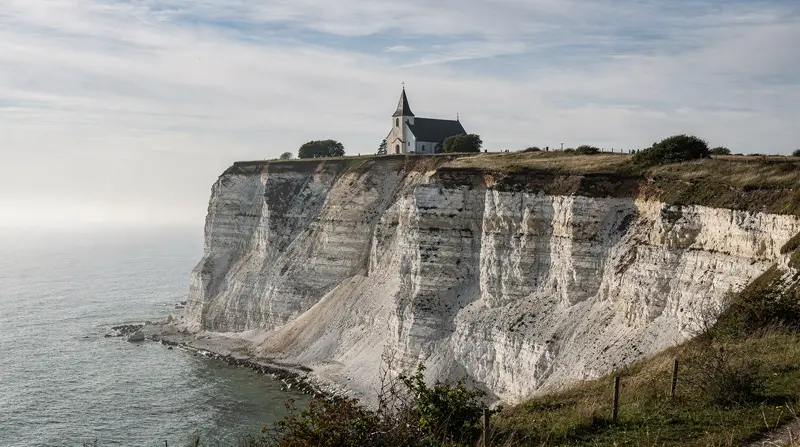
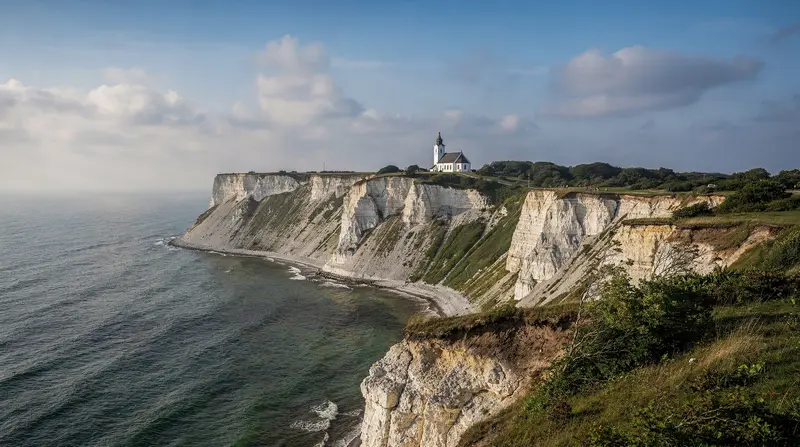
The cliff is also just beautiful in a more ordinary sense: white chalk, bands of black flint, green cliff-top grass, and the Baltic Sea below. On clear days you can see across to the Swedish coast. Højerup Old Church sits on the edge of the cliff so dramatically that part of it has already fallen into the sea — a quiet lesson in the pace of erosion that puts the geological timescales of the K-Pg layer in some perspective.
Getting to Stevns Klint from Copenhagen
By car: The fastest option. Take the E47/E55 south toward Køge, then Route 261 east toward Store Heddinge and Højerup. The total distance is about 55 km and takes 50–60 minutes depending on traffic. There’s a free car park at Højerup church.
By public transport: Take the regional train from Copenhagen H to Køge (30–35 minutes, ~50 DKK one-way). From Køge station, bus 261 runs to Højerup/Stevns Klint several times daily. The bus journey takes 40–50 minutes. Total travel time from central Copenhagen: about 1.5 hours each way. Check current bus schedules at rejseplanen.dk as services vary by day.
Organised tours: This private car day trip covers Stevns Klint efficiently and includes a guide who explains the geology. Worth considering if you’re short on time or want the context delivered verbally rather than read from panels.
The group tour combining Stevns Klint and the Forest Tower makes a full day of it and handles all logistics from Copenhagen.
Højerup Old Church: the cliff-edge church
Højerup Gamle Kirke (Højerup Old Church) is the most photographed sight at Stevns Klint, and for good reason. The church dates from around 1200 and sat safely inland for centuries. Then the cliff began eroding. By 1928, the chancel had already fallen into the sea. Today the remaining nave stands right at the cliff edge, and erosion continues — the church is structurally supported but still visibly precarious.
Entry to the church grounds and interior is free. Opening hours vary by season but the exterior is always accessible. The view from the cliff edge next to the church is one of the best in the area.
A local legend says the church moves one cockerel step back from the cliff every New Year’s Eve at midnight. This is, of course, false — but the erosion is real.
The Stevns Klint hiking trail
The main coastal path runs roughly 15 km from Bøgeskov Havn in the north to Rødvig in the south. This is the primary hiking route in the area and is well-signed throughout. Most day visitors walk a shorter section of 4–8 km, with Højerup church as the central reference point.
Recommended route for day visitors: Start at the Højerup car park, descend to the beach via the path near the church, walk north for 2–3 km along the base of the cliffs, then return via the cliff-top path. This circular route takes about 2–3 hours and gives you the best views of the cliff face including the K-Pg boundary layer, plus the cliff-top perspective with views inland and seaward.
This guided hiking tour runs along the cliff with a guide who identifies the geological features — useful if you want to actually find the K-Pg layer rather than guess at it, and if you want the history of the church and the military history of the area explained in context.
What to look for on the cliff walk:
The K-Pg layer is most easily visible in the section of cliff immediately north of Højerup church. It appears as a thin, dark horizontal band running through the otherwise white chalk. The chalk below this layer is densely packed with Cretaceous fossils (sea urchins, ammonites, small foraminifera). The sediment above it — laid down in the Paleocene, after the extinction — contains far fewer species, reflecting the devastated biodiversity of the recovery period.
Black flint layers run through the chalk both above and below the boundary. Flint forms in chalk from the silica of marine sponges; the layers mark changes in the ancient seafloor environment. These layers have been used as tools by humans in the area since the Stone Age — large flint fragments on the beach are common, and their sharpness even after millennia of wave action is notable.
Footwear matters. The beach at the base of the cliff is rocky and uneven — large, flat chalk and flint cobbles rather than sand. The cliff-top path is grass and compacted earth, manageable in light trainers when dry but slippery after rain. Bring waterproof shoes if there’s any chance of wet weather.
Stevns Museum and the Cold War bunker
One feature of Stevns Klint that surprises most visitors: directly beneath the cliffs lies Stevnsfort, a Cold War naval fortress built into the chalk in the 1950s. It’s now a museum open for guided tours (seasonal, usually May–September). The bunker extends 45 metres into the cliff and was designed to survive a nuclear strike.
The museum above ground (Stevns Museum in Store Heddinge, 15 minutes drive inland) covers both the geological and military history. Admission 100 DKK adults.
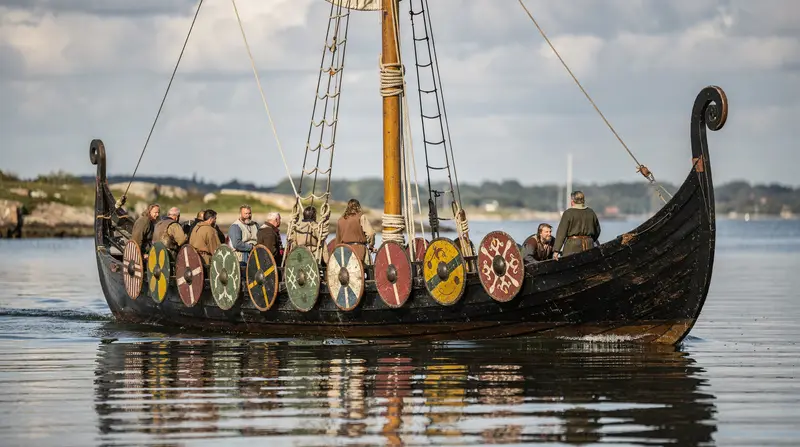
The heritage tour combining Stevns Klint and the Viking fort at Trelleborg adds another dimension — the Viking circular fortress Trelleborg near Slagelse is one of the best-preserved in Scandinavia and makes a logical second stop if you’re driving.
Stevns Klint vs. Møns Klint: which to choose?
This question comes up constantly in Copenhagen travel planning. The honest answer depends on what you want:
Choose Stevns Klint if:
- You don’t have a car (public transport is more workable)
- You want UNESCO credentials and geological significance
- You’re combining with Køge for a medieval town stop
- You have 4–5 hours rather than a full day
Choose Møns Klint if:
- You have a car and a full day
- Dramatic scenery and photography are the priority
- You want a beach at the base (Møns Klint is better for swimming)
- You’re travelling with children who’ll enjoy the fossil hunt
Both are worth visiting if you have time. If forced to choose one, Møns Klint wins on spectacle; Stevns Klint wins on accessibility and scientific interest.
Practical tips for the visit
What to bring: Water and snacks — there is no café at the cliff itself. The nearest food options are in Store Heddinge (15 minutes by car, several bakeries and cafes on the main street) or Rødvig at the southern end of the trail (a small fishing harbour with a café). Sun protection and a hat in summer. Shoes with grip — essential, not optional. A windproof layer even in summer as the cliff edge is consistently exposed.
Photography: The white chalk reflects light intensely in direct sun, which tends to blow out highlights and create harsh shadows in the cliff face. Overcast days often produce better cliff photographs than bright sunny days. The east-facing orientation means morning light falls most directly on the cliff face; afternoon light provides better contrast for the black flint layers.
With children: The cliff-top path is safe and manageable for all ages. The descent to the beach involves steep sections and requires adult supervision with young children. The geology works well as a scavenger hunt for curious kids — finding the dark K-Pg layer, spotting fossils in the chalk, and collecting flint pieces are all activities that hold attention. The Stevnsfort bunker (if open) is also popular with older children.
Dogs: Allowed on the cliff path and beach on a lead. The cliff-top path gets narrow in sections; a short lead is practical.
Accessibility: The cliff-top car park at Højerup has an accessible viewing area near the church. The descent to the beach is not wheelchair-accessible. The church interior is accessible. Stevnsfort has limited accessibility — check their current status before visiting.
Planning your Stevns Klint day
From Copenhagen by train and bus:
- 09:00: Train from Copenhagen H to Køge (35 minutes)
- 09:35: Check bus 261 timetable from Køge station (not all services go all the way to Højerup — verify)
- 10:30: Arrive Højerup
- 10:30–13:00: Cliff walk (church, descent, beach, K-Pg layer)
- 13:00: Lunch from packed food or café in Rødvig (if walking south)
- 14:00–15:30: Stevnsfort bunker (if visiting, seasonal hours)
- 15:30: Bus back toward Køge
- 17:00: Train from Køge to Copenhagen
From Copenhagen by car:
- 09:30: Leave Copenhagen
- 10:30: Arrive Højerup car park (free)
- 10:30–13:30: Church + cliff walk
- 13:30: Drive to Store Heddinge for lunch (15 min)
- 14:30: Stevnsfort and/or Stevns Museum
- 16:00: Optional: continue to Køge for the medieval town (20 minutes north)
- 18:00: Return to Copenhagen
Combining Stevns Klint with Køge
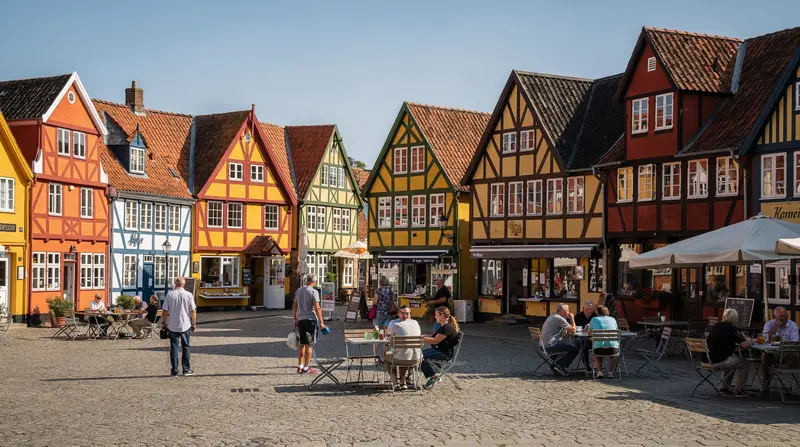
Køge is 20 km north of Stevns Klint and has one of the best-preserved medieval town centres in Denmark. The combination works well as a half-day in Køge (morning) and half-day at Stevns Klint (afternoon), or vice versa. The sequence Køge first then Stevns Klint is logistically cleaner if you’re using public transport, since bus 261 from Køge continues south toward Højerup. Coming back, you return north through Køge anyway.
By car, the combination is very clean: park in Køge, walk the medieval centre for 2 hours, drive south to Stevns Klint for the afternoon, return to Copenhagen in the evening. See the Køge page for details on what to see in the town.
The day trips from Copenhagen guide covers how to sequence a full week of Zealand excursions if you’re planning multiple trips. The Copenhagen day trips itinerary shows how this pairing fits into a broader week of south Zealand exploration.
The Cold War layer: Stevnsfort
The geological boundary isn’t the only hidden layer at Stevns Klint. Directly below the clifftop, excavated into the chalk itself, is Stevnsfort — a massive Cold War naval fortress built in the 1950s and designed to survive a nuclear strike. The fort extends 45 metres into the cliff and housed naval guns, command facilities, and communications equipment.
During the Cold War, Stevns Klint’s position across the water from the Soviet-aligned Warsaw Pact nations made it strategically critical. The fort was manned continuously until 2000 and is now a museum. Guided tours take you through the tunnels, the gun emplacements, and the command centre. The contrast between the ancient geological drama in the cliff face above and the recent geopolitical drama in the tunnels below is one of those accidental historical coincidences that makes a place more interesting.
Stevnsfort is open seasonally — typically May through September, with guided tours at set times. Admission is around 100 DKK. Check opening times before planning your visit around it, as tours fill up quickly on summer weekends.
Seasonal considerations
Spring (April–May): Excellent conditions. The cliff-top vegetation is green, the light is clear, and crowds are modest. Some coastal paths may be wet from winter rains — boots are advisable.
Summer (June–August): Peak season. The cliff walk is at its most accessible, Stevnsfort tours run frequently, and the Rødvig harbour café is open. Weekends can feel busy near Højerup church; arriving before 10:00 or after 15:00 on Saturdays avoids the peak.
Autumn (September–October): Arguably the best photography conditions — warm light, reduced crowds, and the beginning of storm weather that creates dramatic sea conditions at the cliff base. Some facilities begin reducing hours.
Winter (November–March): The cliff is freely accessible year-round. Stevnsfort closes. The bus service from Køge becomes less frequent. The clifftop is windswept and cold, but genuinely dramatic in winter storm light. Bring full waterproofs.
Stevns Klint in a wider Zealand itinerary
For visitors building a multi-day itinerary rather than a single day trip, Stevns Klint pairs naturally with the other south Zealand sights. The 4-day Copenhagen itinerary has room for a full day trip south, and the day trips from Copenhagen guide ranks Stevns Klint against Roskilde, Helsingør and Møns Klint on time, cost and payoff. If cliffs and coastal geology are the draw, Møns Klint’s guide covers the more dramatic — but more distant — alternative in detail.
Frequently asked questions about Stevns Klint
Is Stevns Klint UNESCO-listed?
Yes. Stevns Klint was inscribed on the UNESCO World Heritage List in 2014 for its exceptional scientific record of the Chicxulub asteroid impact and the subsequent mass extinction event 66 million years ago. The K-Pg boundary layer is clearly visible in the cliff face.
How do you get to Stevns Klint without a car?
Take the train from Copenhagen to Køge (30–35 minutes), then bus 261 toward Rødvig, stopping at Højerup. Total journey about 1.5 hours each way. Check current timetables at rejseplanen.dk — bus frequency varies by day and season.
What is the K-Pg boundary and can you see it at Stevns Klint?
The K-Pg (Cretaceous-Paleogene) boundary is a thin geological layer marking the mass extinction event 66 million years ago, caused by an asteroid impact. At Stevns Klint, it appears as a dark band of clay rich in iridium running through the white chalk. A guide can point it out precisely; solo visitors should look for a dark horizontal stripe at roughly mid-cliff height in the central section.
How long does a visit to Stevns Klint take?
A minimum visit covers the Højerup church and a short cliff walk — about 2 hours. A fuller visit including a longer coastal hike and Stevnsfort bunker is 4–5 hours. With travel from Copenhagen, budget a full day.
Is the cliff walk at Stevns Klint difficult?
The cliff-top path is easy walking. The descent to the beach involves steep sections but is manageable for average fitness. The beach itself is rocky and requires care. Not suitable for prams or wheelchairs beyond the car park viewing area.
What’s the weather like at Stevns Klint?
The cliff is exposed to sea wind year-round. Even on warm Copenhagen days, bring a windproof layer. Summer temperatures at the cliff can feel 3–5°C cooler than in the city. Rain makes the paths slippery — check the forecast before heading out.
Can you combine Stevns Klint with Møns Klint in one day?
Technically possible by car but not recommended — the drive between the two is about 80 km and the combined visiting time is 8+ hours. Better to do each as a separate day trip or stay overnight near Stevns Klint.
Is Stevns Klint suitable for a day trip without a car?
Yes. Take the train from Copenhagen H to Køge, then bus 261 to Højerup — about 1.5 hours each way. It’s more accessible by public transport than most other UNESCO cliff sites near Copenhagen, and the cliff-top path itself requires no special equipment beyond sturdy shoes.
Top experiences
Bookable activities with verified prices and instant confirmation on GetYourGuide.