Stevns Klint Day Trip from Copenhagen: UNESCO Cliffs & Højerup
Stevns Klint UNESCO World Heritage Site Tour from Copenhagen
How do you get from Copenhagen to Stevns Klint?
By car, Stevns Klint is about 65 km south of Copenhagen — roughly 55–70 minutes' drive. There is no direct train; the closest station is Hårlev or Store Heddinge (reached via Køge), with a local bus or taxi for the final section. Guided day tours from Copenhagen include transport and are the easiest option. The cliff walk, Højerup church, and GeoMuseum Faxe can fill a comfortable day.
Stevns Klint: the cliff that records the end of the dinosaurs
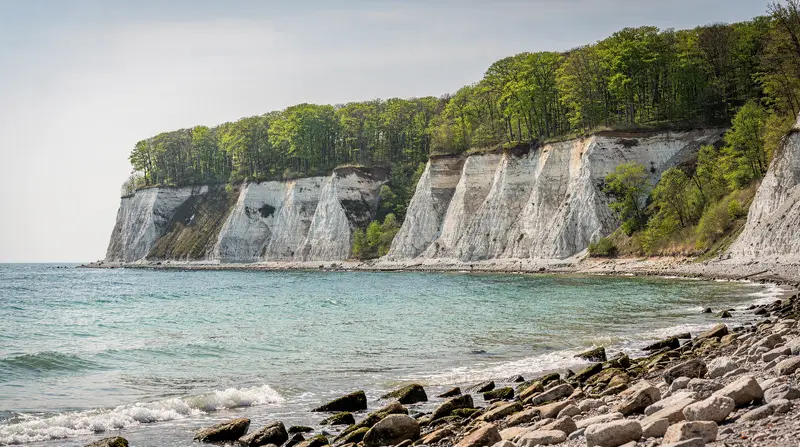
Most Danish day trips sell themselves on scenery. Stevns Klint sells itself on geology — specifically, on being one of the most accessible places in the world where you can stand in front of, and physically touch, the boundary between the Cretaceous and Paleogene geological periods: the layer deposited in the immediate aftermath of the meteorite impact that ended the age of the dinosaurs, 66 million years ago.
That sounds abstract. Seeing it in person is not. The K/Pg boundary at Stevns Klint is a visible dark band — the “fish clay” — sandwiched between white Cretaceous chalk below and Paleogene limestone above. Geologists identified it here in the 1970s, and the chemical signatures in the layer (iridium concentrations, shocked quartz) helped confirm the meteorite impact theory.
UNESCO inscribed Stevns Klint as a World Heritage Site in 2014 — a joint listing with Stevnsfort, the Cold War military bunker complex whose tunnels run beneath the cliffs.
For the casual visitor: the cliffs are also genuinely attractive, Højerup church in its partially-collapsed cliff-edge state is unforgettable, and the GeoCenter is one of the best small museums in Zealand.
Book the Stevns Klint UNESCO site tour from Copenhagen| Where | Højerup, Stevns, ~65 km south of Copenhagen |
| Cost | Free cliffs/church; GeoCenter ~160 DKK adults |
| Time needed | Half to full day, including travel |
| Getting there | Car (~1 hr) or guided tour; train+bus is slow |
| Best time | Arrive before 10:00 in July–August for parking |
Getting there
By car
Stevns Klint is approximately 65 km south of Copenhagen — meaningfully closer than Møns Klint (140 km). The drive takes 55–70 minutes by car.
Route: E55 motorway south from Copenhagen, exit toward Køge, then south via Route 209 through Store Heddinge to the Højerup cliff site. The last section through Store Heddinge is well signed.
Parking: Free car park near Højerup church and the GeoCenter entrance. Fills up on summer weekends — arrive before 10:00 in July and August.
By guided tour from Copenhagen
Guided tours with transport included are the most practical option for visitors without a car. Tours typically run 6–8 hours from Copenhagen, including cliff walk, GeoCenter, and Højerup church.
Fast-track Stevns Klint day trip by car from CopenhagenBy public transport (limited)
Possible, but not straightforward:
- S-train or regional train: Copenhagen → Køge (40–45 min, S-train line E or F, 76 DKK single)
- Regional bus 240: Køge → Store Heddinge (30–40 min, approximately 30–40 DKK)
- Taxi or 4-km walk: Store Heddinge → Højerup cliff site
Total time from Copenhagen: approximately 90–120 minutes each way, depending on connections. Bus 240 runs hourly on weekdays, less frequently on weekends. Check the Sydsjællands Bustrafik schedule before going.
This route is manageable for a patient traveller with good wayfinding, but not recommended for families with children or as a rushed day trip.
What to see and do
Højerup Gamle Kirke (Højerup Old Church)
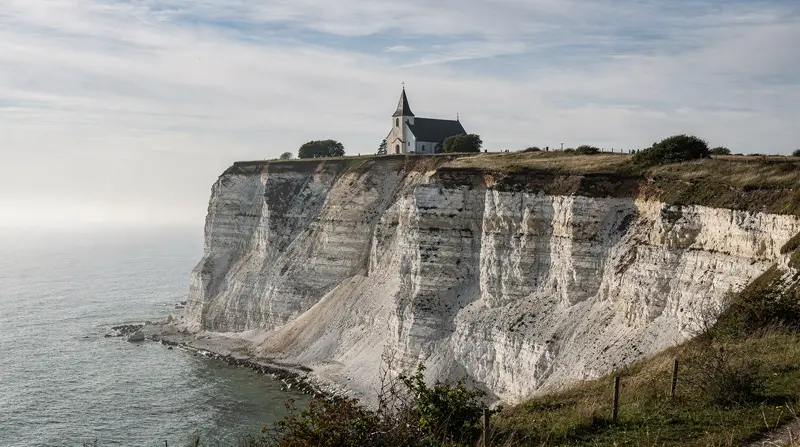
The most visually striking element of the Stevns Klint site. This 13th-century church stands immediately at the cliff edge — close enough that its chancel collapsed into the sea in 1928. The remaining nave is preserved and stabilised, and a glass floor in the chancel area allows you to look down at the drop to the beach below.
Standing at the cliff edge next to the half-church is a singular experience. The cliff at this point drops about 30–40 metres. Entry to the church grounds is free. The interior has limited opening hours — check locally.
The cliff face and K/Pg boundary
Access to the beach below the cliffs is via a path near the church. The descent is gentler than Møns Klint but still steep. The beach walk along the cliff base is the best way to see the geological layers clearly.
The K/Pg boundary layer (the dark fish clay band) is visible in the cliff face at several points. GeoCenter guided tours point it out precisely — finding it independently is possible with a geology guidebook or the GeoCenter’s cliff map.
Allow 1–1.5 hours for the descent, beach walk, and return.
GeoCenter Stevns
The GeoCenter occupies a remarkable setting: part of the old Stevnsfort military installation, a Cold War-era bunker complex built into the cliffs in the 1950s as part of Denmark’s NATO coastal defence. The bunker itself is a UNESCO site (part of the World Heritage listing).
The museum has two main strands:
- The K/Pg impact event — interactive exhibitions on the meteorite, the mass extinction, and the geological evidence at Stevns Klint. Genuinely well-done.
- Stevnsfort Cold War history — the naval bunker, its role during the Cold War, and Danish defence in the NATO context.
Entry prices (2026 approximate):
- Adults: 160 DKK
- Children (6–14): 85 DKK
- Under 6: free
- Family ticket: approximately 425 DKK
Allow 1.5–2 hours for both exhibitions. The geological section is appropriate for ages 8 and above; the Cold War history section works for adults and older teenagers.
Cliff walking: Stevns Klint Scenic Walk
The coastal path north and south of Højerup along the cliff top offers views of the chalk cliffs and the Baltic. The scenery is less dramatic than Møns Klint — the cliffs here are 15–40 metres high, not 128 metres — but the coastal path is pleasant and less crowded.
Scenic hiking at Stevns Klint UNESCO World Heritage SitePractical sample day (by car)
8:30 — Depart Copenhagen.
9:30 — Arrive Højerup. Walk to the church and cliff edge. Time at the church: 30–45 min.
10:15 — Descend to the beach. Cliff face walk, K/Pg boundary search. Ascend.
11:30 — GeoCenter Stevns. Geological exhibition + Cold War bunker. Café for lunch (light meals, 80–140 DKK).
13:30 — Optional: coastal cliff-top walk north or south of Højerup.
15:00 — Depart.
16:00–16:30 — Back in Copenhagen.
This is a shorter day than Møns Klint — the site is more compact and closer to Copenhagen. You can comfortably do Stevns Klint and be back in Copenhagen for a late afternoon in the city.
Stevns Klint vs. Møns Klint: which should you choose?
This comes up constantly, because both are chalk cliff sites in southern Zealand. Here is an honest comparison:
| Factor | Stevns Klint | Møns Klint |
|---|---|---|
| Distance from Copenhagen | 65 km (55–70 min) | 140 km (2 hr) |
| Cliff height | 15–40 m | Up to 128 m |
| Scenery | Good | Spectacular |
| Geological interest | Higher (K/Pg, UNESCO) | High (Cretaceous, fossils) |
| Fossil hunting | Limited on beach | Excellent |
| UNESCO designation | Yes | No (but GeoCenter) |
| Unique feature | Half-collapsed church, Cold War bunker | Forest Tower, dramatic cliff face |
| Public transport | Possible (difficult) | Not practical |
| Full day needed? | Half to full day | Full day |
If you have one day and care primarily about scenery and fossil hunting: Møns Klint.
If you have one day and care about history, geology, and a shorter drive: Stevns Klint.
For visitors with two days available, both sites together make a logical two-day southern Zealand excursion — though the loop route makes combining them efficiently challenging.
For Møns Klint details and for the full day trips from Copenhagen overview, see the relevant guides. If neither cliff site appeals and you’d rather stay closer to the city, Dragør and the Malmö day trip guide are both faster half-day alternatives with a completely different character — a preserved fishing village and a Swedish city respectively.
Practical notes
- Food on site: the GeoCenter has a small café. The village of Højerup has limited options. Store Heddinge (4 km away) has more choice for lunch.
- Seasonality: the GeoCenter is open year-round; the Cold War bunker section may have reduced hours in winter. Check the GeoCenter Stevns website before visiting in low season.
- Cliff edges: the cliff top near Højerup has no uniform barrier. The edge is stable but can be slippery in wet conditions.
- Photography: the church at the cliff edge at golden hour or in low winter light is extraordinary. The K/Pg boundary layer photographs well in overcast conditions when the chalk is less reflective.
Frequently asked questions about Stevns Klint
Why is Stevns Klint a UNESCO World Heritage Site?
For its geological record of the K/Pg boundary — the layer deposited after the meteorite impact 66 million years ago that ended the dinosaur era. The dark fish clay layer is one of the most accessible and well-preserved K/Pg boundary exposures in the world. The UNESCO listing also includes Stevnsfort, the Cold War naval bunker built into the cliffs.
What is the K/Pg boundary and can I see it?
The Cretaceous–Paleogene (K/Pg) boundary is the geological layer marking the mass extinction event 66 million years ago. At Stevns Klint, it is a dark band (fish clay) visible in the cliff face between white Cretaceous chalk below and Paleogene limestone above. On guided tours, you will be shown exactly where it is. With a cliff map from the GeoCenter, you can find it independently on the beach.
How far is Stevns Klint from Copenhagen?
About 65 km — roughly 55–70 minutes by car. Significantly closer than Møns Klint (140 km). Public transport is possible but involves a train to Køge, a bus to Store Heddinge, and a taxi or walk for the final section.
What is Højerup church and why is it famous?
Højerup Gamle Kirke is a 13th-century church at the cliff edge. Its chancel collapsed into the sea in 1928 as the cliff eroded beneath it. The remaining nave is preserved, with a glass floor showing the drop to the beach. It is one of the most dramatic and melancholy sights in Zealand.
Is Stevns Klint worth visiting if I have limited time?
Yes, especially if you are already visiting the Køge area or want a half-day excursion rather than a full day. The drive from Copenhagen is under an hour. The church, the cliff face, and the GeoCenter can be covered in 4–5 hours comfortably, leaving time for a half-day in Copenhagen.
Do I need to book the GeoCenter in advance?
Not always — walk-in is generally possible. In July and August on weekends, buying tickets online in advance avoids a queue. Check the GeoCenter Stevns website for current prices and booking options.
Can children visit Stevns Klint?
Yes. The GeoCenter has family-friendly exhibitions, particularly on the meteorite impact. The cliff descents are less steep than Møns Klint. The Cold War bunker section may be intense for young children but engages teenagers well.
Frequently asked questions — Stevns Klint Day Trip from Copenhagen: UNESCO Cliffs & Højerup
Why is Stevns Klint a UNESCO World Heritage Site?
Stevns Klint was inscribed on the UNESCO World Heritage List in 2014 for its exceptional geological record. The cliffs expose the K/Pg boundary — the geological layer deposited immediately after the meteorite impact 66 million years ago that caused the mass extinction of the dinosaurs. This layer, visible as a distinctive dark band in the cliff face, is one of the most accessible and well-preserved exposures of the K/Pg boundary in the world.What is the K/Pg boundary at Stevns Klint?
The K/Pg (Cretaceous–Paleogene) boundary is the geological layer marking the end of the Cretaceous period 66 million years ago, when a large meteorite impact caused a global mass extinction. At Stevns Klint, it appears as a thin dark layer of fish clay sandwiched between the white chalk below (Cretaceous ocean floor) and the bryozoan limestone above (early Paleogene). You can see and touch it on the beach below the cliffs.How far is Stevns Klint from Copenhagen?
About 65 km by road — roughly 55–70 minutes by car, depending on traffic. The main access point (Højerup church and GeoCenter Stevns) is near the village of Store Heddinge in southeastern Zealand.Is there public transport to Stevns Klint?
Limited. The S-train or regional train runs from Copenhagen to Køge (40–45 min), and from Køge a regional bus (line 240) runs to Store Heddinge (30–40 min). From Store Heddinge, the cliff site at Højerup is about 4 km — taxi or walking. Total journey time: 90–120 minutes each way with connections. A car or guided tour is considerably easier.What is Højerup church?
Højerup Gamle Kirke is a 13th-century church that stands at the cliff edge — and partly over it. The chancel of the original church collapsed into the sea in 1928 as the cliffs eroded. The remaining structure is stabilised and is one of the most dramatically situated churches in Denmark, with part of its floor visible over the cliff edge.Is Stevns Klint or Møns Klint better for a day trip?
They suit different priorities. Stevns Klint is closer to Copenhagen (65 km vs. 140 km), has UNESCO designation, and the K/Pg geological story is genuinely fascinating — but the cliffs are lower (15–40 m) and the scenery less dramatic. Møns Klint has the white chalk cliffs rising 128 m, better fossil hunting on the beach, and the Forest Tower. For geology nerds: Stevns. For dramatic landscape: Møns. For convenience: Stevns.What is the GeoCenter at Stevns Klint?
GeoCenter Stevns opened in 2019 in the old Cold War military bunker complex (Stevnsfort) near Højerup. Exhibitions cover the K/Pg impact event, the geology of the cliffs, and — unusually — the history of the Cold War bunker itself (also a UNESCO site). Entry costs around 160 DKK for adults.
Top experiences
Bookable activities with verified prices and instant confirmation on GetYourGuide.